
June 6, 2026
Elon’s Live Demo
Featured: The Space Trade That’s Actually Tradeable
Editor’s Note: Former tech executive Jeff Brown picked Nvidia in 2016. It’s up 25,155% since. He recommended Bitcoin at $240. It’s up 31,219% since. And he’s been ahead of the curve on Elon Musk’s businesses for over a decade. In fact, he was one of the first to predict SpaceX’s IPO. But today, he says this goes beyond SpaceX. Elon is building something even bigger. And you can get in right now, on the ground floor. Read more below…
Dear Reader,
I’m about to do a live demonstration.
Of Elon Musk’s latest genius invention.
It’s an AI agent…
Perhaps the most powerful ever created.
Elon himself believes it could 70X your money… in a short period of time.
Keep in mind, this is NOT like ChatGPT.
It’s not a chatbot.
Or something you download on your phone.
I expect Musk to publicly launch his AI agent any day now…
Potentially by the end of the month.
But I’m going to give you a sneak preview – for free.
It’s critical you see this live demo…
So you understand exactly what Elon created…
And why it’s so valuable. Watch now.
Regards,
Jeff Brown
Founder & CEO, Brownstone Research
The Space Trade That’s Actually Tradeable
RKLB Quick-Reference Cheat Sheet
- Stock: Rocket Lab USA (Nasdaq: RKLB)
- Price (June 5, 2026): ~$110 | 52-week range: $25.24 – $151.00
- Market Cap: ~$63.7 billion
- FY2025 Revenue: $602M (+38% YoY) | Q1 2026 Revenue: $200M (+63.5% YoY)
- Backlog: $2.2B as of Q1 2026 (+108% YoY)
- Gross Margin (Q1 2026): 38.2% (record)
- Net Loss (FY2025): -$198M | Q1 2026 net loss narrowing to -$45M
- Key Catalyst: Neutron medium-lift rocket, targeted late-2026 debut; 5 dedicated Neutron launches already contracted
- Defense Angle: HASTE hypersonic test missions, Space Force contracts, Raytheon partnership, Anduril hypersonic expansion
- Key Risk: Still unprofitable; Neutron delays could extend cash burn past 2027; stock trades at roughly 105x sales
- Upcoming Earnings: August 6, 2026
Here’s the thing about the SpaceX IPO moment: the most interesting trade might not be SpaceX itself.
S&P Dow Jones Indices confirmed this week it will not shorten the 12-month seasoning period for newly public companies, nor waive existing profitability and public-float requirements based on a company’s size – a direct departure from rivals. Nasdaq has already shortened its waiting period for mega-cap IPOs to just 15 trading days, and FTSE Russell cut its requirement to five trading days. S&P didn’t budge. That matters a lot for where capital flows after SpaceX begins trading.
Passive funds tracking the S&P 500 will not be compelled to buy SpaceX at the point of listing, removing what would otherwise have been a substantial and immediate source of institutional demand. That forced-buying dynamic has historically provided a meaningful post-IPO price floor for companies entering the index quickly. Without it, price discovery falls on active managers and retail participants. Messy. And slow.
So where does that rotational capital land in the meantime? Liquid, public, already-operating space infrastructure. That’s where Rocket Lab enters the picture.
Rocket Lab posted record Q1 2026 revenue of $200.3M, a 63.5% increase year-over-year, record GAAP gross margin of 38.2%, and a record backlog of $2.2B, up 20.2% quarter-over-quarter. Slight tangent, but worth noting: Rocket Lab sold more launches in Q1 2026 than in the full year 2025, and its total launch manifest now exceeds 70 contracted missions. That’s not a company still figuring out demand.
Rocket Lab has shifted from a risky launch-dependent story to a vertically integrated defense contractor with direct government contracts. The company secured its largest launch contract to date, expanded hypersonic testing work with Anduril, advanced a Space Force missile defense program with Raytheon, and moved to acquire Motiv Space Systems. The defense angle here is real and sticky – not just a talking point.
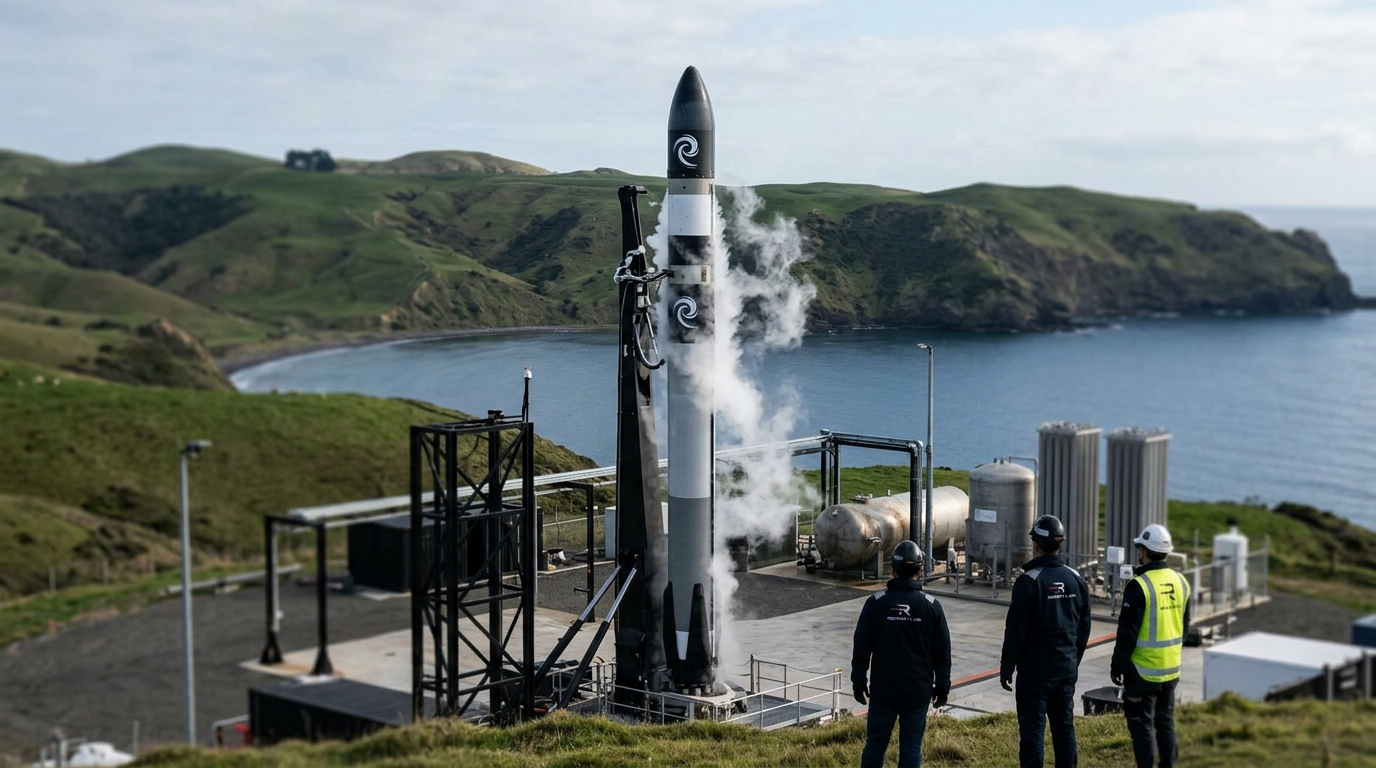
Neutron, its medium-lift launch vehicle currently under development, is targeted for a late-2026 debut and remains the company’s next major growth catalyst. Rocket Lab signed five dedicated Neutron launches during Q1, contributing to the company’s largest launch backlog to date. That’s contracted revenue before the rocket has flown once.
The counterargument is valid and shouldn’t be brushed aside. The net loss for FY2025 came in at $198.2M, widening 4.2% from the prior year. Any material delay to Neutron’s rollout would likely prolong cash burn beyond 2027. And the valuation is not cheap – not even close. The stock trades at a forward price-to-sales ratio of roughly 88x. Paying that multiple requires real conviction in execution, not just momentum.
What’s interesting is the way this week’s S&P decision effectively extended the window for RKLB to absorb displaced capital. By keeping SpaceX out of the S&P 500 for at least another year after its IPO, S&P is effectively delaying that wave of passive buying. That delay doesn’t kill enthusiasm for space as a sector – it redirects it. And right now, RKLB is one of the few names with the liquidity and operational track record to absorb that interest at scale.
Whether the stock holds current levels or pulls back further from its May all-time high near $151 is a separate question. The structural case – liquid, defense-embedded, revenue-growing, backlog-expanding – doesn’t change based on a week’s price action.