June 19, 2026
SPCX Is the Most Volatile Mega-Cap on Earth
SpaceX ran from $135 to $225 and back in days. Here is what is actually driving the swings.
The largest IPO in market history just gave options traders one of the most extreme post-debut structures they have ever seen. And most people are still thinking about it wrong.
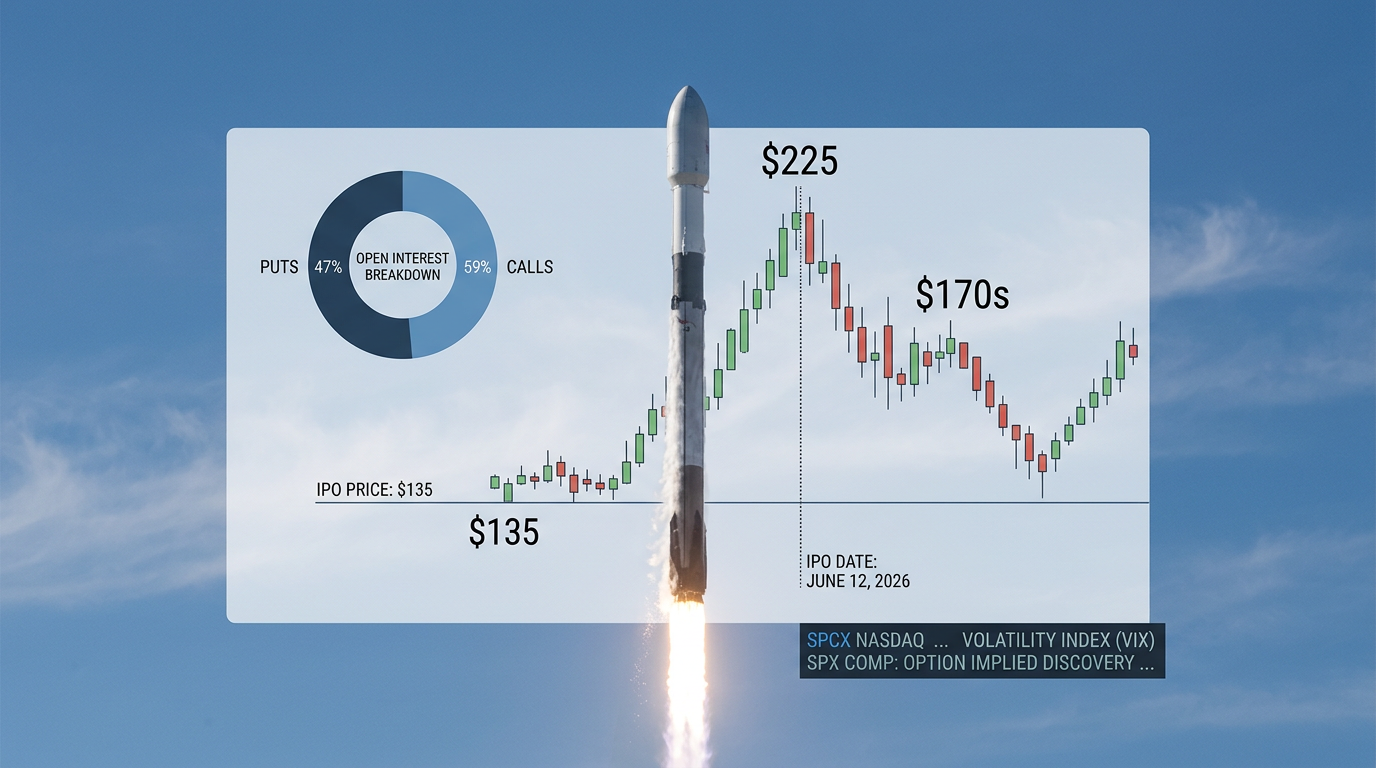
SpaceX priced its IPO on June 11, 2026, and began trading on Nasdaq on June 12 under the ticker SPCX. The IPO priced at $135 per share, raising approximately $75 billion. The first-day close was $160.95, a 19.2% gain on volume exceeding 500 million shares. By June 16, SPCX had hit an intraday high of $225.64. As of June 18, the stock had pulled back to around $174.90, a drawdown of roughly 22% from the June 16 peak in two sessions.
That is a $50 swing in two days on a company now valued above $2 trillion.
Here is the part most retail coverage is glossing over. The public float is approximately 4.25% of total shares outstanding. Underwriters exercised their overallotment option, bringing total offering proceeds to roughly $85.7 billion. But even with that, the publicly tradeable share count is razor thin relative to the market cap. Small buy or sell flows create outsized price movements in both directions. This is not irrational. It is basic supply-demand math operating at an unprecedented scale.
Anthropic’s Project Glasswing: The AI “Too Dangerous” for the Public
Anthropic’s Project Glasswing gives a select group of companies early access to an advanced form of AI that has been deemed “too dangerous” for the public. With this in their arsenal, these companies could become the most powerful businesses in the world this year.
What the S-1 Actually Says
SpaceX generated consolidated revenue of $4.694 billion in Q1 2026, up 15% year over year. Operating loss for the same period was $1.943 billion, with a GAAP net loss of $4.28 billion — largely driven by AI segment spending following the February 2026 xAI merger. Adjusted EBITDA came in at $1.127 billion. The company is not profitable on a GAAP basis. The roughly $1.75 trillion valuation implied at the IPO price reflected expectations that Starlink and Starship deliver on timelines extending well into the next decade.
The bull case rests on Starlink, and it is a real case. Starlink’s Connectivity segment posted $3.26 billion in revenue and approximately $1.19 billion in operating income in Q1 2026, serving 10.3 million subscribers globally across 164 countries. It is the only consistently profitable division in the company. Subscribers doubled from 5 million to 10.3 million in one year.
The bear case rests on the valuation math. Slight tangent here, but it matters: Starlink’s average revenue per user (ARPU) has fallen from $99 per month in 2023 to $66 per month in Q1 2026. The subscriber base is expanding fast, but into more price-sensitive markets. That is a real pressure point on the revenue model that gets less attention than the headline subscriber count. And Morningstar has pegged fair value at $63 per share, less than half the IPO price. That is a wide gap. At above $2 trillion market cap, SpaceX is priced for flawless execution across launch cadence, Starlink subscriber growth, ARPU stability, Starship commercialization, and AI infrastructure monetization. A single material miss in any of those verticals compresses the multiple. Fast.
A former Nasdaq chief has noted publicly that SPCX is not trading on fundamentals right now. Hard to argue with that read.
The “Never Sell” List for Long-Term Investors
Not every great buy-and-hold stock is a household name. Our 7 Stocks to Buy and Hold Forever report includes under-the-radar leaders quietly dominating their niches – alongside global brands with unmatched staying power. Together, they form a portfolio core that can produce rising income and steady growth year after year.
You can get the entire list free today… but only if you act before it moves behind the paywall.
The Calendar Risk That Matters
The lockup structure is the single most important risk in SPCX over the next 12 months. The first selling window opens after Q2 2026 earnings, expected in late July or early August, when roughly 20% of the 180-day block becomes eligible to sell. An additional 10% can release early if SPCX is trading at least 30% above the $135 IPO price going into that date — meaning at or above $175.50. The standard 180-day lockup expires December 8, 2026. Elon Musk’s 6.4 billion shares are locked separately until June 12, 2027. With early investors sitting on extraordinary returns, each of these windows represents a potential supply event worth monitoring.
The first formal earnings release is scheduled for August 6, 2026. Until that date, the market has no new fundamental anchor. Every session between now and August 6 is a float-constrained sentiment trade.
Options Market on a Freshly Listed $2T Stock
SpaceX options began trading in mid-June 2026, just days after the IPO. There is no established implied volatility history, no options term structure with years of data behind it, and no natural anchoring range. This is an unusually extreme implied volatility environment for a mega-cap name.
Implied volatility on SPCX is running at levels consistent with small-cap biotech stocks, not $2 trillion industrials. The reason is straightforward: the market is assigning a wide distribution of outcomes because there is genuinely no comparable. A 15% single-session move in SPCX is structurally possible on any given day until the float normalizes. That is not hyperbole. It already happened.
For traders expecting continued momentum toward the prior high: A defined-risk call spread positioned above the current mid-$170s level, targeting the $200-$210 range, captures a return toward the June 16 peak with capped downside. The risk is the elevated premium cost given current IV levels and the chance that the float constraint creates additional sharp downside moves first.
For traders expecting a continued post-IPO flush: A defined-risk put spread targeting the $150-$160 range, near the original post-IPO trading zone, positions for a retest of early price levels. The IPO price is a psychological anchor and may act as support, but it is not a guaranteed floor given the float dynamics. Risk is capped to the spread width.
For traders who want to express a volatility view rather than a directional one: An iron condor or short strangle around current levels captures the elevated premium environment if SPCX consolidates. This is a high-risk structure in a name capable of 15% single-session moves and requires precise risk management. Not a position for passive monitoring.
Jon Najarian’s Shocking “Beyond SpaceX” Prediction
For 16 years, Jon Najarian was a fixture on CNBC’s Fast Money – known as the man in the red beret.
He called Apple in 2010, Tesla in 2014, and Palantir in 2020. Now that the SpaceX IPO is in the books, he’s making what he believes could be his most important call of the decade.
A shocking prediction about what comes “Beyond SpaceX.”
The Honest Risk Assessment
The AI segment is the biggest wildcard in the S-1. SpaceXAI — the combined xAI, Grok, and X platform business absorbed through the February 2026 merger — posted a $2.469 billion operating loss and an adjusted EBITDA loss of $609 million in Q1 2026 alone. SpaceX spent $7.7 billion in AI-related capex in that single quarter. That is the number people are not talking about enough. Starlink’s profits are currently funding a massive AI buildout with no guaranteed payoff timeline.
The August 6 earnings release is the first real fundamental anchor this stock will have since going public. Between now and then, SPCX is a sentiment vehicle first and a fundamental investment second. Traders who understand that distinction can size positions accordingly. Traders who confuse it for a steady-state investment will get caught in the volatility.
The market priced in history. Now it is figuring out what history is actually worth. Full breakdown on the options structure is worth a closer look before the August 6 earnings reset.