
Batteries Are Now Trading Electricity. That Changes Who Gets Rich.
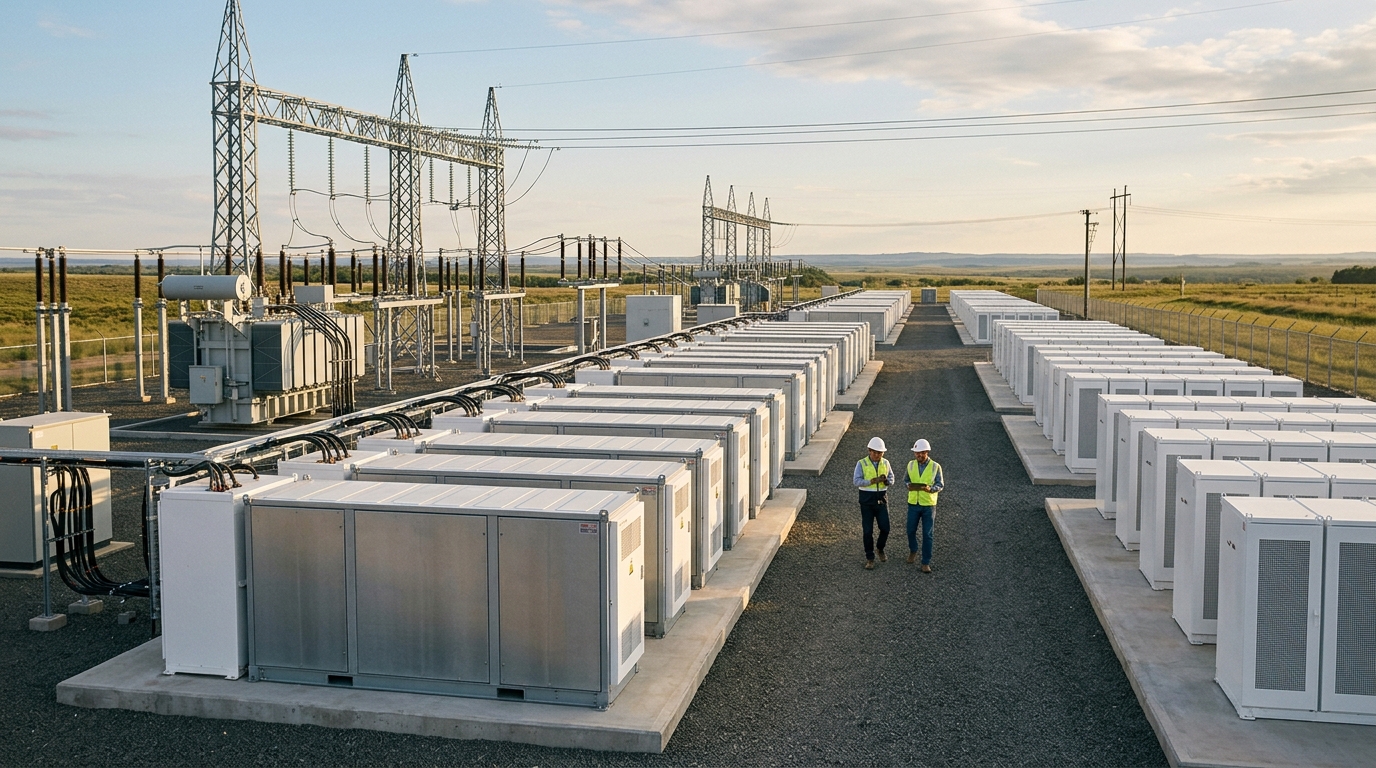
Standalone storage is taking a bigger share of new installs, turning batteries into active market participants rather than solar accessories.
The number that landed this morning is not just a record. It is a signal about who earns the money from artificial intelligence’s power appetite.
A new quarterly outlook from the Solar Energy Industries Association and Benchmark Mineral Intelligence said the US just logged its largest quarterly battery storage build yet, keeping 2026 on pace for another year of rapid deployment. The report also said first-half installations were up year over year, with growth led by utility-scale projects.
The headline figure matters. But the composition beneath it matters more.
Recent quarterly data from SEIA and Benchmark show a meaningful share of utility-scale additions are now standalone storage rather than batteries attached to solar farms. That standalone share is the number investors should be examining. Standalone batteries do not simply store excess solar power and release it at night. They bid into wholesale electricity markets, capture price spreads between cheap off-peak electrons and expensive peak demand, and collect ancillary service payments for keeping the grid stable. Investors are increasingly viewing battery storage not as a renewable adjunct but as a standalone infrastructure class, with returns driven by capacity payments, arbitrage opportunities, and long-term service contracts with hyperscalers.
This distinction separates the businesses that compound from those that merely grow. A battery paired with solar earns whatever the power purchase agreement says. A standalone battery earns whatever the market will pay, hour by hour, and in Texas’s ERCOT, that spread can be enormous. Several of the largest standalone battery projects advancing toward commercial operation in 2026 and 2027 are sited in ERCOT, where proximity to rapidly expanding data center clusters near Dallas and Houston creates both merchant revenue opportunities and a captive customer base.
The AI angle is real, not speculative. AI workloads create highly variable demand patterns with sharp load swings, concentrated power densities, and computational bursts that can stress grid connections, driving faster adoption of battery systems and transforming them from simple backup power into sophisticated grid-interactive assets. Every data center operator trying to secure faster grid interconnection has reason to co-locate or contract with a large battery project.
Which companies sit at this intersection? Tesla’s Megapack business is the most visible. In its filings, Tesla reported deploying 46.7 gigawatt-hours of energy storage in 2025, up sharply from 2024, and contemporaneous coverage of those filings noted that storage and solar contribute a sizable share of gross profit. Megapack projects in Texas can earn across multiple revenue streams, including energy arbitrage and ancillary services, which is precisely the merchant model that standalone storage enables. Fluence Energy (FLNC), the pure-play integrator backed by Siemens and AES, is competing directly for those projects. Siemens has also highlighted Fluence as part of an expanded partner ecosystem aimed at scaling power infrastructure for next-generation AI data centers. NextEra Energy (NEE) is building from the ownership side. Company disclosures and market commentary have put NextEra’s operating battery storage at 6,168 megawatts as of year-end 2025, with plans to add tens of gigawatts more through 2032. GE Vernova (GEV) wins regardless of who owns the batteries, supplying inverters and grid equipment to large projects.
The risk worth watching is margin pressure. A surge of manufacturing capacity aimed at supplying batteries to multiple end markets, including stationary storage, could put downward pressure on system pricing even as demand grows. Analysts have also noted that as incentives and economics shift across transportation and grid markets, some manufacturers may redirect cell production toward utility-scale storage, which could further intensify price competition.
The long-term case does not hinge on today’s cell prices. In the latest SEIA and Benchmark outlook, the central point is that cumulative US storage deployment expected by 2030 has increased versus prior forecasts, now exceeding 610 GWh. Batteries that trade electricity are infrastructure businesses with compounding revenue potential. The record set this quarter is not the ceiling. It is the floor from which the next five years are priced.