September 1, 2026
JOLTS is in. ADP lands tomorrow. Friday’s payrolls number is what the Fed is waiting for.
If you still haven’t downloaded my “Smart Trade Options Checklist”…
…please take a few seconds and download it right now before your new temporary download link expires.
Most traders wreck their accounts because they skip the 7 checks in this report.
I eventually plan to charge for this checklist, so do yourself a favor and download it now…
That way, no matter how much it is in the future, you’ll have a copy on your computer already.
Make sense?
FREE: Smart Trade Options Checklist << Download Now
Good Trading,
Bill Poulos
Three Jobs Reports. One Fed Decision.
The next 96 hours will do more to shape the September 15-16 Federal Reserve meeting than any single speech. Three sequential labor releases land before the weekend, each one either confirming or complicating what is now a market-consensus lean toward a 25-basis-point rate hike. Fed Chair Kevin Warsh’s hawkish Jackson Hole address on August 28 reset the baseline. Labor data this week tests whether it holds.
The Calendar, in Order
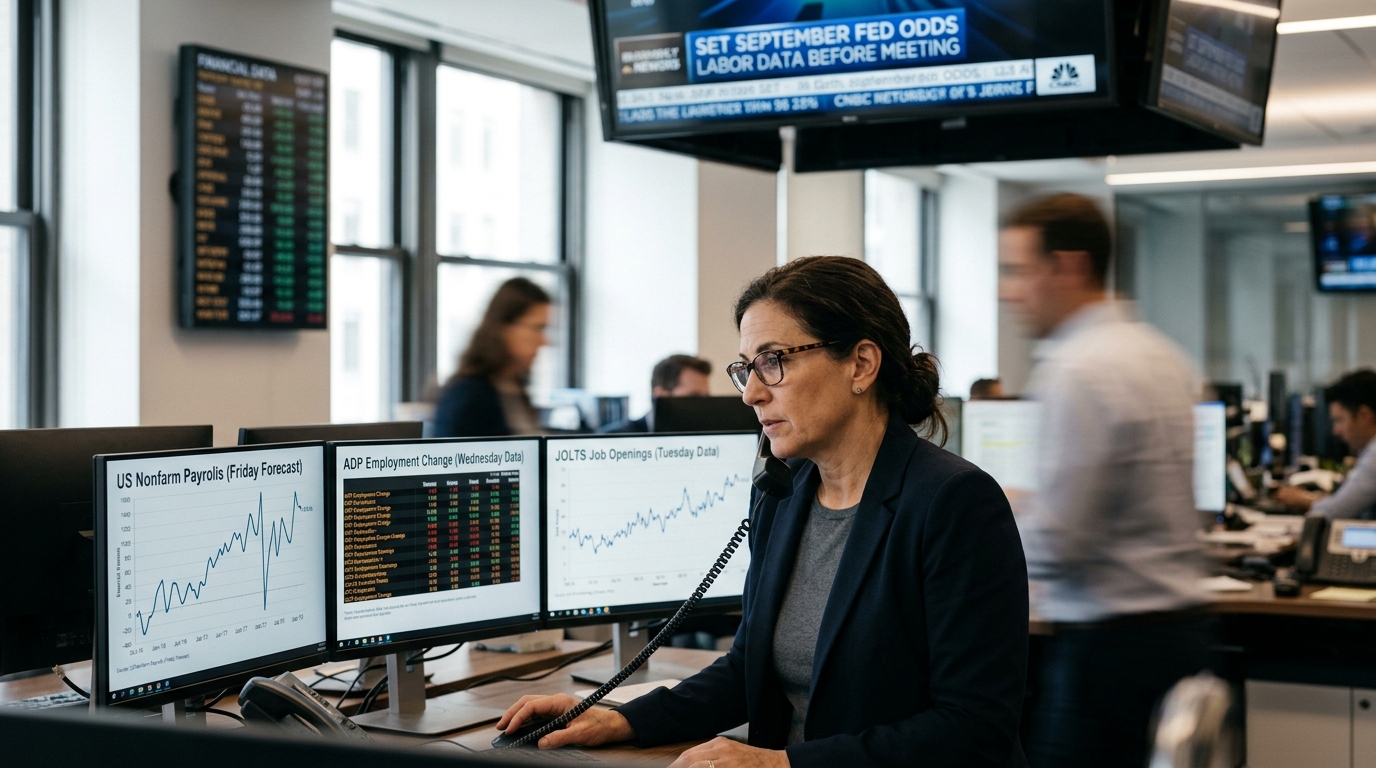
Today, 10:00 a.m. ET: JOLTS (July) — Results are in. July job openings came in at 7.271 million, just below the 7.300 million consensus estimate and the prior month’s revised 7.182 million. Hires were little changed at 5.1 million. The quits rate held at 1.9%, and professional and business services saw a notable hiring drop of 188,000. No single figure here screams alarm, but the direction is consistent: demand for labor is softening at the margin, not collapsing. That keeps the Fed’s cover for a hike intact, but thin.
Tomorrow, 8:15 a.m. ET: ADP National Employment Report (August). The August ADP report releases September 2. July’s private-sector gain was just 44,000 jobs with pay up 4.4% year-over-year, down sharply from June’s 98,000. The ADP Pulse weekly data offered a tentative uptick in early August: average weekly hires of 9,500 for the period ending August 1, rising to 11,750 for the period ending August 8. Two consecutive weeks of gains after seven weeks of decline. That is not a recovery signal; it is a base effect. A monthly August figure above 80,000 would complicate the soft-labor story. Below 50,000 keeps it intact.
Friday, 8:30 a.m. ET: August Employment Situation (BLS). The July BLS report showed nonfarm payrolls falling 23,000, the unemployment rate edging down to 4.1%, with government and retail trade driving the job losses. Combined revisions through the prior two months put employment 103,000 lower than previously reported. August nonfarm payrolls are broadly expected to remain weak given immigration restrictions limiting labor supply. The unemployment rate is expected near 4.2%. A number below 50,000 forces a genuinely contested FOMC vote. A surprise above 100,000 closes the debate.
This Building in West Texas Is Generating “AI Royalties”
This is an AI data center. Thousands of them are popping up across America.
But this one in West Texas could pay everyday investors for decades.
Every ChatGPT query… every Alexa answer… every Netflix recommendation…generates a royalty you can collect.
It’s already paid out over $810 million since 2022. And the real buildout hasn’t even started.
What Moves the Hike Odds
The CME FedWatch Tool showed a 66% probability of a 25-basis-point hike at the September meeting as of August 31. The policy rate currently sits at 3.50-3.75% following the July 28-29 hold, a 9-3 vote in which three FOMC members dissented in favor of an immediate hike. Warsh declined to offer forward guidance at Jackson Hole but reaffirmed the Fed’s 2% inflation target, a posture the market read as hawkish. PCE held at 3.7% year-over-year in July, and July CPI came in at 3.4% with core at 2.5%. Energy costs tied to Middle East supply disruptions are doing some of the inflation work. Barclays is projecting two additional hikes this year, September and December, totaling 50 basis points.
The biggest opportunity in AI may not come from chasing the same mega-cap stocks everyone already owns.
Ross Givens is watching a different setup: 3 under-the-radar investments connected to SpaceX, an AI bottleneck, and the power grid – all converging at once.
He explains why in CONVERGENCE 2026.
The dovish camp on the committee is real but not dominant. For traders, the threshold question is whether the Fed gets the cover it needs. Strong data across all three releases this week provides that cover. Weak data, particularly a Friday payroll number well below expectations, forces a contested vote and puts pressure on the 66% probability heading into the blackout period that begins September 6.
The Cheat Sheet
- Top Theme: Labor data sequencing controls September FOMC odds more than any Fed speaker this week. Warsh already set the tone; the numbers now either validate or undercut it.
- Stock to Watch: Rate-sensitive financials move directly on hike odds. Watch KRE and XLF for same-day reactions to ADP tomorrow and Friday’s BLS release.
- Sector to Watch: Utilities and REITs face the clearest binary risk: strong labor data pushes yields higher and pressures both sectors immediately.
- Biggest Risk: A hot ADP number tomorrow followed by a weak Friday BLS print creates maximum confusion. The two series have diverged repeatedly in 2026, leaving traders with conflicting signals going into the blackout period.
- One Thing to Remember: The 66% hike probability is priced. What is not priced is a clean sweep of soft data across all three releases this week. That outcome is the one scenario that could move the needle meaningfully before September 15.