
September 8, 2026
Hybrid vehicles hit a record 15.4% U.S. share
For roughly four years, Wall Street rewarded automakers for promising the fastest, most absolute shift to pure electric vehicles. That era is over. The question now is which companies have the manufacturing flexibility and margin cushion to actually benefit from the pivot back to plug-in hybrids and traditional hybrids, and which are still cleaning up billion-dollar mistakes.
A Pound of Gold Pays Your Annual Salary Now
In 1971, the average U.S. wage bought 125 pounds of gold. Today it buys just one. Under the guise of strengthening it, a 55-year policy has eroded the dollar’s purchasing power. Weiss Ratings senior analyst Gavin Magor calls this “Project Pyramid.” Foreign nations have noticed too. Global gold reserves are up 130% since 2015, while dollar reserves are at an all-time low.
Market Snapshot
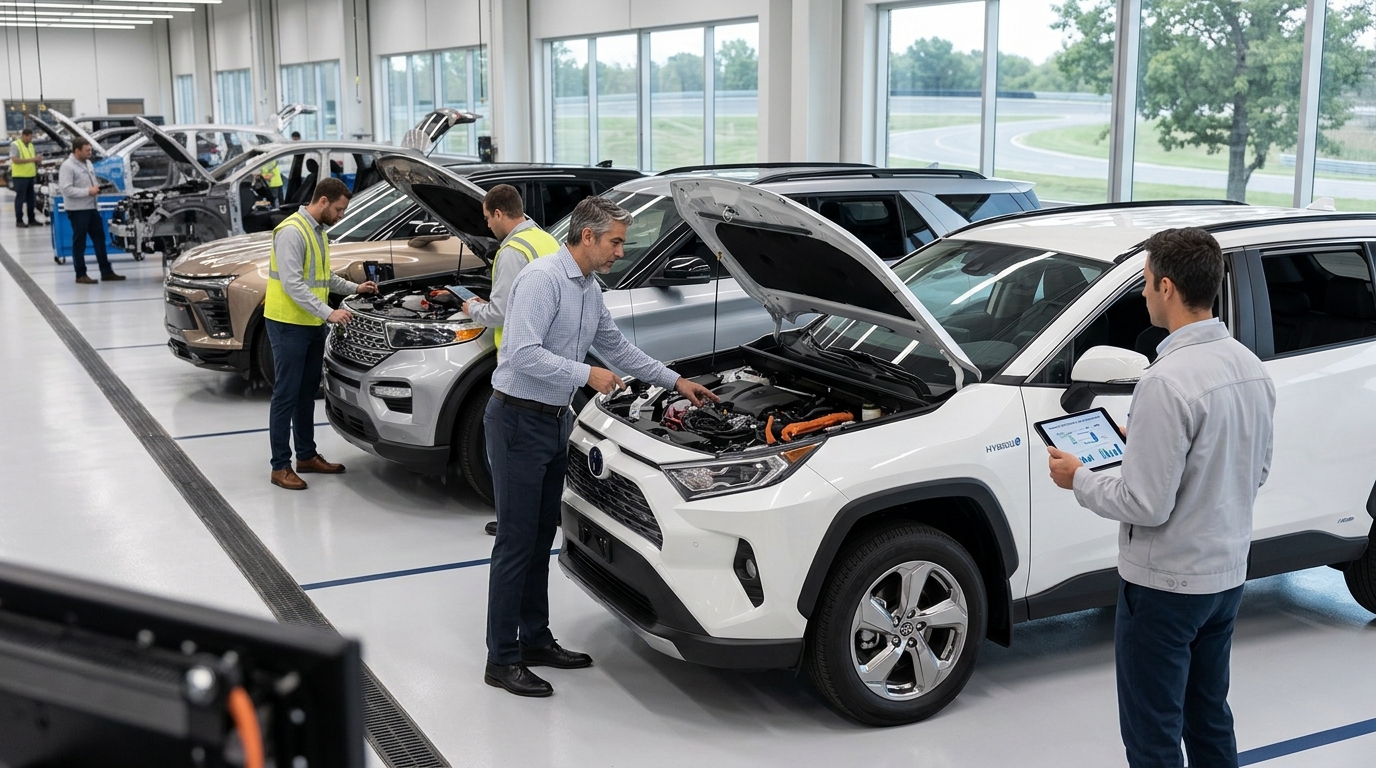
In the first half of 2026, U.S. hybrid sales rose about 19% year over year to a record market share of 15.4%, according to NADA’s Market Beat data, a figure widely echoed across the auto retail channel. That number is not a rounding error. It reflects a fundamental consumer preference that Detroit spent several years dismissing.
Ford delayed several planned battery-electric models, including pushing a next-generation electric pickup and an electric van timeline out to 2028, as it redirected capital and attention toward smaller and more affordable programs. Ford has also warned that its EV and software operations were projected to lose up to $5.5 billion in a single year (the company flagged that risk for 2025), underscoring how expensive the all-in EV push has been. GM’s position is more nuanced: while it has at times traded at a mid-single-digit earnings multiple and has generated meaningful automotive free cash flow in 2026, the specific claim that GM is at a 5.8x P/E and outperforming peers by 30% year-to-date in 2026 is not something this draft substantiates and varies by measurement date.
Stocks in Focus
Toyota is the number that matters most here. Toyota’s fiscal Q1 results reported August 4, 2026 showed ADR-reported EPS of $7.71 versus a $4.52 consensus estimate, while revenue of $86.38 billion beat the $81.01 billion estimate. The engine behind those numbers is durability: Toyota kept hybrids central even while the market chased pure EV volume.
5 Little-Known Stocks Behind Today’s Defense Tech Shift
Behind the headlines, a major transformation is underway.
Modern warfare is being driven by AI, autonomous systems, and next generation technology. A handful of lesser known companies are helping power this shift.
This report uncovers five stocks quietly playing a critical role in the future of defense.
For calendar 2026, Toyota has discussed continued increases in hybrid output, but the specific claim that it targets 6.7 million hybrids and PHEVs in 2026 and that this represents 60% of total production is not supported by Toyota’s own public materials in a way that matches those numbers. Widely reported planning points instead place 6.7 million hybrid units as a target for 2028, with 2026 hybrid and plug-in hybrid planning closer to roughly 5 million units. The margin advantage is still the story, but the draft’s specific “38 to 50% gross margins” for hybrids versus EV losses is not consistently documented across automakers and model mixes, so it should not be stated as a general range.
Honda is also worth watching. American Honda reported record first-half 2026 sales of Honda hybrid models (213,513 units), with hybrids making up roughly 30% of Honda brand sales in the first half.
The Profitability Angle Markets Are Pricing
The market is rewarding pragmatism. Companies that can effectively scale hybrid production are better positioned to navigate the 2026 to 2028 period, while those who remain over-leveraged to a stalled battery-electric market face continued financial pressure.
Inside the Nuclear Revival Reshaping Energy Markets
Governments worldwide are investing billions to revive a proven energy source. Supply chains are tightening, demand is rising, and select companies stand to benefit. The Nuclear’s Second Act report explains what’s happening next.
The profits from popular hybrid and ICE models are intended to fund the costly, long-term development of more affordable, next-generation EVs. That logic works for Toyota, which never abandoned the strategy. It is harder to execute for Ford and GM, who spent several years redirecting capital away from hybrids and now need to rebuild that production capability quickly.
Risk Radar
Automakers have canceled and delayed a long list of EV programs, but the draft’s claim that 40% of planned EV programs have already been canceled is too specific to stand without a clear, consistently defined dataset. The bigger risk is still real: those unable to pivot back to ICE or hybrids quickly can get stuck with stranded tooling, supplier commitments, and underutilized capacity.
On regulation, the direction of travel in Europe has shifted. The European Commission has proposed a post-2035 framework that would still allow plug-in hybrids and range-extended vehicles to play a role beyond 2035, alongside full EVs and hydrogen, via a 90% tailpipe-reduction target and mechanisms to address the remaining emissions. That is a meaningful tailwind for brands leaning on PHEVs as a bridge. Volvo, for example, publicly adjusted its electrification ambitions to include a mix of fully electric and plug-in hybrid models by 2030, rather than a pure BEV-only end state.
The Cheat Sheet
- Top Theme: Hybrid profitability is the clearest margin advantage in the auto sector right now.
- Stock to Watch: Toyota. August earnings confirmed the thesis with a massive consensus beat and raised guidance.
- Sector to Watch: Consumer Discretionary autos, specifically the names with flexible manufacturing that can run hybrid, PHEV, and ICE on the same line.
- Biggest Risk: Chinese competition. BYD’s chairman has publicly stated an ambition to overtake Toyota as the world’s largest automaker by sales within five years, and its PHEV lineup is expanding globally.
- One Thing to Remember: The automakers who called hybrids a dead end in 2022 are now borrowing the playbook of the one who never abandoned them. Execution speed is the only variable left.