September 8, 2026
Bonus Content: Shein’s $99 Million Loss Shows Who Pays When Duty-Free Ends
Editor’s Note: What if you could go for $1,000 in the markets, no matter which way stocks are going? Long-time friend and colleague Larry Benedict is revealing the strategy he used to make hundreds of millions of dollars for his Wall Street clients. Read more below.
Dear Reader,
Nobody seems to know…
Bull market, or historic meltdown?
One week, stocks reach record highs, and investors rush in.
The next it’s the next Great Depression.
If the markets have you feeling whiplashed, you’re not alone.
According to legendary trader Larry Benedict, history shows nearly every tech-driven bull market plays out the same way – and none of it really matters if you have the right strategy.
He says:
“I’ve been trading the markets for four decades, and I’ve seen the markets do this exact song-and-dance before.
Today, I’ll show you how to potentially make your first $1,000 whether we see record highs or a complete meltdown. It’s all noise, and I’ll show you why.”
Go here now to see Larry’s plan to make money in any market.
Best,
Lauren Wingfield
Managing Editor, The Opportunistic Trader
Shein’s $99 Million Loss Shows Who Pays When Duty-Free Ends
The valuation collapse tells the story plainly. Shein, once privately marked at $100 billion in 2022, raised about $1.7 billion in its Hong Kong IPO on September 1, listing at roughly $27 billion. That is roughly a 73% haircut, and the prospectus explains exactly why: the cross-border fast-fashion supply chain is now structurally more expensive than the model was designed to survive.
Revenue growth at Shein went from 41% in 2023 to 20.7% in 2024, then 8% for full-year 2025, and collapsed to 1.1% in Q1 2026. The company swung to a $99 million net loss in that quarter compared with a $395 million profit the prior year. In the prospectus, Shein guided for first-half 2026 growth broadly in line with that 1.1% figure, with operating margin expected to be slightly lower than the first-quarter level. The stated reasons: new European import charges, pricing pressure, and weaker demand in the Middle East linked to the Iran war.
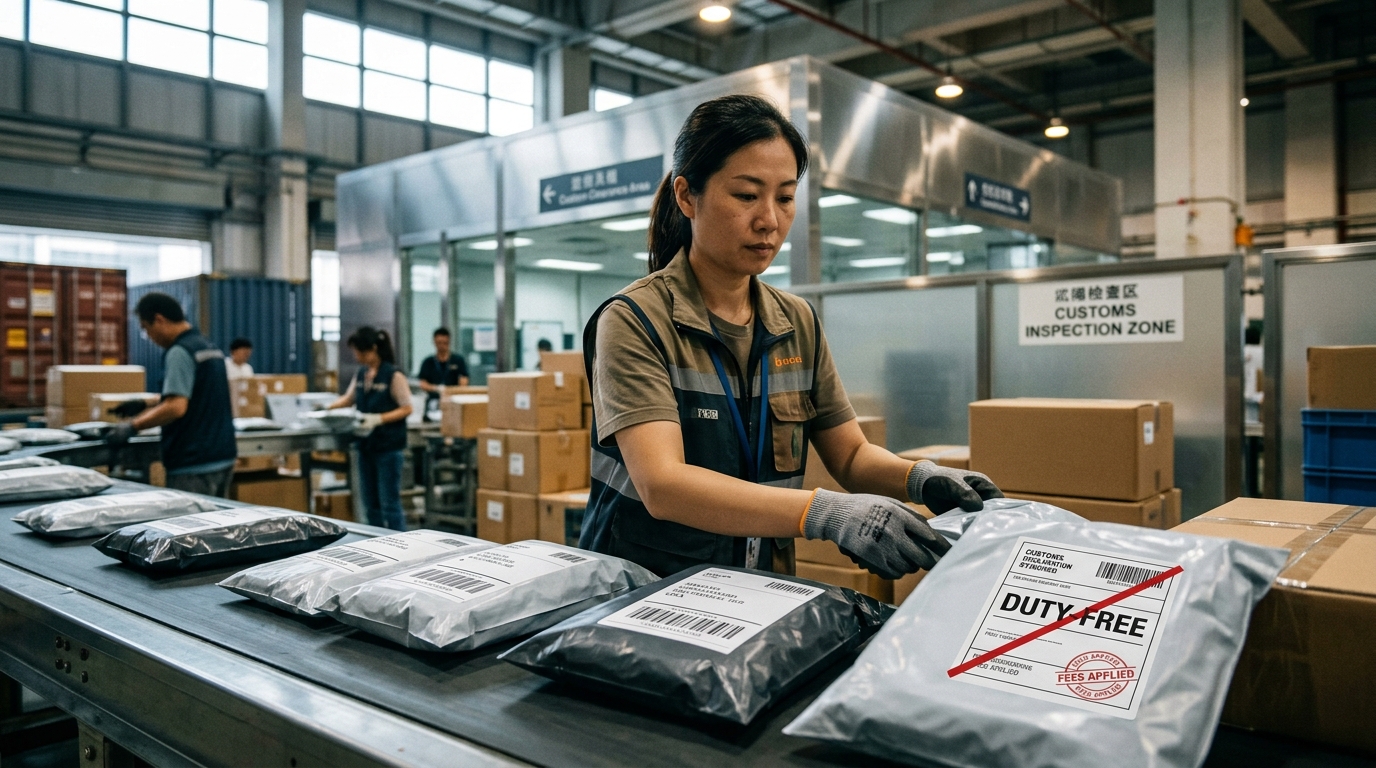
The structural shift is not one regulation but three hitting simultaneously. In the U.S., the de minimis exemption that allowed packages under $800 to enter duty-free was eliminated for Chinese-origin goods effective May 2, 2025, then suspended for all countries effective August 29, 2025. Shein said its U.S. revenues dropped 14.3% in Q1 2026 as a direct result. Its Chinese-origin products shipped to the U.S. are now subject to tax rates ranging from 10% to 87.5%.
In Europe, the EU applied a fixed €3 customs duty per item on distance-sales consignments up to €150 starting July 1, covering 93% of all e-commerce flows into the bloc. That measure applies regardless of origin. Then, beginning September 1, France went further: a per-item environmental levy that in 2026 includes €0.50 on underwear, €9 on jeans and €12 on jackets, with the levy potentially rising toward €19.50 by 2030. Imports of small parcels from China into the EU have already fallen 30% to 40% since the EU levy came into force, according to French customs figures cited by the economy ministry.
PDD Holdings, Temu’s parent, is absorbing its own version of the pressure. In Q2 2026, revenue grew 8% while net income fell about 12%. The company has guided toward sustained heavy spending on supply chain investment, which its CFO described plainly: these investments will inevitably affect financial performance. PDD shares are down roughly 34% over the past year.
For traders, three levels deserve attention. PDD trades in the low $80s with no visible earnings recovery catalyst before the next quarterly report. Shein’s Hong Kong debut was one of the largest IPOs in that market this year, but the prospectus itself offered no forward earnings guidance beyond slightly lower margins, which is not a pitch that supports multiple expansion. The supply chain rerouting now underway, particularly manufacturers staging inventory in European and U.S. warehouses to sidestep per-parcel duties, will take quarters to show in unit economics.
The old model was frictionless: ship cheap, direct from a Guangdong factory to a doorstep in Lyon or Dallas, tariff-free. That is gone. What replaces it costs more, moves slower, and requires capital the platforms are only beginning to commit. Until the cost structure resets, guidance cuts are the most honest forecast either company can offer.