
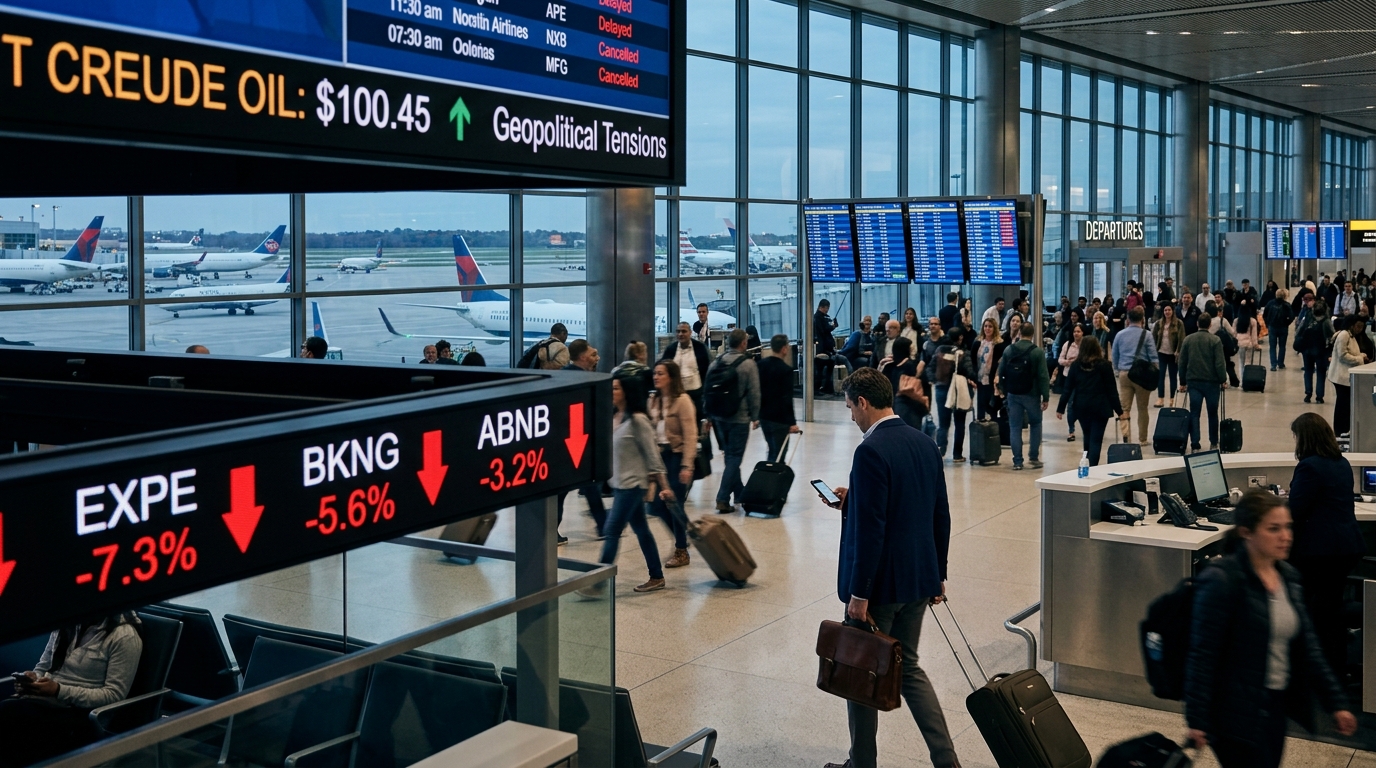
Tuesday’s move in travel stocks was not about earnings. It was not about guidance. Expedia fell 7.3% intraday, shedding roughly $2.3 billion in market value to settle near $272.62. Booking Holdings dropped 5.6%. Airbnb gave back 3.2%. No company-specific news drove any of it.
What did drive it: Brent crude crossed $100 a barrel for the first time in almost six weeks, after Houthi militants launched drone and ballistic missile strikes against Saudi Aramco facilities across southern Saudi Arabia. Fires broke out at energy sites, operations were disrupted at the Jazan refinery, and at least 73 people were wounded. Oil prices had already climbed sharply in early September as the conflict in the region intensified. Tuesday pushed the benchmark above $100 before pulling back.
For six months, the market priced the oil shock through airline fuel costs, a hit to carrier margins, not necessarily to travel volumes. Tuesday reframed the question. The coordinated selling across Expedia, Booking, and Airbnb with no company-specific catalyst signals something different: institutional money exiting a crowded trade.
The mechanics matter. Online travel platforms earn commissions on hotels and other bookings, meaning their revenue is closely tied to travel volumes. An oil-driven geopolitical shock hits both sides of that equation simultaneously: higher jet fuel raises airfares, suppressing the very bookings these platforms monetize, while rising uncertainty discourages consumers from committing to international trips, the itineraries where OTA margins are often richest. Renewed Middle East conflict adds the risk of cancellations across European and Gulf-adjacent routes. That is a different, more fundamental threat than fuel surcharges.
Shift4 Payments confirmed the direction of travel back in August. The payments processor lowered the midpoint of its full-year 2026 outlook for gross revenue less network fees, citing an estimated $25 million impact from Middle East travel disruption hitting its tax-free shopping business in Q3, plus roughly $20 million in FX headwinds. That was a warning with numbers attached. Tuesday, the OTA complex caught up, without the warning.
The stocks that warrant the closest attention now are the ones that were most crowded after a strong summer. Expedia had gained 9.8% just two weeks ago when Corient Private Wealth significantly increased its holdings, a move the market read as institutional conviction. That kind of positioning becomes a liability when the macro story shifts. Sustained pressure through an entire session, as Expedia showed Tuesday, is not routine profit-taking. It is institutional reweighting.
What to Watch
The thesis for selling extends beyond the OTAs. Hotels with Gulf and European exposure, Marriott, Hilton, face the same demand question. Airlines like Delta and United carry the fuel cost burden and now absorb demand hesitation too. Etsy’s 4.8% drop on the same session is a reminder that discretionary consumer spending broadly is being reassessed.
The bull case for travel stocks rests on two conditions holding: consumer willingness to spend, and route availability. With Brent at $100 and Goldman Sachs warning it could reach $120 if disruptions persist into 2027, neither condition looks secure heading into the off-peak season. That is the trade the sector just started pricing.
Watch whether Expedia and Booking hold Tuesday’s lows over the next two sessions. A failure to recover suggests the unwind has further to go. A bounce on above-average volume would indicate buyers still have conviction at current levels. Until one of those signals confirms, the evidence favors staying light on OTA exposure and watching from the sideline.