
September 15, 2026
Bonus Content: Western Digital’s Order Book Runs to 2028. The Hard Drive Is Not the Story.
In a market where copper and gold are fast-rising commodities, having them as part of a portfolio is quickly becoming essential for any investment strategy.
Gold is moving up because of the shifting economic environment.
Copper is at all-time highs because of the growing demand for electricity all over the world.
And all of this is happening just as supply for both commodities is dwindling.
Getting new supply online is easier said than done… which is why the companies that can help discover those metals could emerge as tomorrow’s winners.
One lesser-known Canadian copper-gold explorer with exploration assets in mineral-rich Australia is well-positioned to be at the forefront of that race.
It already has drills turning in two major mineral belts.
It has funding from a major company.
It has new targets advancing.
And despite all of that, the company has a small market cap and a share price below $1.
That creates a compelling setup if and when the broader market wakes up to the kind of opportunity this company is sitting on.
Our new online report has all of the details. Inside, you can learn just why this overlooked copper-gold explorer is positioned for significant upside as this commodity bull market surges.
Western Digital’s Order Book Runs to 2028. The Hard Drive Is Not the Story.
Western Digital’s fiscal 2026 results landed without much controversy on the revenue line. $12.9 billion in full-year sales, up 36% year over year. Q4 alone put up $3.75 billion, beating consensus. EPS more than doubled to $10.22 for the year. Shares still sold off after the August 5 release.
That reaction is the angle worth understanding heading into Tuesday’s session.
The selloff was not about what WDC reported. It was about what comes next, and whether the machine can actually deliver it.
The Backlog Is Real. The Constraint Is Capacity.
CEO Irving Tan has been clear since February: the company is supply constrained, not demand constrained. WDC is currently supply constrained and expects technology transitions to enable higher exabyte shipments over time. The order book already reaches into 2028. WDC has successfully transitioned many customers to long-term agreements extending into 2027 and 2028, providing a level of revenue visibility the company has never had in its 50-year history.
That visibility is the bull case. The risk is execution on the product transitions that unlock the next capacity tier.
Western Digital has been ramping its 32-terabyte ePMR products and is preparing a series of further transitions, including ePMR drives of up to 40 TB, and first-generation HAMR drives of up to 44 TB. HAMR, the company’s highest-density recording technology, is on track to ship 44TB products in the first half of calendar 2027, with positive customer feedback on qualifications. Beyond that, WD will extend ePMR to 60TB by leveraging HAMR innovations without increasing power consumption, while HAMR will scale to 100TB by 2029.
Why Agentic AI Changes the Storage Math
The standard AI storage argument centers on model training, and that argument is largely played out in WDC’s current valuation. The fresher claim involves inference and what sits above it.
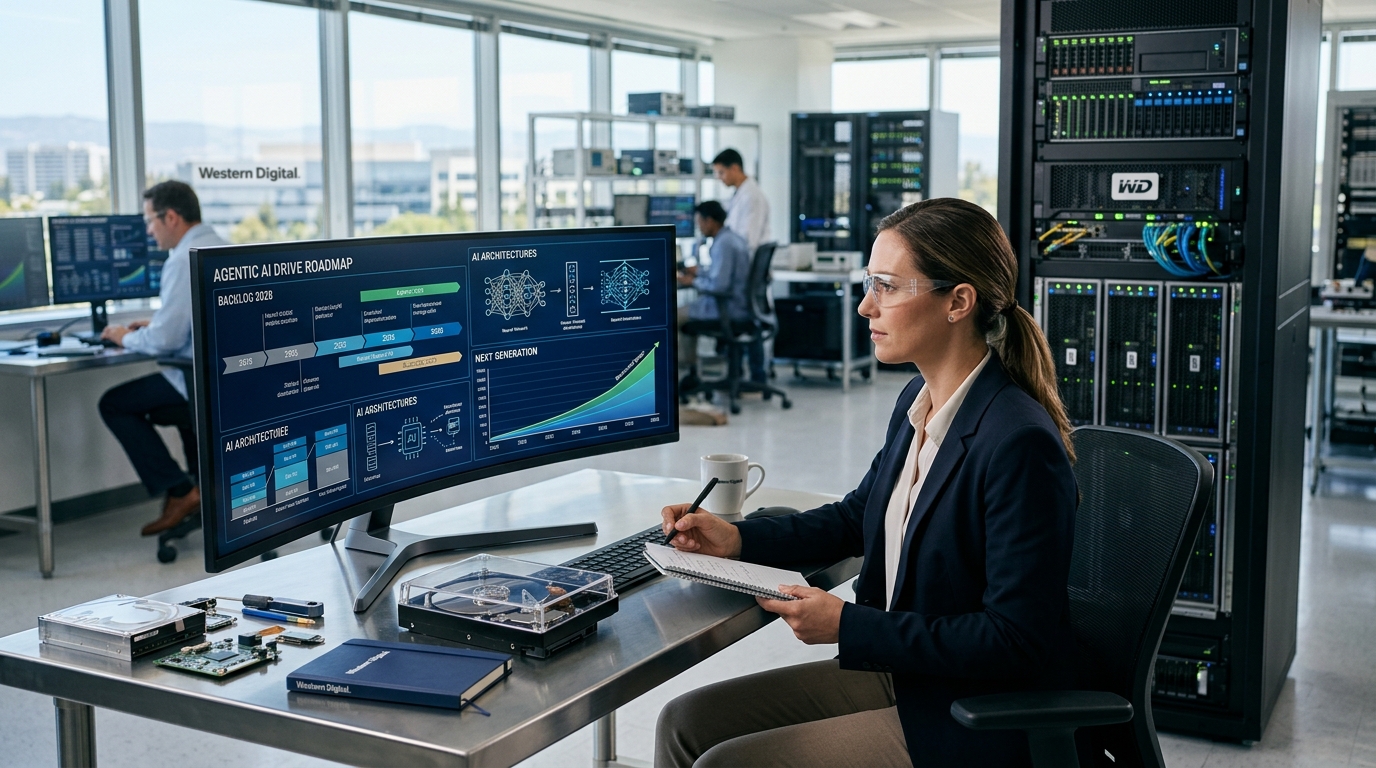
AI is moving rapidly from merely answering questions to agentic AI that coordinates tasks, accesses data, and operates continuously across multi-step workflows. That transition creates a fundamentally more data-intensive workload, and one that is increasingly persistent rather than transient. Agents generate data at every step of a workflow, increasing both the volume of data created and the amount that must be stored over time. WDC views agentic AI as a structural and step-function driver of capacity-oriented storage demand.
This is why the CFO’s Q1 fiscal 2027 guidance of $4.1 billion in revenue, representing roughly 45% year-over-year growth, deserves more attention than the August selloff implied.
The Performance Bet Most Traders Are Missing
The capacity story is well-documented. The performance layer is not. High Bandwidth Drive and Dual Pivot design technologies deliver 2x bandwidth and a path to 8x future bandwidth, and up to 2x sequential IO performance gains supporting AI workloads at HDD economics, reducing reliance on flash.
That matters because it directly challenges the assumption that SSDs are structurally irreplaceable in high-throughput AI workloads. If WDC’s drives can match flash throughput at a fraction of the cost, the total addressable market expands beyond bulk cold storage into tiers where margins are higher.
What to Watch
- 40TB ePMR volume ramp. WD began shipping 40TB ePMR drives and expects UltraSMR to account for 60% of nearline exabytes by the end of fiscal 2027. Any slip in that timeline is the primary downside catalyst.
- HAMR qualification progress. The company’s first HAMR products are in qualification with four large hyperscale customers, with volume shipping expected to begin in the first half of calendar 2027.
- Pricing power. Pricing was up about 9% year over year in fiscal Q3, even as cost per exabyte declined about 10%. That spread is the margin engine. Watch whether it holds into Q1 fiscal 2027 as new capacity comes online.
WDC is not cheap relative to its hardware history. But the demand case is structural, the contracts are signed, and the technology transitions are measurable. The question is timing, not direction.