
October 9, 2026
Bonus Content: The Firms Locking Up 20-Year Water Contracts Before Droughts Get Worse
Washington Wants the Next Drone Boom Built in America
America wants to dominate the next great weapons market.
For generations, military strength was measured by the size of a nation’s ships, tanks and aircraft. But the next era may belong to something smaller, faster and more intelligent: Drones.
Drones can gather intelligence, move critical supplies and complete missions without putting pilots at risk.
And Washington is moving to bring that industry home. A new Executive Order calls for expanded domestic production, secure supply chains and greater military adoption of American-made drones.
The global drone market was valued at $83.8 billion in 2025 and is projected to reach $182.4 billion by 2033. A nearly 120% increase!
North America already accounts for more than 40% of that market. Yet one Chinese company still controls roughly 70% of the U.S. civilian drone market.
Washington wants to change that.
And with the Pentagon reportedly seeking around 300,000 drones, investors may want to know which American companies could benefit.
One little-known Nasdaq company has spent more than 25 years developing professional drone technology. It has patents, a broad product lineup and real-world deployments behind it.
If America leads the next drone revolution, this overlooked company may finally get Wall Street’s attention.
The Firms Locking Up 20-Year Water Contracts Before Droughts Get Worse
The contract awards are getting larger and longer, and the urgency behind them is no longer theoretical.
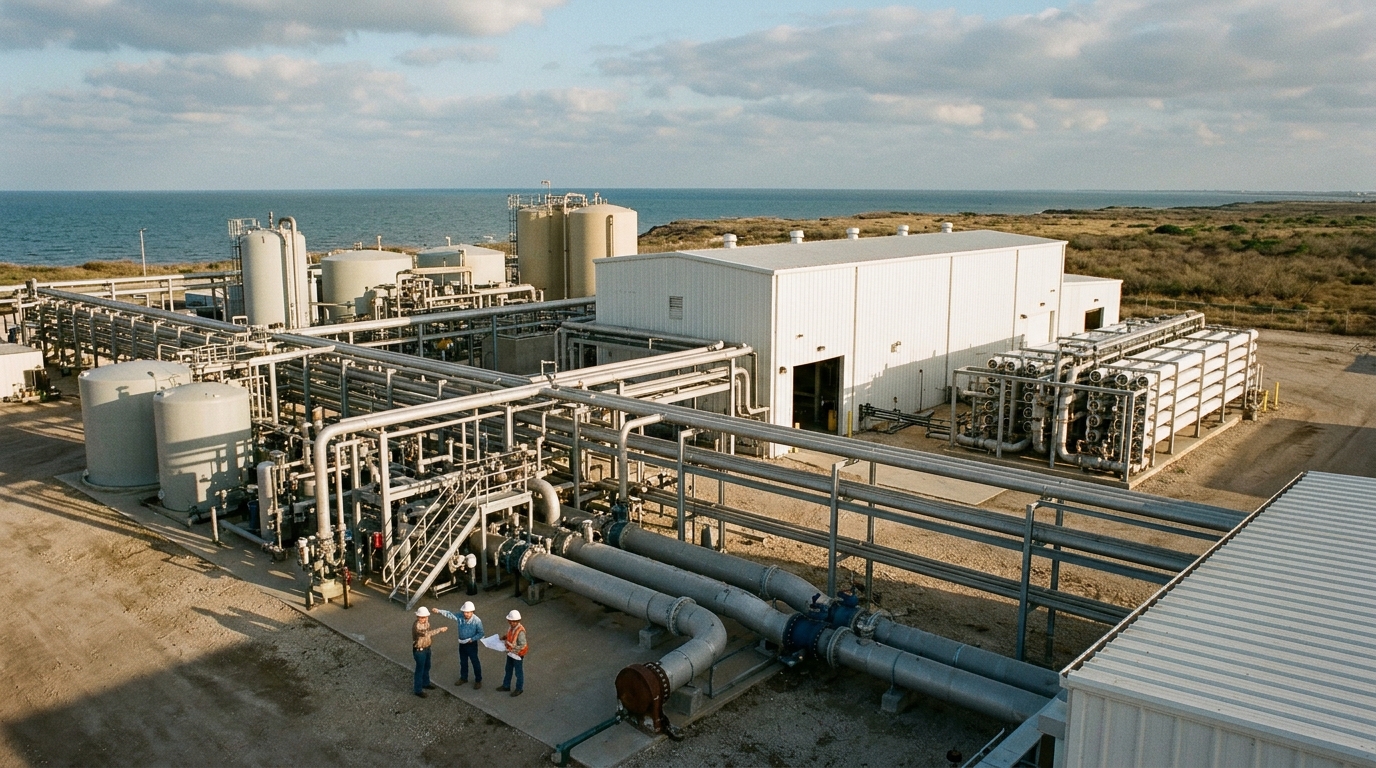
The biggest single move this year is in South Texas. IDE Technologies was unanimously selected by the Nueces River Authority Board to develop a facility designed to deliver 100 million gallons of water per day, which IDE says would be the largest seawater desalination facility in the Western Hemisphere. The estimated cost varies by scope, but public reporting around the Harbor Island plant plus associated transmission infrastructure has put the total in the multi-billion-dollar range. Officials have described a 2029 target for initial production, but the schedule remains subject to permitting and final project agreements. That is not a grant or a study. It is a public-private partnership that could structure IDE’s cash flows for decades.
The contract structure itself is the trade. The desalination market is now characterized by large-scale engineering, procurement, and construction contracts, long-term operations and maintenance agreements, and increasing integration of renewable energy sources. Firms that win the build phase often retain the O&M agreement. IDE’s modular approach, building components in phases to shorten the time from construction to first water production, is designed to compress the gap between contract award and revenue recognition.
The same dynamic is playing out on the other side of the Atlantic. Anglian Water awarded the technical contract to develop two upcoming desalination plants, in Lincolnshire and Norfolk, to a TYPSA-Stantec joint venture, supported by Acciona Agua as Primary Desalination Technical Partner and an RSK-GHD JV supported by Veolia as Secondary Partner. The contract is worth up to £29 million and will last five years starting January 2026, with an option to extend for a further five years. Anglian’s region is among the driest in the UK, making that optionality a real lever.
Among publicly traded names, Consolidated Water (CWCO) is the most direct expression of this theme. The company secured a new 25-year license dated June 18, 2026 to produce and distribute potable water from seawater in the Cayman Islands. The Kalaeloa facility in Hawaii is being developed under a contract to design, build, operate and maintain a seawater reverse osmosis plant producing 1.7 million gallons per day, with a 20-year operating term. The company has described the Hawaii project as a roughly $204 million contract over an approximately 24-year base term.
CWCO is not without friction. In its filings, the company has said permitting delays have pushed anticipated revenue recognition and related cash flows for the Hawaii project into future periods. The stock is down more than 20% year-to-date. That gap between contracted value and current price is where the debate sits.
Industrial Info Resources estimates that desalination projects under construction globally are worth approximately $9.6 billion. The contract pipeline behind those figures is expanding faster than any single project delay can obscure. Market sizing forecasts vary widely by methodology, and the headline numbers are not a trading signal by themselves.
Traders focused on individual headlines are missing the structural point. The firms winning today’s build-operate contracts are not just booking revenue. They are capturing 20-year municipal relationships in regions where the alternative to desalination is rationing.