October 9, 2026
An NIH cancer-vaccine partnership is the newest catalyst, but Wall Street’s targets still lag the stock.
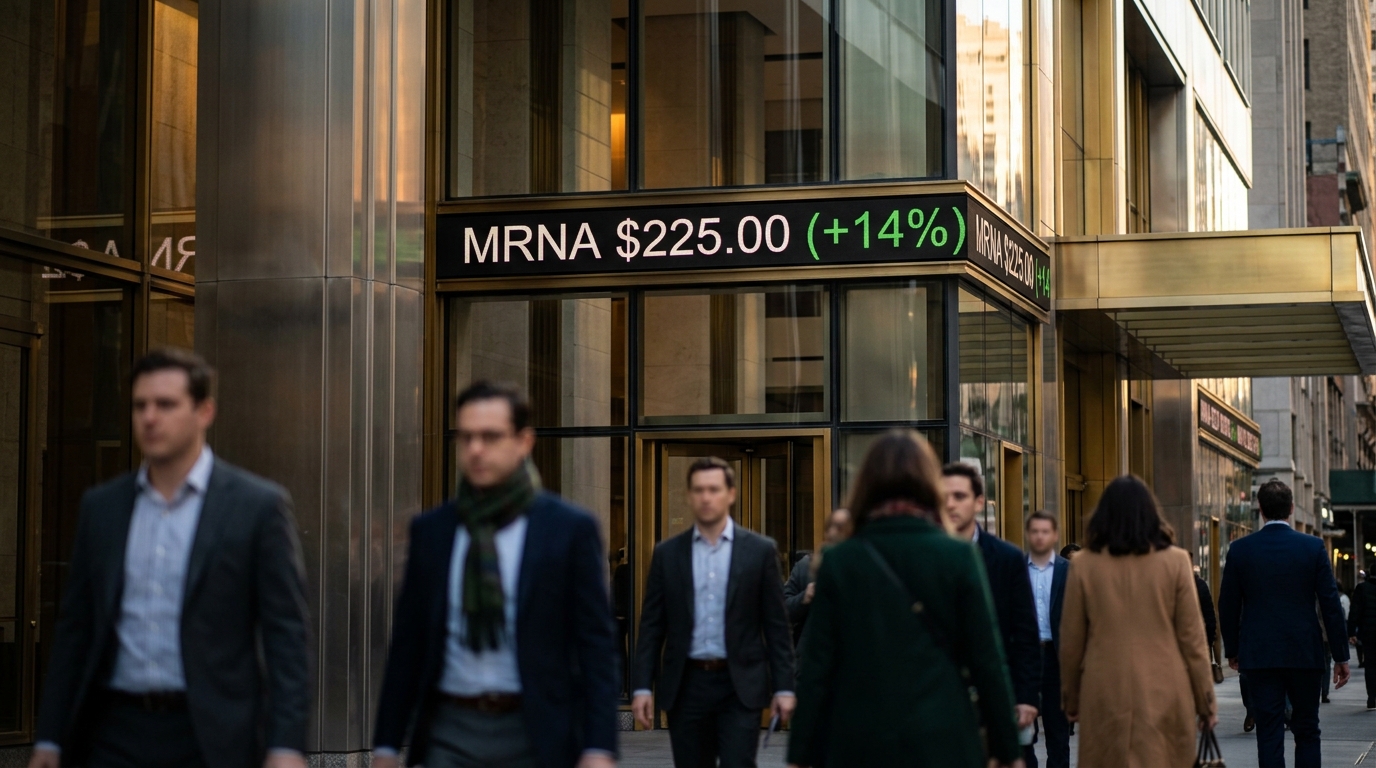
Moderna closed at $225 on Friday, a four-year high and a new 52-week record, after the New York Times published fresh details about a planned national cancer vaccine initiative. MRNA popped 14% on Friday, reaching its highest level since January 2022. The move extends one of the most violent reversals in large-cap biotech in recent memory: MRNA rose roughly 510% over the year to September 21, climbing from about $25 to about $173. Friday’s surge pushed it further still.
What 25 years on a Wall Street desk taught me about retirement income
I spent 25 years at Merrill Lynch and Vanguard watching the same play run, week after week, in every market condition imaginable. The money keeps coming in on every trade. Now that I’m on the outside, I’ve put together a free guide that breaks down exactly how this works, in plain English.
The immediate trigger was government, not the drug. The NIH plans to launch a public-private partnership in December to speed development of personalized cancer vaccines, bringing together the NIH, the Foundation for the NIH, researchers, drug and biotech companies, advocacy groups, philanthropies, and patients, starting with pancreatic, liver, and colorectal cancers and a subset of pediatric tumors. A senior NIH foundation official hopes the effort mirrors the public-private push behind COVID vaccines, though the pace is expected to be much slower.
The structure of the rally tells you something. Stocks including MRNA and BNTX surged Friday on the NIH news. That breadth points to a sector rerating, not a company-specific event. Moderna is simply the most direct vehicle, given what its pipeline already holds.
ALERT: The 11-Hour Options Window Opens Tomorrow
“11-Hour Options” exploit a little-known clock on the market…
… a focused window most investors never look at.
And the win-rate’s over 90%.
You need to see how the window actually works..
The clinical foundation for this week’s move was laid in August. The Phase 3 trial marked the first successful final-stage study for an mRNA-based individualized neoantigen therapy in cancer. The analysis linked the combination to a 49% reduction in the risk of recurrence or death and a 62% reduction in the risk of distant metastasis or death. Merck and Moderna are now moving toward regulatory filings. The full data presentation is scheduled for October 24, which is the next discrete catalyst traders need to circle.
Valuation is where the trade gets complicated. According to 23 analysts, the average rating for MRNA stock is Hold, with a 12-month price target of $122.67, implying roughly 45% downside from current levels. Citi’s Geoff Meacham downgraded Moderna to Sell on September 30 and raised his price target to $80, arguing that the share price is premised on customized cancer therapy proving effective across a wide variety of tumor types. That is a defensible concern: Merck and Moderna are studying the vaccine in trials for non-small cell lung cancer and bladder cancer, but those readouts are not imminent.
Elon Musk’s 5-Word Message Could Be Worth a FORTUNE to Investors
Elon Musk’s 5-Word Message Could Be Worth a FORTUNE to Investors
On January 4th at 4 a.m….
Elon Musk posted a simple, 5-word message on X to his 241 million followers…
It had nothing to do with Tesla, Starlink or SpaceX …
But according to legendary tech investor James Altucher…
It will go down as the most important announcement Elon Musk has ever made.
And for investors who know how to play it, it could create a fortune in the coming years.
On the upside, William Blair projected the company could eventually earn more than $5.4 billion in peak annual sales in melanoma alone from its 50-50 profit split with Merck. Whether that justifies $225 per share, ahead of full data, depends entirely on what October 24 shows.
What Traders Are Watching
- October 24 data readout: Full Phase 3 results for intismeran autogene at a medical conference. Any softening versus the interim results could reverse the move sharply.
- NIH December launch specifics: Which companies earn formal roles in the public-private partnership matters. Inclusion could reinforce MRNA’s institutional case.
- Analyst target revisions: BofA raised its price target on Moderna to $200 from $170 and maintained a Neutral rating. More upgrades would need to follow to narrow the gap between street targets and the stock.
- Sector spillover: BioNTech and other vaccine developers also rose Friday. If the NIH program generates sustained momentum, names with earlier-stage cancer vaccine programs could see disproportionate moves on any new government announcement.
The core tension is straightforward. The NIH initiative validates the category, but it does not accelerate Moderna’s regulatory timeline or change its revenue picture before 2027 at the earliest. At $225, the stock is already pricing in a lot of things going right, and October 24 is the first real test of whether that optimism holds.