The merger headline is real, but don’t let it swallow the earnings call. Tonight, after the close, Tesla reports Q3 results into one of the most unusual situations in its history: a sister company just posted a quarter so strong that it reframes every Tesla metric by comparison.
What SpaceX Changed Last Night
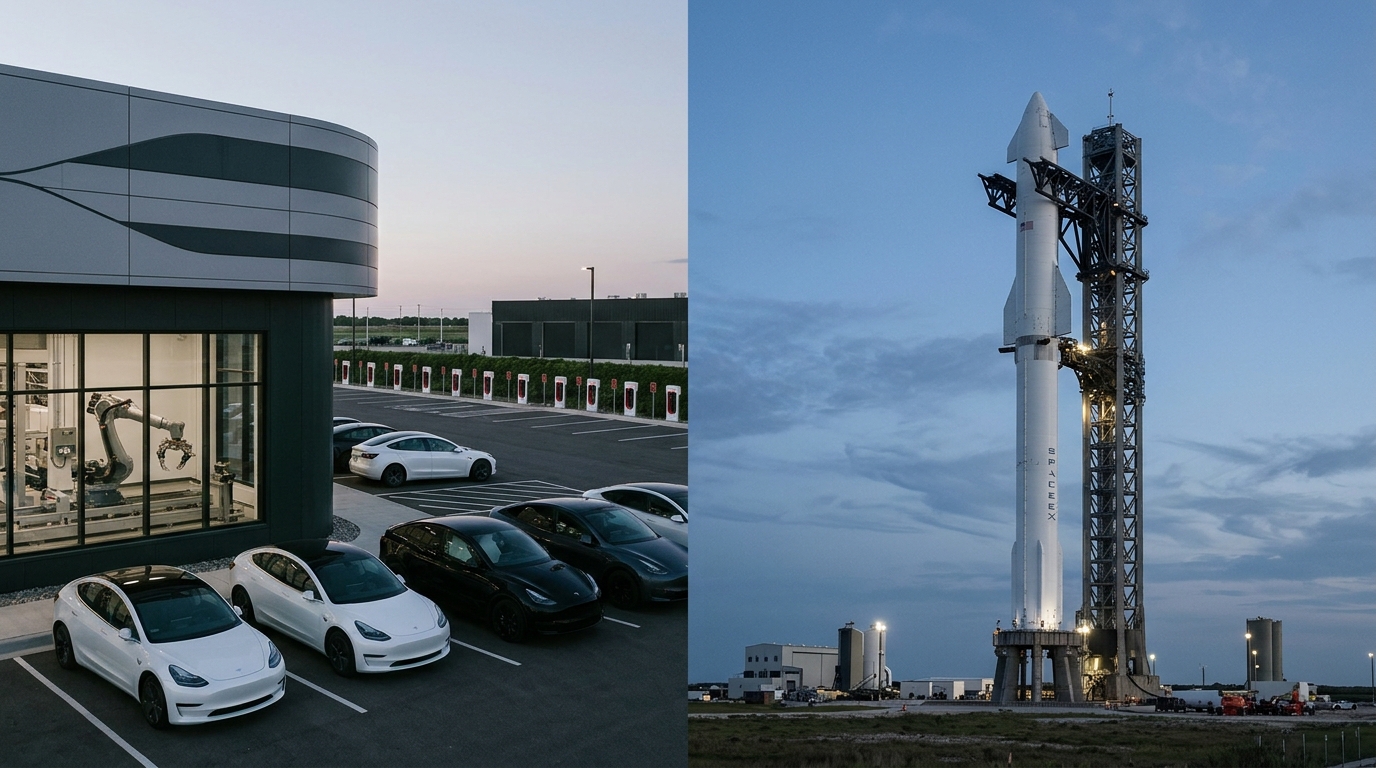
SpaceX delivered $14.6 billion in Q3 revenue, comfortably ahead of Wall Street’s $12.87 billion consensus. Top-line growth ran 161% year-over-year, while net income reached $4.4 billion. The quarter was largely driven by a roughly ninefold jump in SpaceX’s AI business, to $7.56 billion from $813 million in the same quarter a year ago. Then, on the earnings call, Musk said a merger with Tesla would be a “good idea,” adding that both boards have formed special committees to discuss a tie-up.
Musk emphasized that negotiations remain in early stages with no guarantee of an agreement, and acknowledged his role as a conflicted party, describing the process as “this sort of odd kabuki dance where two groups of people are talking and I can’t be in the conversation.” SpaceX now carries a market value of roughly $2 trillion, and equity analysts have argued that Tesla investors may accept a merger only if it hands them at least half of the new company, and that they may worry about dilution from future share sales to fund SpaceX’s spending on rockets, satellites, and AI data centers.
What Tesla Must Show Tonight
Deliveries are banked. Production reached 464,391 vehicles and deliveries totaled 486,532, exceeding prior market expectations. That part is done. The open questions are everything else.
- Margins. Automotive gross margin excluding credits came in at 16.3% in Q2, down from 19.2% in Q1. The market anticipates an overall gross margin of 17.9% tonight, with an operating margin of only around 2.5%. Any further compression and the bull case on autonomous monetization gets harder to defend.
- Free cash flow. Wall Street sees Q3 free cash flow at negative $4.51 billion, with capital expenditures climbing to $7.77 billion for the quarter. A year ago, free cash flow was nearly $4 billion positive. That is an $8.5 billion swing in 12 months.
- Capex guidance. In April, the stock rose about 4% after hours on an earnings beat, then erased those gains as management raised full-year 2026 capex guidance to more than $25 billion and said free cash flow would remain negative for the rest of the year. Any upward revision to spending tonight carries the same risk.
The Merger Lens Changes the Calculus
Here is what the SpaceX quarter exposed: a potential acquirer with $4.4 billion in net income is eyeing a target whose own quarterly operating income was $398 million in Q2 at a 1.4% margin. Tesla’s Q2 GAAP EPS of $0.32 included an unrealized gain of about $1.0 billion on its SpaceX investment and a California tax reserve release. Since Tesla received its SpaceX stake through the xAI investment that was converted into SpaceX shares, reported earnings will now move with the SPCX share price. That linkage makes clean fundamental analysis harder.
Tesla’s trailing valuation metrics remain extreme. The valuation rests not on current earnings but on the option value of autonomy and robotics. A merger with SpaceX would collapse that option value into a real asset, but it would also hand SpaceX shareholders a partner burning through cash at record speed.
The valuation pressure is compounded by competitive headwinds Tesla cannot negotiate away. China’s recall of nearly 3 million Tesla vehicles and a new handle-design rule reshaping the competitive landscape add a regulatory overhang that a merger does nothing to resolve.
What to Watch on the Call
Automotive margin trajectory and any change to the more-than-$25 billion full-year 2026 capex guide matter more than the headline EPS tonight. A merger does not rescue a weak balance sheet, it just repackages it. If Tesla’s Q3 shows auto margins recovering toward 18% and capex spending beginning to generate measurable returns in energy or autonomy, the deal math improves for Tesla holders. If margins stay compressed and free cash flow stays deeply negative, SpaceX’s independent directors have every reason to demand a steep discount.
Barclays has noted that SpaceX could acquire Tesla in an all-stock deal that might be announced before the annual shareholder meeting on December 3, 2026. Tonight’s numbers are, in effect, Tesla’s opening negotiating position.