Dear reader,
Most investors wait for the government press conference.
I follow the money before the cameras show up.
And the money trail now leads straight to one tiny nickel stock.
Its U.S. platform has already been selected for $135.4 million in disclosed federal grants: $114.8 million tied to a domestic processing facility and another $20.6 million supporting exploration in Minnesota and Michigan.
That is not a prediction. That’s money already disclosed.
The next step is my forecast: I believe Washington could eventually go further and take an equity stake.
It may never happen. But the U.S. has already shown it is willing to put taxpayer capital directly into strategic mineral companies. And this company now controls the only primary nickel mine operating in America.
Meanwhile, Tesla has locked in a six-year supply agreement, and America remains dangerously exposed to foreign nickel supply.
Russia, China, and Indonesia have leverage because the United States allowed its domestic pipeline to wither.
This little company is one of the few credible ways to fight back.
That’s why I bought 10,000 shares before any equity announcement.
I am not promising Washington will buy in. I am saying the grants, the operating mine, the Tesla agreement, and the strategic pressure form a setup I refuse to ignore.
Click here to learn more about the $5 nickel stock I believe Washington could target next.
Yours for peace, prosperity, and liberty, AEIOU,
Dr. Mark Skousen
Macroeconomic Strategist, The Oxford Club
P.S. Washington has already backed this platform with $135.4 million in disclosed grants.
If an equity stake comes next, I believe a stock this small could move violently.
I refuse to wait for the press conference.
Click here to reveal details on what I bought before Washington makes its next move.
Iran Blockade Turns Kinetic: What Crude and Tankers Do Next
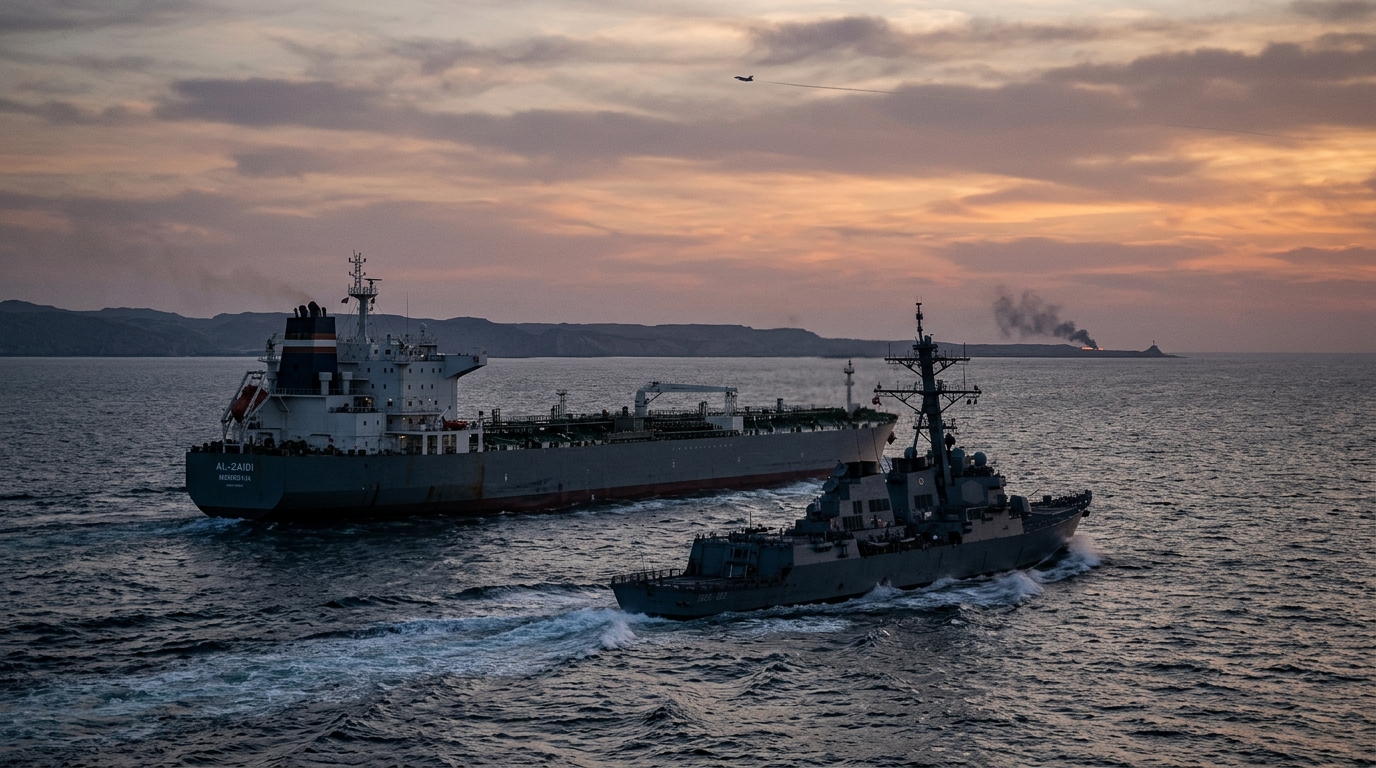
Two events hit the wire over the weekend that the Friday close could not price in. On Saturday, a U.S. military aircraft fired precision munitions at the stern of the M/V Huda, a St. Kitts-flagged cargo ship in the Gulf of Oman, after the crew attempted to break the U.S. naval blockade on Iran and ignored repeated warnings. The UAE National Guard subsequently rescued 22 crew members after a fire broke out aboard a cargo ship in the Gulf of Oman. Then on Sunday, CENTCOM announced it had established Task Force Iron Gate to disrupt Iran’s land-based supply routes, expanding the months-long naval blockade in and around the Strait of Hormuz.
The two moves together close a loop. The new team will coordinate with other U.S. government agencies on preventing the movement of advanced weapons systems, dual-use technologies, sanctioned materials, and illegal revenue streams across Iran’s land borders and the Caspian Sea. On the other side, Iran’s Revolutionary Guard lifted its self-proclaimed limit of 2,000 kilometers on the range of its ballistic missiles, suggesting the country may seek to develop missiles capable of reaching more distant targets amid fears of renewed all-out war. Neither side is signaling retreat.
Market Snapshot
Brent was at $97.76 on November 6, the last trading session before the weekend escalation. WTI stood at $90.83 on the same day. Both benchmarks closed before CENTCOM struck the Huda and before Task Force Iron Gate was announced, leaving this morning’s open to absorb the full weekend development. Key technical levels for WTI vary by model and will reset with the open.
The options market has been flagging this risk for months. The OVX sitting at roughly three times the VIX signals traders are pricing re-escalation risk, not a resolved situation.
The Strait of Hormuz is effectively closed to commercial shipping as of this morning, with one vessel transiting on November 1 against a normal daily count of roughly 85. That is not a new number, but the weekend events confirm enforcement risk is still elevated.
Stocks in Focus
Tanker names are the most direct expression of this trade. Baltic Exchange-linked reporting showed VLCC earnings on Middle East Gulf to China benchmarks surged above $1 million per day in October, far above early-year levels. Rates pulled back this past week from record highs, with the Gulf of Oman-to-China VLCC benchmark around WS 776 on the Worldscale basis. Saturday’s strike on the Huda adds fresh risk premium. Frontline (FRO), Teekay Tankers, International Seaways (INSW), and Euronav are the names most directly sensitive to rate moves in this region.
Several large crude-tanker owners have posted materially stronger results during the disruption, but the question for Monday is whether the weekend strike reignites the rate spike that briefly cooled late last week, or whether the market treats the Huda incident as routine enforcement rather than a new threshold crossed. Task Force Iron Gate’s land-route mandate does not directly move tanker rates, but it signals that Washington is widening the pressure campaign, reducing the probability of a near-term settlement that would reopen Hormuz traffic and normalize freight costs.
Sector Watch
Energy is the dominant sector today. U.S. officials have publicly argued the blockade has denied Iran tens of billions of dollars in crude-export revenue. Independent tracking and consultancy estimates around Iranian export leakage vary, but the core point for traders is unchanged: the Strait disruption and enforcement posture keep Middle East supply risk embedded in the tape.
Risk Radar
- Iran missile escalation. Tehran removing its self-imposed 2,000-km missile range ceiling removes a constraint that had bounded the conflict’s geographic scope. Traders in energy and regional equities should treat this as an ongoing tail risk rather than resolved noise.
- Tanker rate whipsaw. Rates fell last week on diplomatic speculation and softening demand. A second strike, or an Iranian response to the Huda incident, could reverse that move sharply. Positioning in tanker names ahead of that volatility carries gap risk.
- Cargo ship flag-state complications. UK Maritime Trade Operations reported an incident involving a commercial vessel in the Gulf of Oman but did not immediately confirm it was the same ship targeted by U.S. forces, illustrating how confused the operational picture remains for vessels transiting the area.
The Cheat Sheet
Top theme: The Iran blockade shifted from interdiction to kinetic enforcement over the weekend. The market has not priced that yet.
Stock to watch: Frontline (FRO). Highest direct exposure to VLCC rate moves, with a large fleet positioned across the conflict zone’s key routes.
Sector to watch: Energy. Crude supply constraints from the blockade are real, and Task Force Iron Gate extends that pressure to overland routes.
Biggest risk: Iran’s missile range announcement. If Tehran translates that signal into action against regional infrastructure, the conflict scope changes materially for energy markets.
One thing to remember: Brent and WTI closed Friday before either the Huda strike or Task Force Iron Gate was public. The open is the market’s first chance to respond to both. Watch the first 30 minutes in crude futures and tanker names before drawing any directional conclusions.