One Asset Gained 2,300%
The Last Time This Setup Happened
Here’s What It Was
Dear Reader,
From 1970 to 1980, one specific asset gained more than 2,300%.
That’s not a typo. A $10,000 investment became $230,000 in a decade.
And here’s why we’re bringing it up right now.
The exact same conditions that produced that gain in the 1970s are forming again today.
Stagflation. The toxic combination of high inflation AND a stalled economy. The 1970s version trapped the U.S. economy in a vise for nearly a decade. Stocks went sideways for 10 years. Bonds got crushed. Cash lost half its value.
Now look at where we are:
Inflation expectations spiked to 4.8%. JP Morgan and Moody’s are warning of recession by 2026. Oil is surging on Middle East tensions. And the Fed is trapped – cut rates and inflation worsens, hike rates and recession arrives faster.
The setup is identical.
Now we know what you’re thinking. “That was 50 years ago. It can’t happen again.”
The smartest money in the world disagrees.
Central banks are loading up on the same asset that gained 2,300% in the 1970s – at the fastest pace in 50 years. JP Morgan is forecasting it could hit $8,000 before this cycle ends.
You’re going to make a decision today whether you realize it or not.
Position before stagflation locks in. Or watch from the sidelines while the same trade plays out again.
Because once the trap closes, getting out gets expensive.
The VIX Just Had Its Third-Largest Jump in History.
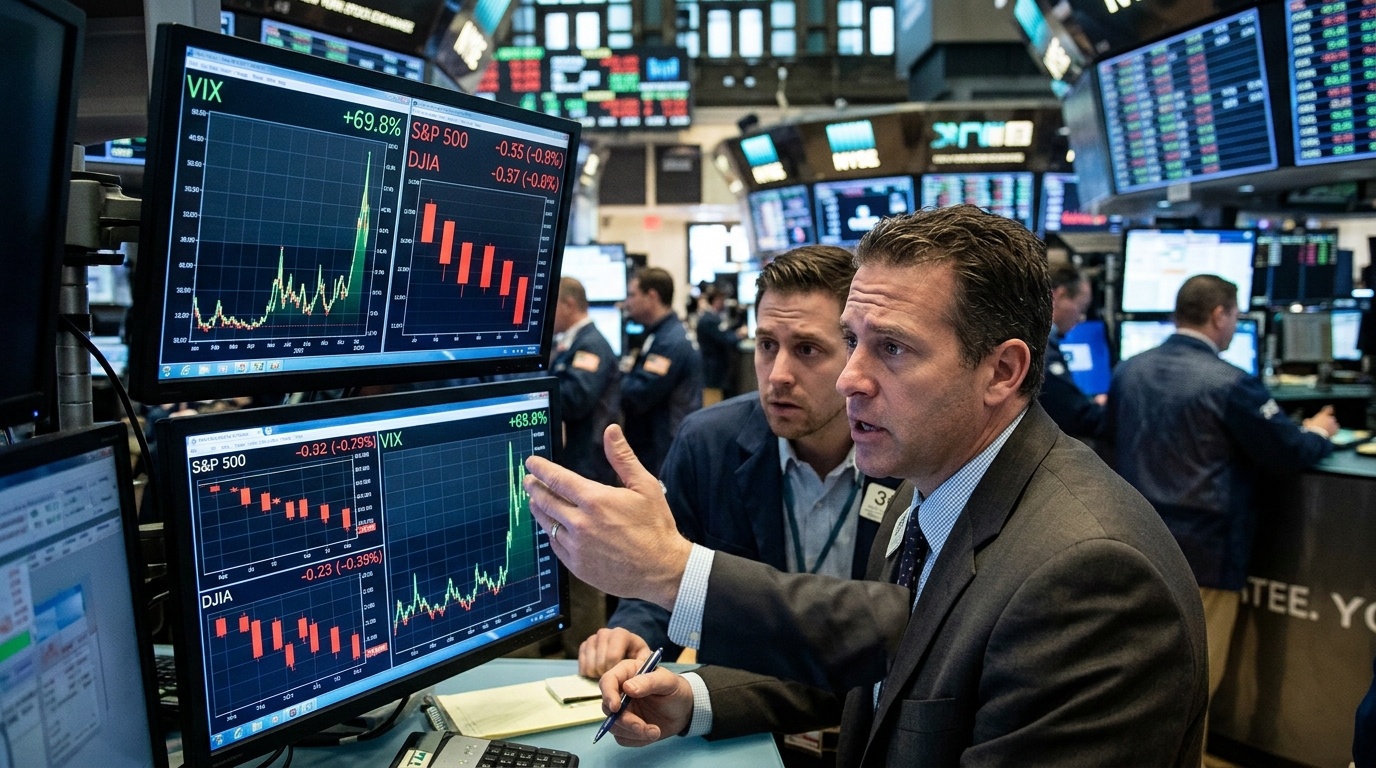
Thursday, November 5 delivered one of the most disorienting single-session swings in recent memory. The VIX surged about 70% intraday to 28.09, its highest reading since March, and closed at 28.18. That is the third-largest one-day percentage gain for the fear gauge since 1990, ranking it alongside moments most traders would rather forget.
The proximate cause was political. The week’s volatility reflected a significant reassessment of artificial intelligence investments following the Democratic Party’s sweeping victory in the U.S. midterm elections, with investors increasingly concerned that new restrictions on data center construction could slow the enormous spending that has supported semiconductor companies and AI infrastructure businesses. Texas alone is home to about 25% of planned data center build, according to Axios, and the elections of three governors who campaigned on restricting data center development, Gina Hinojosa in Texas, Amy Acton in Ohio, and Keisha Lance Bottoms in Georgia, could be consequential for the AI industry’s future expansion.
The damage across a single session was historic. Estimates varied by measure, but Dow Jones Market Data put the one-day market-cap hit for S&P 500 companies at roughly $2.9 trillion. Nvidia fell more than 9% to hit a seven-month low, down more than 25% from its October high. AMD plunged 17%, and Broadcom dropped 10%. The Magnificent Seven lost about $1.0 trillion in aggregate market cap in the tech-led selloff, according to NDTV Profit.
Friday brought a partial exhale. The S&P 500 gained approximately 0.3% and the Nasdaq Composite advanced about 1.1%, supported by renewed buying in semiconductor and artificial intelligence companies. The VIX itself eased back toward 25.64, though it remains well above pre-election levels.
The question for the week ahead: does this bounce hold, or is Thursday a warning shot rather than a one-day event?
The bounce signal is real, but the sector composition of this selloff matters for how it resolves. Custom silicon revenue from hyperscaler capex commitments is one of the cleaner ways to track whether AI infrastructure spending is actually slowing.
History argues for patience. Since 1990, the VIX has jumped 50% or more in a single session only about 10 times, and in those instances the S&P 500 was higher one month later 90% of the time, with an average gain of about 2.56%, according to a compilation of historical VIX spike events.
The complication is that prior VIX spikes of this magnitude were not driven by regulatory policy targeted at a single sector responsible for a significant portion of index earnings growth. Much of the data center capacity expected to come online in 2027 is already under construction, limiting the near-term impact of new restrictions, but tighter regulations could become a more significant headwind to AI investment from 2028. That is a slow-burn risk the historical average cannot fully capture.
Adam Turnquist, chief cross-asset strategist at LPL Financial, noted that volatility has not yet reached the capitulation or contrarian extremes that have marked market bottoms. With the VIX still below 30 and the S&P 500 sitting at 7,353, the structural bull case remains intact but it is now carrying a heavier political discount than it was 72 hours ago. Traders pricing the next move should weigh the historical bounce signal against the possibility that this particular selloff has a longer legislative tail.