
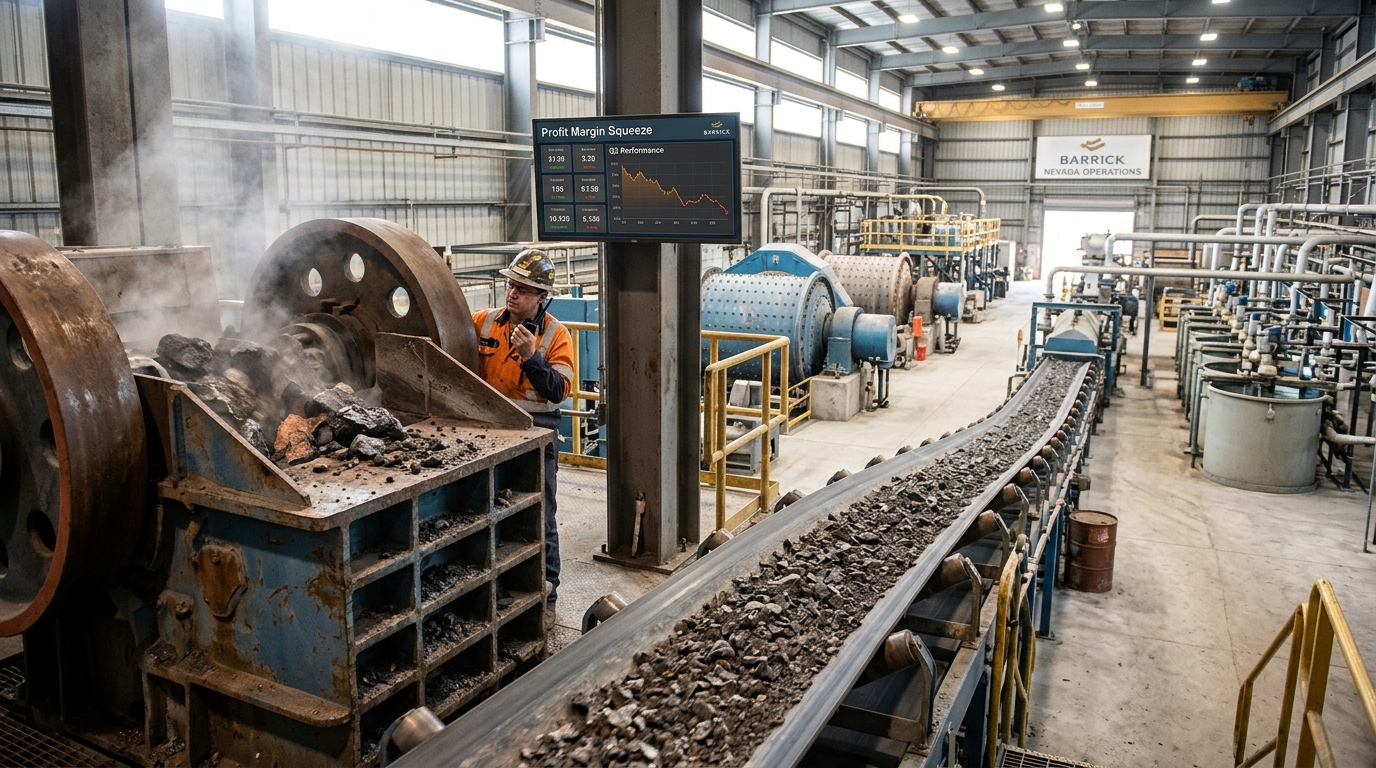
When gold slid from its late-January 2026 all-time high, most of the coverage fixated on the chart. Monday’s Barrick earnings are where the real accounting happens.
The Big Question
The debate among institutional gold investors right now is not whether gold’s bull market is over. It is whether the drawdown has broken the earnings case for the producers. That is a sharper question, and Barrick’s Q3 income statement, due before the open on November 9, is the first place to test it at scale.
Why Wall Street Cares
Gold mining stocks carry operating leverage to the metal price. When gold rises, margins expand faster than revenue because a large portion of the cost base is fixed. The reverse is equally true. Barrick ran an all-in sustaining cost of $1,708 per ounce in Q1 2026, the quarter it realized an average gold price of $4,823 per ounce. That is a gross margin of roughly $3,115. By Q2, realized prices had retreated to $4,417 while AISC climbed to $1,866, compressing margin to approximately $2,551 per ounce. Now comes Q3, where the consensus pegs Barrick’s average realized price at $4,263. Against a cost base guided at $1,760 to $1,950 for the full year, that is a further $150-plus squeeze from Q2 alone. From Q1 to that Q3 consensus, Barrick has given back more than $500 per ounce of margin in two quarters.
The Bull Case
The structural argument for gold producers remains intact, at least on paper. Reuters reported this week that Goldman Sachs cut its year-end 2026 gold target to $4,150 from $4,650, while keeping a constructive longer-term view. Barrick’s production is growing sequentially and was guided to peak in Q4. If costs hold inside the low end of guidance, the company earns real money even at $4,100 gold.
The Bear Case
Goldman’s December rate-hike call is the near-term problem. Traders now price roughly a 70% to 80% chance the Fed moves again in December, depending on the tool you look at and the time of day. Barrick’s cost structure has trended the wrong direction: AISC rose 11% year over year in Q2. At current gold prices near $4,050, margins have compressed to roughly $2,184 per ounce, less than 70% of their Q1 peak. Any further cost creep in Q3 makes that number worse before it gets better.
What Investors Are Missing
The asymmetry in analyst models. Barrick has disclosed a cost sensitivity of $5 per ounce for every $100 per ounce move in gold price. That sounds modest until you apply it. A $600 per ounce price retreat from Q1 reduces the AISC metric by only about $30 per ounce, while the revenue line falls the full $600. The leverage cuts both ways and the income statement magnifies it.
Stocks to Watch
- Barrick (B) reports Monday and owns the near-term read on sector margins.
- Newmont (NEM) faces identical cost-versus-price math with a heavier AISC burden, making it more exposed to further weakness.
- Wheaton Precious Metals (WPM) and Franco-Nevada (FNV), as streaming companies, carry fixed contractual costs rather than mine-operating exposure, so their margins compress far less in a drawdown, which is precisely why institutional capital has rotated toward them.
- GDX, trading around $87.60 as of November 6, gives the blended picture: broadly flat year to date, masking a wide dispersion between operators and streamers. That spread is the investment debate.