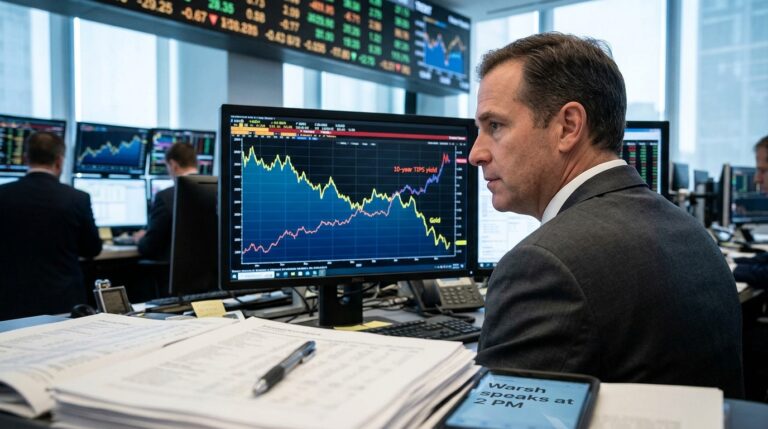

One set of minutes, four contradictory verdicts. That is the market’s scorecard after the Federal Reserve released the record of its October 27–28 meeting on Wednesday afternoon, November 18, 2026.
According to the minutes, “almost all participants judged” that further action to raise the federal funds rate “would likely be appropriate” to return inflation to the Fed’s 2% goal. Two members had preferred a 25-basis-point increase at that meeting itself, while some participants said more than 25 basis points could warrant consideration in December if inflation data were unfavorable. The October hold, in other words, was a pause with conditions attached, not a turning point.
What Actually Moved
The dollar index strengthened to about 103.8 on Wednesday. Gold plunged 3.51% to $3,728.60, falling to a 14-month low. Equities split cleanly along duration lines. The Dow Jones Industrial Average dropped 1.11%, or 561.25 points, to 50,198.17, while the Nasdaq rose 0.42%. The benchmark 10-year Treasury yield lost almost 4 basis points to 5.064%.
Why It Happened
The dollar and gold reactions are internally consistent. Higher rates for longer lift the real yield on dollar assets, strengthening the currency and raising the opportunity cost of holding gold. Gold has fallen far more than the dollar has risen over the past week, which suggests something beyond simple rate math. Positioning had already stretched. Much of the gold selling came before the minutes hit, after hawkish comments earlier in the day from Fed Governor Christopher Waller. The minutes confirmed the direction; they did not create it.
The equity split is harder to explain as a coherent response to the same document. The Dow fell harder because of broad declines in energy, health care and other value-oriented stocks, while parts of the technology and consumer sectors held up. Rate-sensitive industrials and healthcare stocks bore the weight, while the Nasdaq benefited from a separate catalyst: Anthropic pricing its IPO above its range ahead of Thursday’s debut, lifting sentiment across growth names. The minutes were incidental to that move.
What the Market May Be Missing
The 10-year yield’s decline on the same day the Fed minutes confirmed a hawkish path deserves more attention than it received. If the long end is falling while the short end stays anchored and the Fed is explicitly telegraphing more hikes, the bond market may be pricing a growth slowdown that equities have not yet absorbed.
There is also a credibility question around the 50-basis-point signal. New York Fed President John Williams, the FOMC vice chair, said Tuesday that “I don’t think the situation calls for dramatic action” when asked about a half-point hike. Markets now estimate the probability of a 25-basis-point move in December at about 90%, with the chance of a 50-basis-point increase around 10%.
Risks and Counterpoints
The bull case for equities rests on the same minutes carrying an unspoken ceiling: the hawkish message was largely priced in following the CPI data and Waller’s morning statements, meaning Wednesday’s release confirmed what traders already suspected. If October PCE softens, the 50-basis-point threat fades quickly and so does the pressure on rate-sensitive stocks.
What to Watch Next
The October PCE report and the November jobs report likely carry more weight for any larger hike. Those two releases are the real verdict on whether the officials who floated 50 basis points build a majority or stay isolated. The DXY near 104 and gold below $3,730 have already priced a 25-basis-point December move as near certainty. Any softening in PCE would hit both of those trades harder than the equity market, which has shown it can compartmentalize.