QUITO/GUAYAQUIL, Feb 16 (Reuters) – After hundreds of Ecuadorean inmates were killed in prison riots in 2021 and 2022, President Daniel Noboa made restoring order in jails one of the central pillars of his security strategy when he took office in 2023.
While the government has sharply curbed the number of riots, figures revealed in a Reuters investigation show prison deaths are reaching levels not seen since the height of the unrest.
Deaths of inmates almost quadrupled year-on-year in 2025 due to both violence and natural causes, including a tuberculosis outbreak, according to the figures obtained by Reuters through a freedom-of-information request to the Interior Ministry. Deaths attributed to violence alone also rose fourfold from the year before.
Of the 1,220 inmates who died in 2025, at least 206 were killed during gang clashes and other violence, up from 46 the previous year, according to the figures. It was the highest number since 2021, when 328 inmates died.
The other deaths last year were attributed to illness, suicide and other undetermined causes — a 256% increase from the 285 recorded in 2024. The government has not released comparable figures for 2021, 2022 or 2023.
Neither Noboa’s office nor prison agency SNAI responded to requests for comment about the increase in deaths during 2025. In its response to the freedom-of-information request, the Interior Ministry said the sharp increase in deaths “even compared to historically critical periods such as 2021″ could “without proper technical context,” create “distorted perceptions of institutional management”.
The ministry did not respond to a separate request asking it to explain the technical context.
Fatal prison riots were nearly a monthly occurrence in Ecuador in 2021 and 2022 as the nation’s jails became a microcosm of a wider surge in drug-related violence rocking the country.
Bringing prisons under control is a main plan of Noboa’s security agenda. The conservative business heir has staked his legacy on fighting drug trafficking and crime, which have surged in Latin America in recent years, inspiring the election of tough-on-crime presidents from Costa Rica to Chile.
Noboa put the military in charge of certain penitentiaries, is building new jails he says are better equipped to handle violent felons, and has transferred some high-profile prisoners. His government says the moves have reduced violence compared with previous years.
OVERCROWDING AND TUBERCULOSIS
The government acknowledges overcrowding in prisons and says it is responding to healthcare issues with disease screenings and medical attention.
But the death figures tell a grim tale of prison conditions, as relatives of inmates and rights organizations highlight violence, abuse, tuberculosis worsened by overcrowding, insufficient medical care and lack of adequate food, all of which they say have been exacerbated by the strict conditions imposed as part of the military intervention.
The government says military operations have dismantled criminal operations inside prisons, including drug shipments, extortion and planning for attacks against politicians and officials and that they have closed nightclubs and even a private pool within prisons which were once enjoyed by gang leaders.
But officials are also contending with overcrowding of 30.6% in adult prisons. Juvenile facilities were not overcrowded in 2024, according to official data, but reached a level of overcrowding of 15.3% in 2025.
The government says a 7.6% increase in the national inmate population last year, to 35,454, is due to more arrests and longer sentences. It says many cells are unusable because of riot damage, forcing inmates to crowd into fewer spaces.
“We are now facing a health crisis, a food crisis, and complaints from relatives about alleged mistreatment and torture by military personnel,” said Rodrigo Varela, secretary general of Ecuador’s official human rights ombudsman. He said his office has referred several complaints about inmate conditions to the prosecutor’s office.
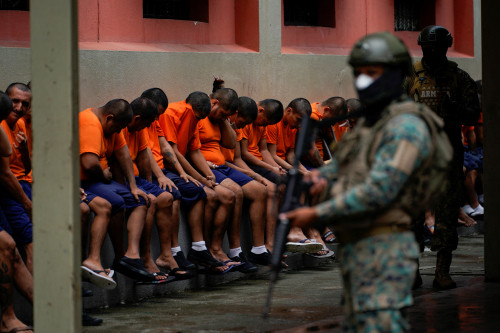
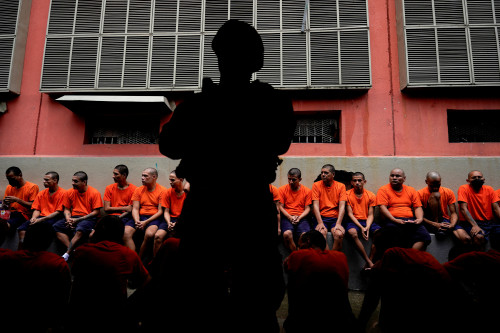
Though Noboa has resisted comparisons to El Salvador’s President Nayib Bukele, famed for a harsh prison strategy that rights groups have decried as abusive, Noboa has posted images similar to many shared by the Central American leader: of shaven-headed inmates, dressed in orange and sat in tight rows, as heavily armed, masked soldiers look on.
“We are not following either Bukele’s manual or (Argentinian President Javier) Milei’s manual — we are dealing with Ecuador’s reality,” Noboa told CNN en Espanol in an interview last year, adding that new prisons are the answer to overcrowding.
The Inter-American Commission on Human Rights asked Ecuador in December to improve conditions for the 7,000 inmates at the Litoral Penitentiary, Ecuador’s most dangerous prison, citing a government report listing 564 deaths there from January to September 2025, including 550 classified as natural or undetermined. Interior Minister John Reimberg has linked the outbreak to overcrowding, but has not explained its origins nor provided data on infections.
NO PILLOWS
Six relatives of inmates interviewed by Reuters said military presence has made already precarious conditions – including extortion among inmates – even worse.
“Many times these are not riots — these are inmates raising their voices because they are dying or in agony,” said Ana Morales, an activist coordinator for relatives whose son is held at Litoral Penitentiary. “It is a lack of humanity by the military and dehumanization by the Ecuadorean state.”
All of the relatives decried lack of food and cell searches where military destroy personal possessions.
“We’re seeing not just a resurgence of tuberculosis but of military abuse,” said Stefany Salinas, whose husband is imprisoned for homicide in El Rodeo prison in Manabi. “We oppose mistreatment — they break everything, they throw away personal belongings.”
The SNAI and the defense ministry did not comment on the accusations. Reimberg has said all prisons have food provided, but many inmates prefer to trade their meals for drugs.
The government began transferring hundreds of prisoners to break up gang control of certain facilities in late 2025, and around 900 inmates were moved in January alone, SNAI said in a recent statement.
Inmates who were deemed highly dangerous — including gang leaders and former vice president Jorge Glas, convicted of corruption — were moved to El Encuentro, a new maximum-security prison built by Noboa, with capacity for 800 people. The government plans to build a similar facility for more than 15,000 inmates, scheduled for completion in 2027.
It has lauded El Encuentro, which allows no visits by lawyers or relatives and where members of different gangs are mixed together and held four to a cell, as a model.
Prisoners are not allowed pillows, because they can be used as weapons, Reimberg told television channel Ecuavisa.
(Reporting by Alexandra Valencia in Quito and Yury Garcia in Guayaquil, Editing by Julia Symmes Cobb and Alistair Bell)