By Bart H. Meijer and Julia Payne
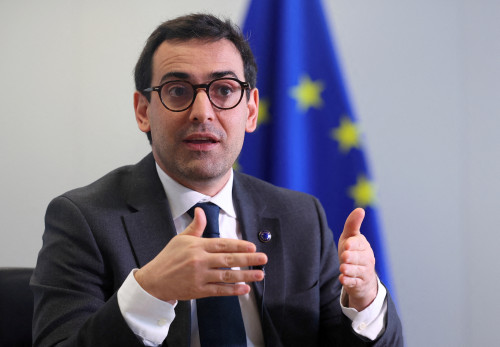
BRUSSELS, Feb 2 (Reuters) – Europe needs to protect its own industries with a “Made in Europe” strategy, EU industry chief Stephane Sejourne said in a newspaper article published late on Sunday that was co-signed by more than 1,100 CEOs and other business leaders.
In an attempt to boost European industries in the face of cheaper imports from China, the European Commission plans to propose a so-called Industrial Accelerator Act this month that will likely set requirements to prioritise locally manufactured products. But the approach has split EU countries.
“Without an ambitious, effective and pragmatic industrial policy, the European economy is doomed to be just a playground for its competitors,” Sejourne said in the article, which was published in newspapers across Europe.
“We must establish, once and for all, a genuine European preference in our most strategic sectors,” the French member of the Commission said.
The article was co-signed by CEOs from a broad range of industries, including steelmakers ArcelorMittal and Tata Steel, drugmakers Novo Nordisk and Sanofi, tyre makers Continental , Michelin and Pirelli, airline group Air France KLM, and French utility Engie.
“Canadian Prime Minister Mark Carney is right: those who are not sitting at the table now will end up on the menu … Steel is inextricably linked to this,” said Marie Jaroni, CEO of Europe’s No. 2 steelmaker Thyssenkrupp Steel Europe, another signatory.
‘MADE IN EUROPE’ REGULATIONS DIVIDE EU COUNTRIES, INDUSTRIES
Car makers were absent from the list, however, since, owing to their sprawling global supply chains, they are concerned about how narrow the “Made in Europe” definition will be.
“Ford supports strengthening Europe’s industrial base, but the planned ‘Made in Europe’ rules must remain open to trusted partners like the UK and Turkey,” Ford of Europe President Jim Baumbick said in a comment to Reuters.
“Our European factories depend on deeply integrated supply chains in the UK and Turkey and excluding them would weaken production inside the EU itself.”
And Stefan Hartung, CEO of major car parts supplier Bosch, cautioned the new rules should “address level-playing field issues” rather than “compensate for competitive disadvantages.”
Governments including France are championing the idea of “Made in Europe” regulations. But others, including Sweden and the Czech Republic, warn that “buy local” requirements could deter investment, raise prices in government tenders, and hurt the EU’s competitiveness globally.
“The Chinese have ‘Made in China’, the Americans have ‘Buy American’, and most other economic powers have similar schemes that give preference to their own strategic assets. So why not us?” Sejourne wrote.
“Whenever European public money is used, it must contribute to European production and quality jobs.”
Local content is also taking centre stage in negotiations for the European Commission’s next budget 2028-2034.
But Mercedes-Benz CEO Ola Kaellenius told reporters that local content requirements risked driving up inflation and shrinking the market.
“You have to be incredibly, incredibly careful here to use a scalpel,” he said.
(Reporting by Bart Meijer, Julia Payne and Foo Yun Chee; Additional reporting by Jan Strupczewski in Brussels, Ilona Wissenbach in Stuttgart and Christoph Steitz in Frankfurt; Editing by Cynthia Osterman, Lincoln Feast, Gareth Jones and Joe Bavier)