By Catarina Demony and Marissa Davison
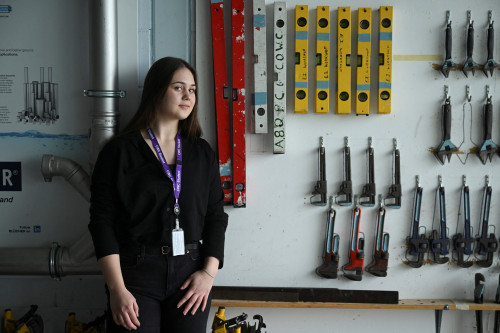
LONDON, Dec 2 (Reuters) – In a labour market where artificial intelligence is quickly transforming and sometimes replacing jobs, student Maryna Yaroshenko wanted to find a future-proof career that offered long-term stability.
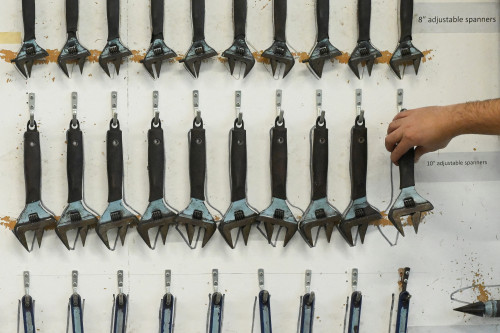
Like a growing number of young people in Britain and beyond, 18-year-old Yaroshenko opted for a skilled trade and is now training to become a plumber.
“That’s something AI won’t take over,” said Yaroshenko, who is originally from Ukraine and is studying at the City of Westminster College (CWC) in London.
White-collar jobs are viewed as more vulnerable to disruption by AI and automation than manual labour. In Britain, one in six employers expect the use of AI tools to allow them to reduce their headcount in the next 12 months, according to a survey last month conducted by the Chartered Institute of Personnel and Development, a professional human resources body.
Yaroshenko sees AI as a useful tool, but not one that could replace the hands-on nature of plumbing, which many shy away from due to its physical demands and a lingering stigma around trades such as electrical work, carpentry, and welding.
“We will definitely work with it (AI) but only a human can make those unique things AI cannot,” she said. “No AI can do plumbing, no AI can do real engineering, no AI can be an electrician.”
DEMAND FOR HANDS-ON COURSES GROWING
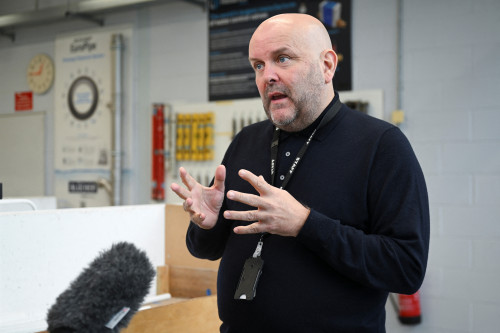
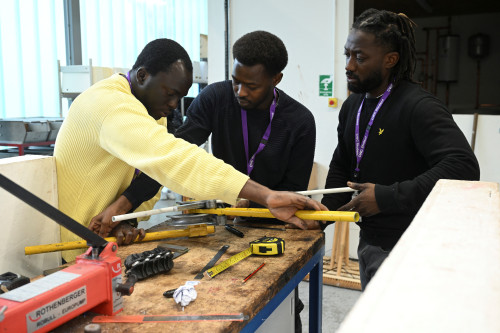
CWC, part of the United Colleges Group, is a further education and training institution rather than a university. Over the past three years, it has seen enrolments in its engineering, construction and built environment courses rise by 9.6%, a jump CEO Stephen Davis attributes partly to the growth of AI and also to student worries about the cost of university.
Some young people are opting against university to avoid the thousands of pounds of debt it can entail.
A survey of 2,600 adults carried out in August by the Trades Union Congress, the country’s biggest union umbrella, found that half of UK adults were worried about AI’s impact on their jobs, with those aged 25 to 35 particularly concerned.
“There’s a lot of anxiety among young people right now that their jobs are automated away,” said Bouke Klein Teeselink, a lecturer and AI researcher at King’s College, London.
Teeselink’s study at King’s College, published in October, found that AI-driven cuts in workforces disproportionately affect junior positions, making it harder for young people to get a foothold on the career ladder.
Other colleges are reporting similar trend shifts.
Angela Joyce, CEO of Capital City College, also in London, said it had seen strong growth in interest in construction, plumbing, hospitality, and other trades.
“This shows that more people are recognising the value of becoming skilled professionals,” Joyce said, adding that for some people, apprenticeships could offer better earning potential than degrees.
Davis said AI has pushed not only young people but also adults looking to switch careers to think more strategically. Many are seeking job security and higher wages, he said.
According to the Office for National Statistics, plumbers earn an average of 37,881 pounds ($50,169) per year, while skilled construction and building trades workers typically make around 35,764 pounds. This compares with an overall average salary of 39,039 pounds across all sectors.
Davis noted that skilled trades, however, often provide greater opportunities for people to run their own businesses, increasing their earning potential.
NEW BLOOD IN TRADES
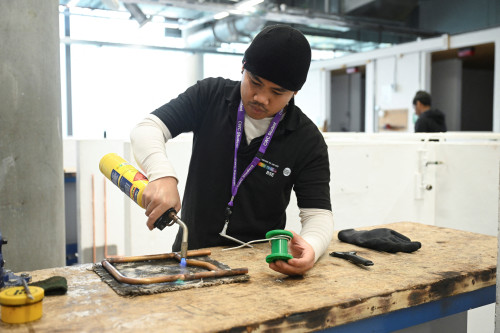
Back in the plumbing workshop, Yaroshenko said another reason she sees herself staying in a skilled trade in the long term is that the current workforce is aging and demand for a new generation of skilled workers will stay high.
Yaroshenko added that she chose a college over university because she wanted to gain “real-life work” experience as quickly as possible.
Undergraduate enrolments at UK universities have slightly declined, falling 1.1% in 2023/24 from the previous academic year, the first annual decrease in nearly a decade, according to the Higher Education Statistics Agency.
Teeselink said it would be a while before robot plumbers took over, because it’s such “intricate work”.
Davis said that while robotics technology was evolving rapidly, students on courses such as plumbing were well-positioned.
“Sometimes plumbers have to put their hands down the toilet to unblock it … and I’m yet to meet a robot that does that for us,” Davis said.
($1 = 0.7551 pounds)
(Reporting by Catarina Demony and Marissa Davison; Editing by Frances Kerry)