By Chibuike Oguh and Amanda Cooper
NEW YORK/LONDON, Jan 21 (Reuters) – Global shares rebounded on Wednesday from a selloff the previous session after U.S. President Donald Trump said a framework on a future deal over Greenland has been reached.
Trump, who is attending the World Economic Forum in Davos, said the U.S. will no longer be imposing tariffs that had been scheduled to take effect from February 1. He had ruled out taking Greenland by force in an earlier speech, which also helped to calm investor nerves.
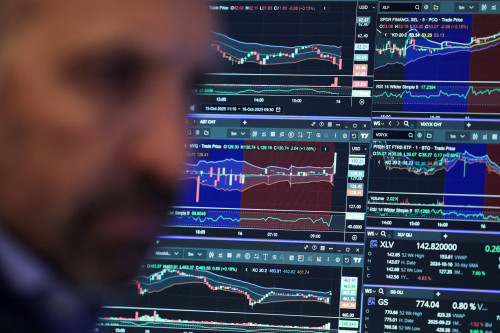
Wall Street stocks jumped following Trump’s comments on a Greenland framework. The Dow Jones Industrial Average rose 1.21%, the S&P 500 gained 1.16% and the Nasdaq Composite added 1.18%. The benchmark S&P 500 registered its biggest daily percentage gain since November 24.
“Markets aren’t rallying because they suddenly understand the endgame in Greenland,” said Matthew Smart, director of financial planning and portfolio analysis at WWM Investments in Chicago. “They’re rallying because uncertainty just got priced out. The signal from Donald Trump coming out of Davos is coordination, not confrontation, and that matters. Pulling back near-term tariffs, while opening a framework with NATO around Greenland tells investors this is shifting from headline risk to negotiation risk.”
MSCI’s All-World index was up 0.87%, after losing ground in the last session, while Europe’s STOXX 600 index finished a touch lower by 0.02%. Britain’s FTSE index added 0.11%.
The VIX index, which measures demand for protection against big swings in the S&P 500, dropped more than 15% to 17, a day after jumping to its highest since November. The index is often used as a proxy for investor nervousness.
“The market bounced when he said we wouldn’t use force,” said Mark Hackett, chief market strategist at Nationwide in Boston. “Following the events of last April, investors are catching on that his negotiating style is very different than past administrations, so uncertainty is a natural outcome.”
The European Parliament decided to suspend its work on a trade deal between the 27-member bloc and the U.S., a parliament member said, following Trump’s repeated requests to take control over Greenland. The European Union will convene an emergency summit in Brussels on Thursday to discuss the matter, with the long-standing U.S.-EU alliance at risk.
“You had the Venezuelan thing, you had Greenland and you had Iran and none of these things seemed to be making a huge dent,” said James St. Aubin, chief investment officer at Ocean Park Asset Management in Santa Monica, California.
“Obviously we had a pretty significant selloff yesterday but in the grand scheme of things it seems the market should have a hard time making new highs and yet it continues to brush off some of these very provocative ideas that Trump likes to throw around.”
BOND PRICES RALLY
The global bond market was still reeling from a brutal selloff, having been caught up in worries over exposure to U.S. assets and a surge in Japanese government borrowing costs.
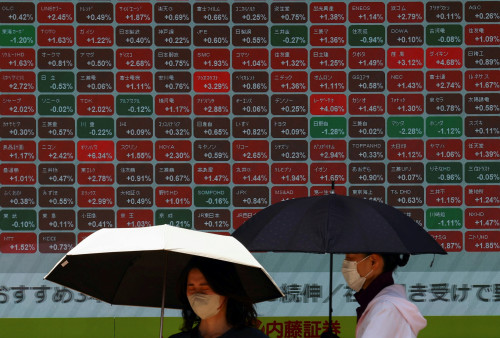
At the epicentre were long-dated Japanese sovereign bonds, which endured their most aggressive selloff in nearly 25 years on Tuesday as fears grew over increased government spending under Japanese Prime Minister Sanae Takaichi.
U.S. 30-year Treasury yields neared the 5% threshold for the first time since September, while German government bond yields also rose sharply.
By Wednesday, Japanese bond prices rallied as buyers returned, almost entirely reversing the previous day’s rise in yields. A similar dynamic played out across U.S. Treasuries, where 30-year bond yields fell 5.1 basis points to 4.8693%. The yield on benchmark U.S. 10-year notes eased 4.4 basis points to 4.251%.
In currency markets, the dollar index, which tracks the U.S. currency’s performance against six others, rebounded from earlier losses and was up 0.25%. The euro pared earlier gains and was down 0.34% at $1.1686, while the Swiss franc fell, leaving the dollar up 0.69% at 0.7954 francs.
The yen was down 0.16% at 158.37 per dollar ahead of a Bank of Japan policy meeting on Friday. No rate hike is expected this time, although policymakers could signal an increase may be coming as soon as April.
Oil prices edged higher. Optimism around tighter supply, after a temporary shutdown at two large fields in Kazakhstan, was offset by expectations of a build in U.S. crude inventories. Brent crude futures settled up 0.49% at $65.24 a barrel.
Spot gold was up 1.11% to $4,815.93 per ounce.
(Reporting by Chibuike Oguh in New York; Additional reporting by Laura Matthews and Chuck Mikolajczak; Editing by Shri Navaratnam, Elaine Hardcastle, Chizu Nomiyama, Nick Zieminski and Edmund Klamann)