
October 2, 2026
E-commerce volumes are straining cargo hubs, and runway-adjacent land is scarce.
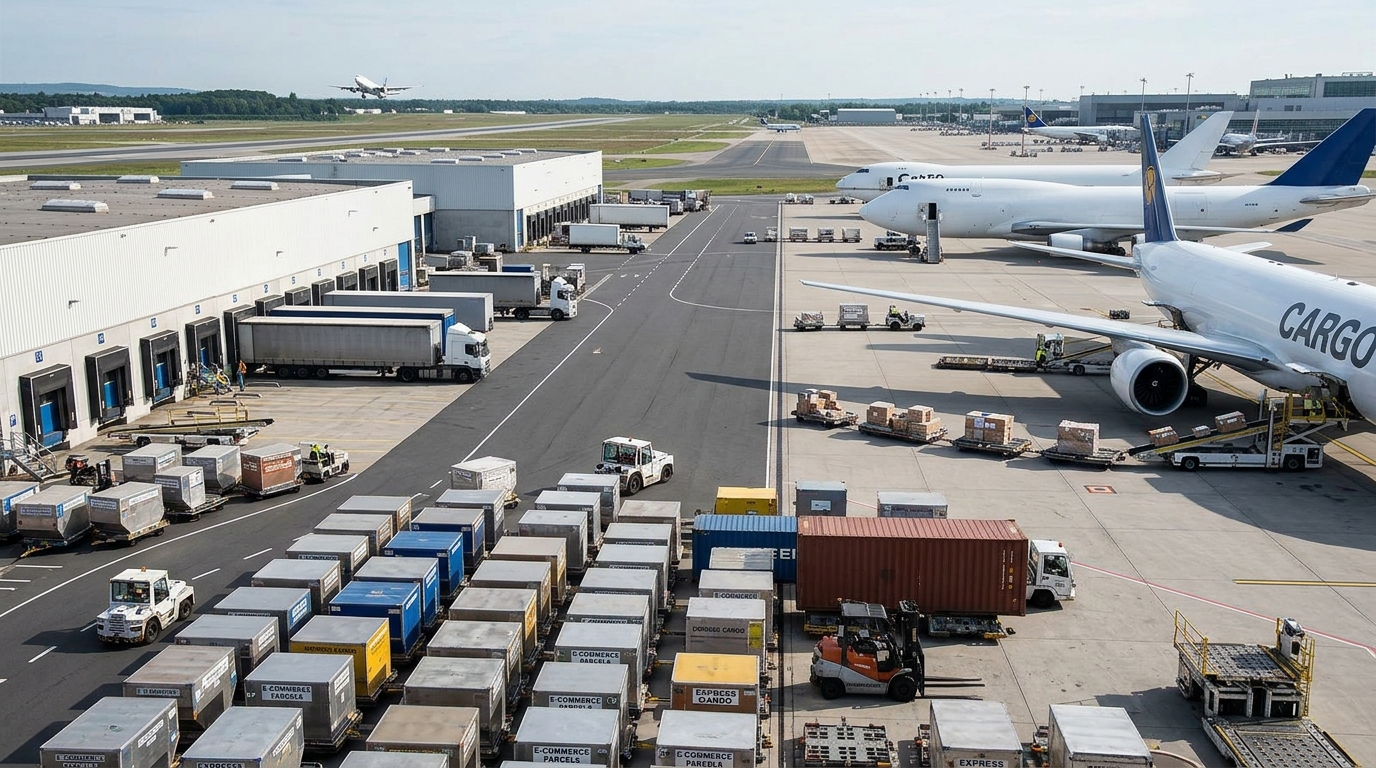
The air cargo industry has a blunt structural problem. The rapid growth of cross-border e-commerce has transformed air cargo demand, exposing infrastructure bottlenecks as airports, customs systems, and ground operations struggle to process high volumes of time-sensitive parcel shipments. Traditional cargo hubs, designed for consolidated freight, are ill-suited to e-commerce’s high-frequency, low-density shipments, leading to congestion, extended dwell times, and weakened last-mile connectivity. That gap between the aircraft and the warehouse dock is where the real estate opportunity lives right now.
“Market Wizard” Who Made Hundreds of Millions for Clients Reveals Two-Rule Strategy
Trading legend reveals how any American can go for their first $1,000 using his simple two-rule system.
E-commerce accounts for roughly 20% to 25% of global air cargo volumes in the mid-2020s, up from the low double digits in the 2010s. Multiple industry forecasts still point to that share pushing toward about 30% by 2027. The volume keeps arriving. The infrastructure does not keep up.
The Rent Signal Is Already There
Industrial rents near JFK Airport have eclipsed $30 per square foot for the first time. Leasing activity in 2025 marked a 63% annual increase, reaching roughly 770,000 square feet. Vacancy rates near JFK fell to about 6.4%, below the city average. No new construction was underway at the time those figures were reported. That combination, high rents, falling vacancy, and no new supply pipeline, is exactly what institutional capital chases.
Industrial rents within five miles of major cargo airports like LAX and DFW can command up to 24% higher rates than the broader market. Logistics and 3PL firms make up over 50% of tenants in airport-adjacent industrial zones. Institutional investors such as Prologis and Terreno have been active buyers in these submarkets, a sign that this is no longer a niche trade.
He Doesn’t Buy Gold. He “Skims” It.
A former hedge fund manager ranked in the top 1% by Barron’s has developed a three-step strategy to profit from gold – without buying a single ounce.
His followers have had the chance to collect $2,975… $3,781… and even $6,786 at a time. With a 73% win rate.
He calls it “Gold Skimming.” And he’s just revealed the full strategy for the first time.
Who Is Building, and Where
The response from major players is visible but slow relative to demand. Prologis, WFS, and Aéroports de Lyon inaugurated a new air cargo handling facility at the CargoPort zone of Lyon-Saint Exupéry Airport in France this week (inaugurated September 29, 2026). Developed by Prologis, the facility integrates directly into the airport’s CargoPort infrastructure. It covers 25,313 square metres of usable floor area on a 52,000-square-metre site.
In the U.S. Midwest, the MKE Air Cargo Center at Milwaukee Mitchell International Airport is being positioned as an alternative to Chicago O’Hare for the international shipping community. The $80 million public-private partnership is expected to deliver about 333,000 square feet of cargo space, with completion expected in fall 2026. The thesis is straightforward: MKE has available warehouse space and excess land that O’Hare lacks.
India is moving faster than most. In February 2026, FedEx broke ground on a fully automated air cargo hub at Navi Mumbai International Airport, describing a ₹2,500 crore long-term investment tied to a proposed 300,000-square-foot facility. By August 2026, FedEx announced plans for another $150 million cargo facility at Delhi’s Indira Gandhi International Airport, designed to increase package-processing capacity from around 600 to 5,000 packages per hour.
The Cautionary Tale Hiding in Liège
Not every airport land bet pays off. Cainiao, the logistics subsidiary of Alibaba Group, cancelled plans to expand its operations at Liège Airport in Belgium. The company indicated it would not proceed with the construction of two additional warehouses planned adjacent to its existing facility, meaning about 44,000 square metres of warehouse space will not be built. The reversal shows that political and regulatory shifts, including trade rule changes on de minimis shipments from China, can strand airport-adjacent real estate bets fast.
One company sits at the dead-center of Elon’s AI takeover…
And James Altucher believes this takeover could mint as many as 1.8 million new “Musk Millionaires.”
It’s not Tesla, SpaceX, or even a company Elon currently owns. It’s a name almost nobody’s talking about – and it still trades for less than $100.
James put the whole prediction into his FREE Millionaire Maker Masterclass… including details on exactly what Elon filed with the FCC and how you can position yourself before December 8.
Where the Supply Constraint Bites Hardest
Some of the biggest cargo airports have started expansion works, but these developments can still take multiple years from plan to usable capacity. In the meantime, e-commerce volumes are increasing quarterly.
That mismatch between build time and demand growth is the core trade. Prologis Research has argued that 2026 conditions still support moderate rent growth, with the path varying by location, size, and quality. In other words, users should not expect a flood of easy options to appear overnight.
The airports with night-flight permissions, permissive zoning, and room to build adjacent warehousing are the scarcest inputs in global logistics right now. Whoever controls that land controls the chokepoint. That is the trade embedded in every ton of cross-border e-commerce shipped by air.