October 23, 2026
Bonus Content: The 10-Year Treasury Hit 5.13%. The Fed Meets in Six Days.
Dear Reader,
Every time oil climbs, most Americans lose.
We feel it at the pump first. Then higher energy and transportation costs can work their way into prices across the economy.
But I believe there is a way to turn part of that squeeze into potential income.
I’m Marc Lichtenfeld, Chief Income Strategist at The Oxford Club. I’ve been featured as an income expert by The Wall Street Journal, Bloomberg and Fox Business.
In November 2021, while the Federal Reserve was still calling inflation “transitory,” I warned it could exceed 8% within 18 months and favored energy. Inflation later reached 9%, and energy became the best-performing asset class of 2022.
See the unusual oil income setup I’m watching now
The obvious response to rising oil is to buy a giant producer. But producers must pay for rigs, crews, transportation, insurance and debt.
My approach is different. The business behind my recommendation participates in production revenue without shouldering those same operating bills.
At the source date, about 73% of its recent oil, gas and natural-gas-liquids revenue came from oil. Its latest quarterly distribution also worked out to a double-digit yield at the September 22 price.
Watch my oil income presentation for free – no email or credit card required
Good investing,
Marc Lichtenfeld
Chief Income Strategist, The Oxford Club
P.S. Oil prices are already moving, so waiting for the next painful fill-up could mean arriving late. See the potential oil-price counterpunch now.
The 10-Year Treasury Hit 5.13%. The Fed Meets in Six Days.
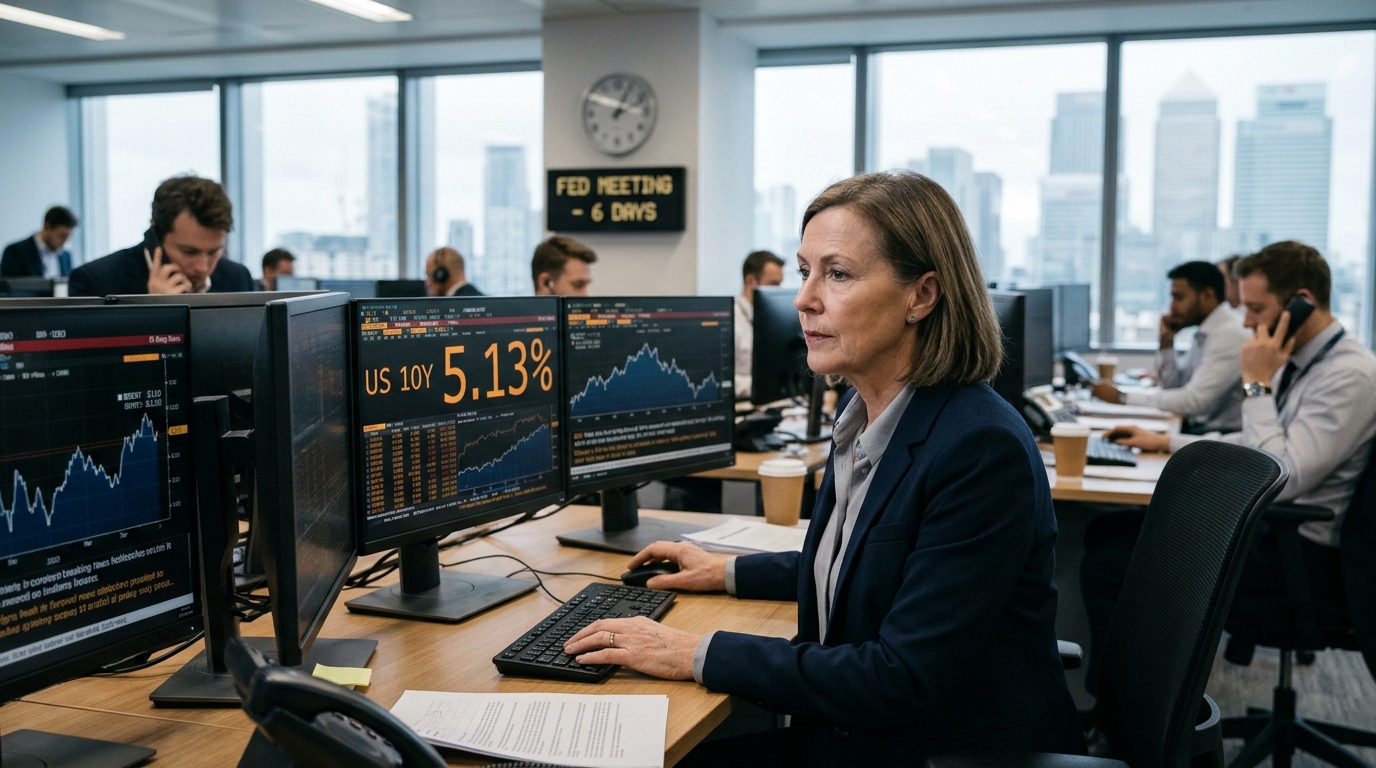
The bond market is doing the Fed’s talking for it. The 10-year Treasury yield closed at about 5.13% on October 21, up roughly 1.2 percentage points from a year ago. Overnight, Brent crude traded above $110 a barrel as Middle East risk premiums widened further. Together those two numbers frame every rate-sensitive trade heading into the FOMC week.
Market Snapshot
- US10Y: 5.13%, up about 1.2 pp year-over-year. The 10-year has traded roughly between about 3.9% and the mid-5% range over the past year, so current levels are closer to the ceiling than the floor.
- Brent crude: Around $111 a barrel, fuelled by supply fears in the Gulf.
- TLT: Bond prices move inversely to yields. With the 10-year anchored above 5%, TLT remains under structural pressure until the rate path shifts.
The Fed Decision That Is Already Priced
The Fed announces at 14:00 ET on Wednesday, October 28. The current target range stands at 3.75% to 4.00%, reflecting the 25-basis-point hike delivered in September, the committee’s first increase since 2023.
October is almost certainly a hold. Prediction markets and Fed funds futures have been pricing a hold as the base case in recent days.
Chair Kevin Warsh has given traders little to work with beyond the data. “I don’t prejudge meetings. I don’t believe in saying now what I might do at the meetings that we have in the balance of this year,” he said in a public conversation with IMF Managing Director Kristalina Georgieva in Bangkok last week. Warsh has taken a deliberately cautious approach to forward guidance, arguing it allows markets to operate on economic signals rather than Fed signals. Some Wall Street economists have taken that as consistent with a pause in October, with the next move more likely to come at year-end.
December Is Where the Risk Lives
The October meeting matters less as a decision event than as a communication one. What Warsh says about December will move more than what the committee votes. In a Reuters poll conducted October 16-20, all 100 economists surveyed anticipated a rate hike at the December 8-9 meeting.
That combination of a heavily priced hold and a chair who refuses to guide is why vol sellers are comfortable today, and why this meeting can still hurt. When the outcome is heavily priced, the market reaction compresses into the statement language and the press conference. Any shift in Warsh’s phrasing around December, inflation tolerance, or the neutral rate is the real trade.
The 10-year yield near 5.13% is not just a bond story. Real rates at these levels are overriding geopolitical risk premiums across asset classes, including gold, which shows how far the Fed’s rate path now dominates even war headlines.
Today’s Jobless Claims: The Last Look
The initial jobless claims report for the week ending October 17 is published this morning at 8:30 am ET. The prior reading was 199,000. Consensus sits near 200,000. Because claims are published so quickly after the reference week, economists and traders use them as an early warning of whether hiring and firing patterns are shifting, well before the monthly jobs report confirms the trend.
After this morning’s release, the Fed is in its pre-meeting blackout period. A claims number that surprises materially in either direction, above 215,000 would sharpen recessionary worry, below 185,000 would revive October hike talk, could move Treasuries and TLT before the quiet period locks in the conditions.
Oil as the Inflation Wild Card
Investors are worried about potential supply disruptions via Saudi Arabia and the Strait of Hormuz. In recent days, Houthi-linked attacks and claims of responsibility for strikes on Saudi infrastructure and airports have added to the risk premium. The US Strategic Petroleum Reserve sits near 283 million barrels, around its lowest level since the early 1980s, limiting Washington’s ability to offset a supply shock. Brent above $110 and climbing keeps headline CPI sticky and December hike odds elevated regardless of what the labour market prints.
The supply picture is more constrained than the headline Brent number suggests. Saudi Arabia’s East-West pipeline outage eliminated the kingdom’s last reliable export bypass around Hormuz, removing the buffer that previously capped how far a Gulf disruption could push prices.
The Cheat Sheet
- Top Market Theme: A near-certain October hold disguises the real question: how far does Warsh signal December at the press conference?
- Asset to Watch: TLT. The 10-year at 5.13% means bond price risk is asymmetric to the upside if claims disappoint and the hold is paired with dovish language; asymmetric to the downside if Warsh reinforces December.
- Biggest Risk: A claims miss above 215,000 complicates the December hike case and could trigger a short-covering rally in TLT that reverses sharply on the statement.
- Biggest Opportunity: December hike odds are already substantial. If Warsh’s statement language is softer than expected on December, the unwind in short bond positions could be swift.
- One Thing to Remember: After 8:30 am today, the Fed goes dark. Whatever the claims number says, it is the last piece of labour intelligence traders get before the October 28 decision. Position sizing ahead of the statement should reflect that information vacuum.