Dear Reader,
I took $57,000 and turned it into $1.87 million in 18 months.*
Not by trading. Not by luck.
By applying the principles of the three-phase system BlackRock uses to manage $14 trillion.
I’m Tan Gera, a CFA® charterholder and ex-Wall Street investment banker.
I spent two years building my own version of BlackRock’s playbook.
The same playbook that generates them approximately $16.1 billion in fees annually.
Their system wasn’t built for retail investors. It required millions in capital. It required institutional access.
So I rebuilt it for digital assets with retail investors and these goals in mind:
1) Protection when markets crash.
2) Income whether they go up or down.
3) Access to opportunities before they go public.
Over 4,500 of our members are using this method now.
It works in just about any market conditions.
I call it the ABN System…
BlackRock’s three-phase framework adapted for everyday investors with $50k+.
If you already hold digital assets, this system could multiply what you’re sitting on right now.
Watch how to copy BlackRock’s $14 trillion playbook →
To your wealth journey,
Tan Gera, CFA
Decentralized Masters
P.S. I took $57k and turned it into $1.87M using my version of BlackRock’s system. Learn the exact three-phase framework I reverse-engineered →
*Results not typical.
DoorDash Is Buying Instacart. The Ad Business Is Why.
When DoorDash announced on October 29, 2026 that it would acquire Instacart for roughly $17 billion, most of the coverage landed on delivery routes and grocery shelf space. The more important angle is what happens to the ad platform.
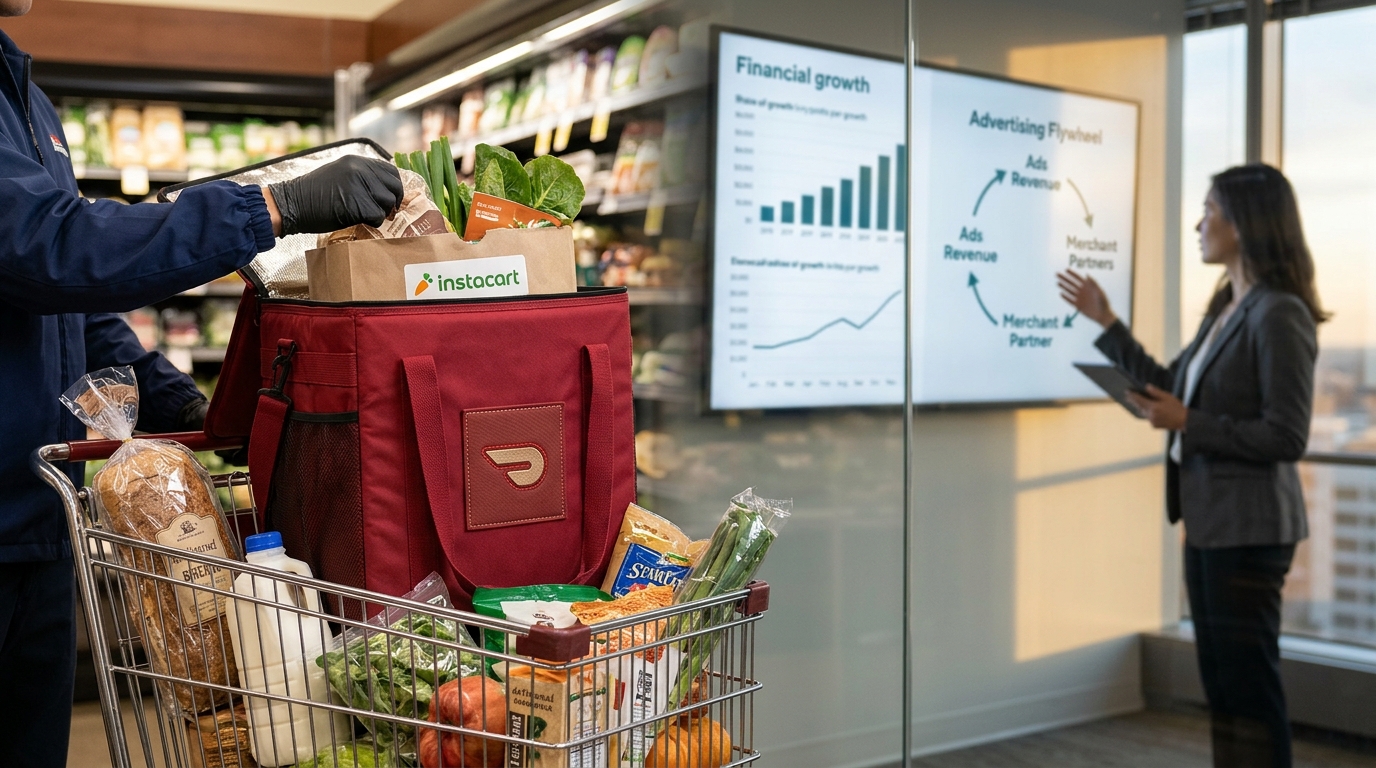
The advertising flywheel is already moving fast. DoorDash and Wolt Ads have said they crossed an annualized advertising revenue run rate of over $1 billion in 2024, serving more than 150,000 advertisers across 30+ countries. By June 2026, that base had scaled to 400,000 advertisers spanning DoorDash, Wolt, and Deliveroo. Advertiser count on its Symbiosys offsite product doubled and spend tripled inside a single year. These are not delivery numbers. They are media company numbers.
The mechanics matter here. DoorDash’s advertising segment expanded rapidly, with Symbiosys delivering particularly strong early traction. Advertiser count doubled and spend tripled, while Smart Campaigns are gaining adoption, opening a higher-margin revenue stream that monetizes both restaurants and emerging verticals. Smart Campaigns are designed for merchants who have to manage many different operational priorities simultaneously.
The grocery gap is the key. Despite strong overall ad growth and maturity in restaurant products, advertising in grocery and retail remains nascent. Management sees substantial upside as these verticals scale and merchants embrace performance marketing, suggesting that ad take-rates and high-margin revenue could rise as the non-restaurant business matures.
That is exactly where Instacart plugs in. The Instacart acquisition would combine DoorDash’s delivery network with Instacart’s grocery technology and relationships with nearly 100,000 stores. Those retailer relationships bring a new tier of CPG and grocery brand ad budgets that DoorDash cannot currently access at scale. The combined company will offer grocers and retailers of every size DoorDash’s delivery network and Instacart’s grocery and fulfillment technology, along with the advertising and AI tools each company has built.
The CPG and restaurant brand opportunity is not theoretical. Starbucks expanded its DoorDash partnership nationwide precisely because delivery orders generated twice the spend of in-store visits.
The base business is not standing still. Q3 2026 revenue increased 34% year-over-year to $4.6 billion. Total orders grew 28% year-over-year, with organic growth of 23% excluding Deliveroo. DoorDash commands about 61% of the U.S. food delivery market, a position that continues to strengthen. That dominance matters for advertisers because it means brands have no credible alternative at this reach level on the platform.
The deal does carry real risk. The American Economic Liberties Project is already pushing regulators to block the deal, arguing it would control an estimated 58% of the U.S. third-party grocery delivery market. The approximately $17 billion transaction could introduce financial and execution risks, requires shareholder and regulatory approvals, and is not expected to close until late 2027 or the first half of 2028.
That runway is long enough to matter. Traders watching DASH over the next session should track two things: any regulatory signaling from the FTC or DOJ on the Instacart review, and Q4 guidance commentary on ad revenue trajectory. The delivery numbers are strong. The ad margin story is what moves the multiple.