From the man who tabbed NVIDIA before it soared 6,271%
over 7 years at its peak
Wall Street’s Hottest Stock Has a Waiting List. Here’s How to Skip It.
Wealthy investors are lining up for Anthropic shares and coming up empty. Tech Visionary, Matt McCall, says you can get into a backdoor opportunity today for less than $100 a share.
Anthropic, the company behind Claude, is set to go public at a record $2 trillion valuation.
It could top SpaceX as the biggest IPO in history.
And right now, almost nobody can buy a single share.
One Wall Street broker, whose firm trades about 1,000 private stocks, told TechCrunch:
“The hardest stock to source in our marketplace is Anthropic. There’s just no sellers.”
Even Goldman Sachs is charging clients 15% to 20% of their profits just for a way in.
The Line Is Out the Door
Meanwhile, people who already own a piece of Anthropic are holding on tight.
While everyone else is stuck in line. Even wealthy investors are struggling to get shares.
And it’s all leading to the most anticipated IPO in history.
When Anthropic finally goes public, millions of regular folks will rush to buy whatever they can get.
But tech legend Matt McCall isn’t getting in line.
“Most people are going to wait for Anthropic to go public and then buy as many shares as possible,” he says. “But I think that’s a huge mistake.”
Who Is Matt McCall?
There is a short list of analysts in America who were early on the AI boom.
Matt McCall is one of them.
He’s the Head Innovation Strategist at Monument Traders Alliance and editor of The McCall Innovation Report.
Over the past two decades, McCall has written about 50 stocks that went on to peak gains of 1,000% or more. Including:
- Tesla, before it climbed as high as 3,129%
- NVIDIA, before it soared a peak 6,271% in 7 years
- AMD, which he singled out in 2009
That’s why people call him “Mr. 1,000%.”
On March 6, 2009, McCall went on FOX Business and gave away nine stocks. One was AMD, trading around two dollars. By 2026 it rose 25,000%, enough to turn a $5,000 stake into more than $1.28 million.
No Waiting List Required
McCall’s play isn’t Anthropic. It’s a stock linked to Anthropic that you can buy right now in a regular brokerage account.
No waiting list. No special broker. No fighting Wall Street for scraps.
He calls it a “Second IPO.”
It may sound too good to be true. But it has happened before.
When Rivian went public in 2021, Ford owned a 12% stake. In the six months around Rivian’s IPO, Ford shares roughly doubled.
Yahoo quietly built a huge stake in Alibaba. In the two years around Alibaba’s IPO, Yahoo shares could have tripled your money.
It happened again shortly after EchoStar acquired $8.5 billion in SpaceX shares. In the months leading up to the SpaceX IPO, its shares soared 600%.
Now it’s happening again!
Anthropic’s “Silent Partner”
Years before the IPO frenzy, a much smaller firm took a $100 million stake in Anthropic. It beat Apple, NVIDIA, Amazon and Google to the punch.
Today, the entire company is valued at less than $15 billion. That’s 100x smaller than Anthropic.
McCall believes its early stake could cause it to double or triple in the years ahead.
And you can buy it for less than $100 a share.
We sat McCall down in front of our cameras to get the whole story. He even gave away the name and ticker.
For the time being, you can watch it free.
|
“If history repeats… investors could double or triple their money in the years ahead.” – Matt McCall
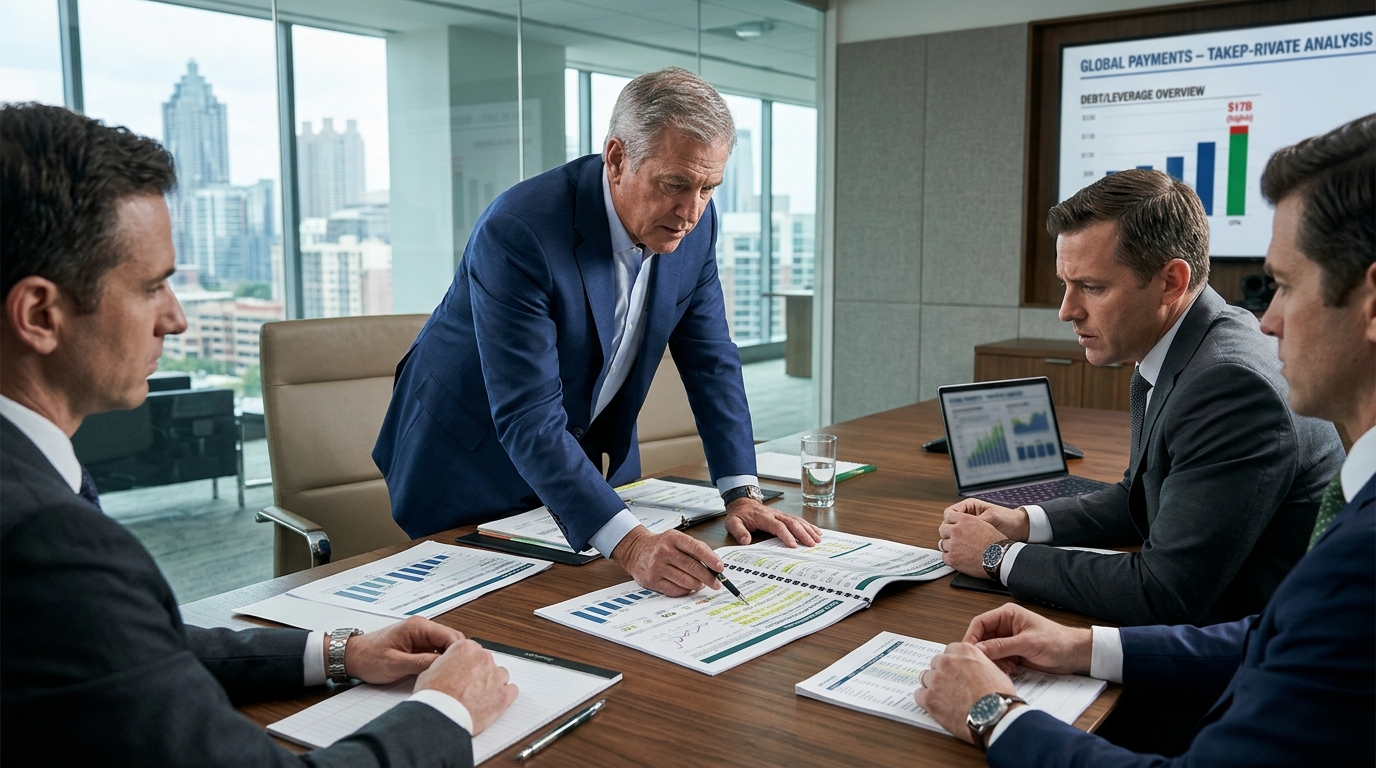
GPN’s $17 Billion Debt Problem Is the Deal Hurdle
When Clayton, Dubilier & Rice’s pursuit of Global Payments broke on October 30, the stock jumped. Shares rose more than 11% after the Financial Times reported that CD&R was pursuing a take-private of the payments processor. That reaction told you something, but not what most people assumed. It told you the market had never been rewarding this company on earnings. It was penalizing it on debt.
Four consecutive quarters of EPS beats could not lift GPN. CD&R’s reported interest arrived with the stock at a depressed earnings multiple and a debt load nearly matching its entire market cap. That is the core tension in this deal, and it has not been resolved.
What the Balance Sheet Actually Says
The company carries an enterprise value of about $40 billion, including debt. Market capitalization sits at roughly $23 billion, with more than $17 billion in net debt making up the remainder. On the Q3 earnings call on November 5, CEO Cameron Bready declined to comment on the buyout discussions. What he did confirm: $870 million in adjusted free cash flow for the quarter, with net leverage ending at 3.4 times.
Management noted that more than 90% of the existing debt is fixed-rate at a weighted average cost of about 4%. That matters enormously. Any LBO financing layered on top arrives at current market rates, not 2021 rates, which means the blended cost of the combined debt stack climbs sharply. Analysts have described the reported interest as credible given GTCR’s significant stake, though they note that Global Payments’ nearly $22 billion of net debt could complicate financing, particularly in a higher-rate environment.
Why GTCR’s Role Is Not Optional
William Blair analysts said a potential transaction appeared credible because GTCR already owns roughly 15% of Global Payments shares at a cost of $97 per share. GTCR acquired that stake through the Worldpay transaction, which reshaped GPN’s ownership and balance sheet simultaneously. Its participation in any buyout group is structural, not cosmetic: the involvement of GTCR suggests alignment among large stakeholders, which could smooth the path to a deal if terms are agreeable.
What GTCR brings is existing equity at a known cost basis and institutional knowledge of the business. What CD&R brings is capital formation capability. A successful buyout at the indicated scale would rank among the largest leveraged buyouts in history, testing appetite among banks and credit investors for the substantial debt required to fund such a transaction.
Bank appetite for underwriting at this scale is not guaranteed. JPMorgan has positioned itself as the leveraged-loan desk most willing to underwrite large buyout debt while rivals remain stuck on prior commitments.
The Synergy Case That Makes the Math Work
The operating story is not broken. Adjusted net revenue rose more than 4% to $3.18 billion and adjusted EPS increased 10% to $3.58, while operating margin expanded 220 basis points to 42.5%. The company also raised expectations for annual run-rate Worldpay integration expense synergies to $650 million. Private equity buyers price on EBITDA and free cash flow, and both are moving in the right direction.
The problem is timing. The $650 million synergy target is to be achieved by the end of 2028. That means a buyer in late 2026 is underwriting savings that fully materialize two years out, while servicing a debt load that starts on day one.
If no deal materializes, GPN reverts to a company trading at a depressed multiple with a consistent beat record the market has declined to reward. That is the floor. The ceiling depends entirely on whether CD&R and GTCR can structure financing that the leveraged-loan market will actually absorb.