July 8, 2026
Micron Is Up 209% This Year. Burry Just Shorted It.
This Pre-IPO Stock is Up 4,000% Already
How do you follow 4,000% valuation growth? By preparing for an IPO.
That’s what Immersed did, reserving the NASDAQ ticker $IMRS. And the real opportunity for investors is now, before public markets do.
Why? Immersed changed the game in AR/VR, developing the Meta Quest store’s most popular productivity app. More than 1.5M people, including Fortune 500 teams, already use it up to 60 hours a week.
But that’s not all. Immersed’s soon-to-be-released Visor headset has 2M more pixels than Apple’s Vision Pro, for 70% less money, and with 70% less weight. No wonder they’re projecting $71M in first-year sales.
Here’s how they’re redefining the $250B+ future of work:
Breakthrough Platform: Immersed built the first full-stack remote productivity system, combining immersive AR/VR software, an AI assistant that works alongside you, and its own lightweight Visor headset to replace the traditional desktop.
Massive Momentum: Immersed is preparing to ship Visor, its first productivity-focused headset, with 75,000+ already on the waitlist. Meanwhile, its AI assistant, Curator, is rolling out new features to deepen user engagement and adoption.
Opportunity: You can join 6,000+ pre-IPO investors who have already secured pre-IPO shares in Immersed’s growth.
They have partnerships in place with Qualcomm and Samsung. Executives and founders from Intel, Reddit, and Sailpoint are shareholders. You can be, too. But there’s no time to waste.
FEATURED
Micron Is Up 209% This Year. Burry Just Shorted It.
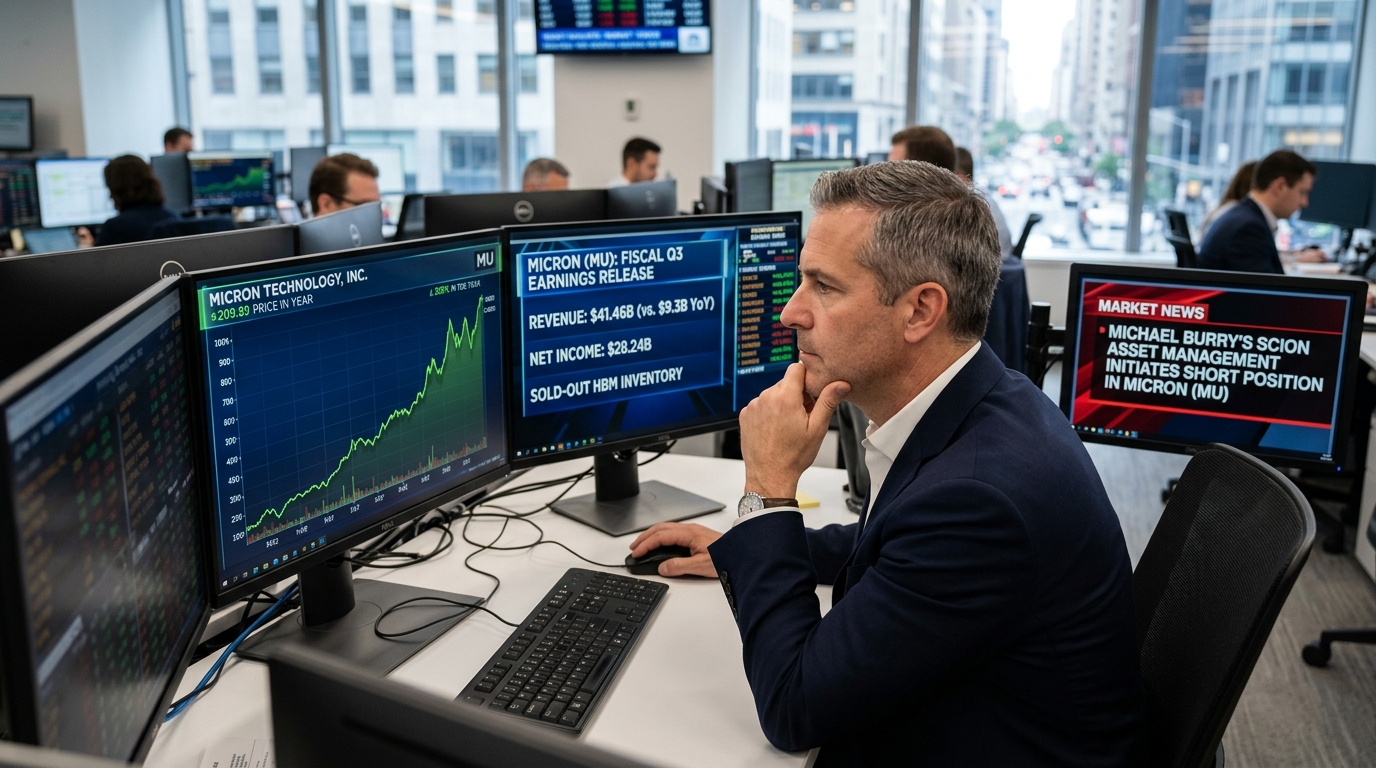
Let’s be honest about what’s happening here. Micron just posted the best quarter in its history. Revenue hit $41.46 billion for the fiscal third quarter, up 346% from the same period a year earlier. Non-GAAP gross margin expanded to a record 84.9%. Operating margin hit 81.2%. Net income came in at $28.24 billion against $1.89 billion in the same period last year. By almost every measure, the business is on fire.
And then Michael Burry shorted it.
On July 2, the man behind the 2008 housing trade disclosed via Substack that he shorted Micron at $1,051.87 per share. He said the puts looked too expensive, so he went short the stock directly and said he would look to add puts if volatility eased. The stock fell about 5.5% on the day of the disclosure, and as of early July it was trading around $938 — down roughly 22% from its late-June peak above $1,200.
Why Burry Is Bearish
Burry’s argument isn’t really about the current quarter. It’s about what always happens next in memory. He says Micron is the clearest example of boom and bust in the entire chip sector, pointing to 34 drawdowns of more than 30% over the past 42 years. His cited figures: median return on invested capital of 4%, median return on equity of 7%, and free cash flow negative roughly 48% of the time historically.
He also flagged something specific: Micron’s stock is currently more extended above its 200-day moving average than at any point since 1984, including the dot-com peak. That’s the kind of stat that gets his attention. His read is that the AI/HBM rally reflects investor FOMO, not a permanent structural shift in Micron’s earnings power.
Slight tangent worth noting here. Micron isn’t the only name in Burry’s AI short basket. On June 30, just two days before the Micron disclosure, he revealed short positions in Nvidia, Applied Materials, Caterpillar, Tesla, and the SOXX semiconductor ETF. This isn’t a single-stock call. It’s a sector-wide bet that AI infrastructure stocks are priced for a future that may not arrive on schedule.
What the Bulls Are Looking At
The counterargument is straightforward. Micron has said its HBM supply is sold out into 2026, with tight conditions expected to persist beyond 2027. Management guided Q4 revenue to $50 billion at the midpoint — another record — and projected gross margin of approximately 86%. That’s not a business about to roll over.
Micron has also signed 16 multi-year Strategic Customer Agreements. Fourteen of those 16 include cumulative minimum contract revenue of approximately $100 billion over the remaining agreement terms, and the company expects to receive about $22 billion in customer deposits and financial commitments. These are take-or-pay structures, which is meaningfully different from how memory contracts have worked historically.
“My system said ‘SELL’ right before this stock tanked. Today, I’m shouting ‘BUY NOW’ before it soars.”
In 2023, Marc Chaikin’s system flashed bearish on an automotive company no one had yet heard of. The stock crashed 35%. Today, his system rates this company “Very Bullish” and Marc calls it a screaming buy thanks to a new “groundbreaking partnership” with Nvidia that hands this company the keys to the self-driving kingdom on a silver platter.
UBS has said the recent pullback in Micron’s stock looks temporary given that fundamentals remain strong. The Anthropic partnership adds another layer: Micron is Anthropic’s primary memory and storage supplier for next-generation AI systems, and the two companies are co-developing HBM and storage technologies. Micron also made a strategic investment in Anthropic’s latest financing round.
On the Q3 earnings call, management emphasized that DRAM and NAND industry demand continues to significantly exceed supply, and that tight conditions are expected to persist beyond calendar 2027. Adjusted free cash flow for the quarter came in at $18.3 billion — a quarterly record.
The Complication Landing This Week
There’s a third factor entering the picture on July 10. SK Hynix is scheduled to begin trading on the Nasdaq as an ADR under the ticker SKHY. The company revised its target raise to approximately $28.2 billion after its Seoul stock price pulled back in recent weeks — still one of the largest share sales in history. That listing creates a direct comparison trade for American investors. Capital rotation is a real near-term risk, and it puts pressure on MU precisely when Burry’s short is already adding negative sentiment. SK Hynix holds roughly 57% of global HBM revenue, making it the dominant player in the market Micron is trying to grow into.
There’s also an active class-action lawsuit alleging DRAM price fixing involving Samsung, SK Hynix, and Micron. Neither of those factors is disqualifying on its own. But both add headline risk if earnings growth slows even slightly.
Forward Scenarios
- Bull: HBM pricing holds, long-term agreements absorb any macro volatility, and MU reclaims resistance at $1,014 on the way to $1,090. Analyst consensus targets suggest meaningful upside over 12 months, with some price targets above $1,480.
- Base: MU consolidates in the $930 to $1,050 range through summer as the SKHY listing and Burry sentiment weigh on the stock, before Q4 results in September reset expectations.
- Bear: South Korea semiconductor capex plans accelerate oversupply fears, HBM spot pricing softens, and Burry’s cyclical argument starts gaining traction. A sustained break below $930 opens a deeper correction toward the next major support zone.
Trump’s Favorite AI Energy Stock??
It’s wildly profitable – Over $3 billion in operating income. It has a partnership with the hottest AI stock on Wall Street.
And Trump has publicly backed it?
Technical Overlay
MU is currently trading around $938, down roughly 22% from its all-time closing high of $1,213 set on June 25. RSI is in technically oversold territory, and the stock is showing positive divergence at the current trendline. Key resistance is $1,014. A sustained close above that level is the first real confirmation the pullback is over. The 200-day moving average is well below current prices, meaning the longer-term trend remains intact despite the recent selloff.
What Investors Should Watch
- SK Hynix Nasdaq ADR listing on July 10 and how capital flows around it
- HBM spot pricing and any shifts in hyperscaler capex commentary
- Antitrust lawsuit developments
- Q4 earnings, currently expected in September, and any updates on 2027 and 2028 contract terms
- Whether Burry adds puts to his position as options volatility normalizes
Here’s what this really comes down to. Burry is making a cyclical call against a company that is, right now, structurally different from the one he’s describing. Long-term take-or-pay agreements, record margins, and sold-out inventory are not the hallmarks of a business about to crater. But Burry has been early on cyclical calls before, not wrong. The question is whether the AI memory cycle is permanent or just very extended.
That answer won’t come this week.