July 6, 2026
The LNG Boom Has a Toll Booth Nobody Is Watching
First a note from Stansberry Research
Editor’s Note: Marc Chaikin, the 60-year Wall Street legend who called Nvidia before it soared 45,000%, just came forward with another huge opportunity he’s spotted in the AI space. While the media is caught up in “SpaceX fever” right now, the under-the-radar event Marc reveals below could give you access to three brand-new AI IPOs in a rare deal known as a “starburst.” You may never get a chance to take part in one of these again in your life… and while it’s speculative, Marc urges readers to get in before July 22nd while everyone’s attention is elsewhere…
Dear Reader,
A tech firm that’s been called “the unseen winner of the AI race” could soon break itself up into three separate companies.
The next Netflix…
The next Tesla…
And the next Amazon are all poised to spin off just from this one stock.
That would create a once-in-a-lifetime opportunity for investors who buy shares in the company before it happens.
Buy shares of this stock before July 22nd, and you could get the same amount of free shares automatically deposited in your account for each spinoff.
Meaning, 10 shares could turn into 30 shares overnight.
And you could wake up with the world’s newest, hottest tech disruptors all sitting in your account – with no extra work on your part.
Believe me, when it happens, it feels like magic, but it’s actually something called a “starburst.”
This brilliant type of spinoff is especially rare in the tech industry.
And if the starburst announcement goes public (and it hasn’t yet), it’s going to be all the media talks about for a while afterward.
This potential “starburst” is my No. 1 recommendation for how average folks can set themselves up to benefit from what I’m calling AI’s “jump to lightspeed” moment.
Sincerely,
Marc Chaikin
Founder, Chaikin Analytics
P.S. In 2021, GE announced a starburst when the stock traded at just $67 per share. They rolled out the deal in stages, and when it was done, shareholders owned three companies instead of just one. The share prices on those once they were individually valued? $75… $300… $614… That means that one starburst unlocked $184 billion for investors. I predict this potential AI starburst will be orders of magnitude larger. And I believe this stock could see a major jump in share price on July 22nd. Get the details when you click here…
The LNG Boom Has a Toll Booth Nobody Is Watching
Trading Cheat Sheet: AROC
- Ticker: Archrock (NYSE: AROC)
- What it does: Largest U.S. outsourced natural gas compression company. Controls 35% of the market. Runs 4.53 million horsepower across Permian, Haynesville, Northeast, and Rockies basins.
- Core thesis: Every cubic foot of U.S. gas heading to LNG export or through a new pipeline must be compressed first. Archrock is the dominant provider of that function and is structurally positioned to benefit from the U.S. LNG buildout.
- Key numbers: 2025 revenue $1.49B | 2025 adjusted EBITDA $901M | Q1 2026 EBITDA $221M (+12% YoY) | 2026 guidance $865M-$915M EBITDA | Fleet utilization above 95%
- Primary catalysts: Five new U.S. LNG export projects ramping through 2027 | Qatar supply disruption redirecting global demand to U.S. Gulf Coast | 44.9 Bcf/d of new U.S. pipeline capacity coming online 2026-2027 | Supply chain moat from 160-week Caterpillar equipment lead times locking out new competition
- Geographic edge: Nearly 60% of revenue from Permian Basin, which is now the center of the entire U.S. gas export buildout. Q1 2026 bookings also showed diversification into Northeast, Mid-Continent, and Rockies.
- Key risks: Oil price weakness slowing Permian drilling | $2.4B in debt (2.6x leverage, nearest maturity 2032) | Long-term shift toward electric motor drive compression | Lube oil cost headwinds flagged for H2 2026
- Time horizon: Medium to long term. The LNG infrastructure buildout runs through at least 2027-2028. The Qatar capacity loss compounds the demand picture for three to five years.
What If the Rising Prices at the Gas Pump Paid YOU?
Every time you fill up, someone’s getting rich, and it’s not you. A former hedge fund manager has a way for regular folks to come out ahead when oil and gas prices climb. Anyone can do this – without buying oil stocks.
In March 2026, Iranian missiles struck Qatar’s Ras Laffan Industrial City, home to the world’s largest LNG export complex. Two specific liquefaction trains — Trains 4 and 6 — were damaged in the attacks, taking roughly 17% of Qatar’s export capacity offline. QatarEnergy has declared force majeure on long-term contracts covering buyers in Italy, South Korea, Belgium, and China, and the CEO has said repairs will take three to five years. Qatar accounts for about 20% of global LNG supply. That capacity is not coming back quickly.
The market’s immediate reaction was to bid up LNG shipping rates and cheer the U.S. Gulf Coast producers. That’s the first-order move. And it’s already crowded.
But stop there for a second. Because what almost nobody has worked through is what happens three steps downstream from that headline.
The Force Acting on Everything
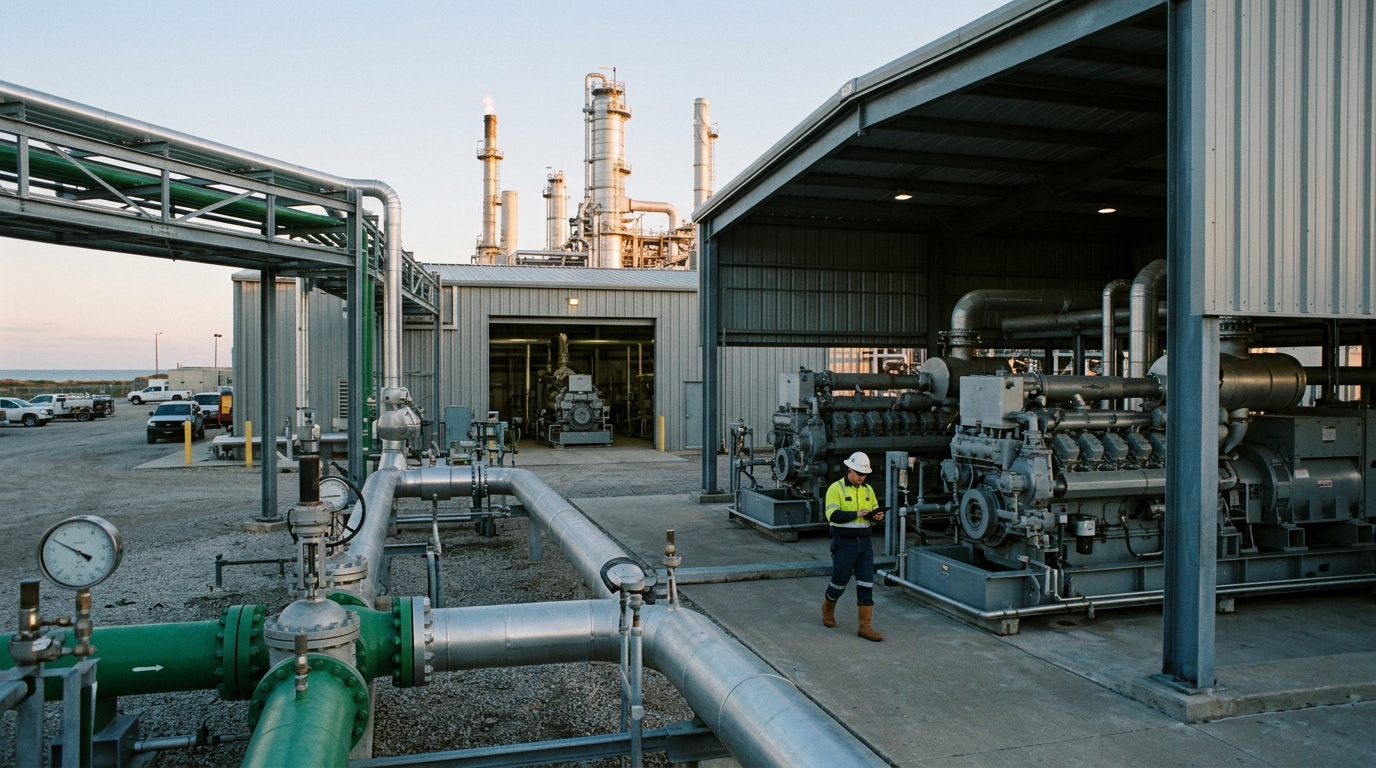
Before a molecule of natural gas reaches an LNG terminal, a pipeline, a power plant, or a data center, it has to be compressed. Multiple times. That is not optional. It is physics. Gas does not move through pipelines at sufficient pressure without compression. It does not get gathered, processed, or transported without it.
Now layer in what is actually happening in the U.S. right now. The EIA forecasts that U.S. LNG exports will continue increasing as five LNG export projects start operations and ramp up through end of 2027. Net exports of U.S. natural gas are projected to grow 18% to 18.7 Bcf/d in 2026, with LNG exports rising 1.9 Bcf/d to average 17.0 Bcf/d.
That is not a projection someone invented. Over 100 bcm per year of new liquefaction capacity was sanctioned in 2025, marking the highest year for LNG final investment decisions on record. And the cycle has continued into 2026, with additional U.S. projects reaching final investment decisions through early June.
More exports require more gas. More gas requires more pipelines. More pipelines require more compression. That chain is not debatable.
This Is What Modern Warfare Looks Like Now
One operator controlling multiple drones… AI identifying targets in seconds… Technology is rapidly changing the battlefield and creating new opportunities in defense.
This exclusive research highlights five companies at the forefront of this shift and explains why they are gaining attention.
The Bottleneck Everyone Is Missing
Here is the part Wall Street keeps skipping over. The Permian Basin has a well-documented problem: natural gas production there has been outpacing takeaway capacity, leading to negative prices at the Waha hub and real infrastructure bottlenecks. Major pipeline projects like Hugh Brinson and Blackcomb aim to add capacity by late 2026, while operators are adapting strategies to manage constraints amid rising LNG and power generation demand.
Permian Basin natural gas production has roughly doubled since 2018 to around 25 Bcf/d, and more than 66% of the roughly 44.9 Bcf/d of new U.S. natural gas pipeline capacity expected to come online in 2026 and 2027 originates in Texas.
Slight tangent, but it matters: even the pipelines coming online as a fix to the bottleneck do not eliminate compression demand. They create it. New pipeline miles mean new compression stations. Every new segment of steel in the ground is, by definition, a new compression contract waiting to be signed.
The infrastructure buildout is not the thing to own. It is the demand signal for the company one layer deeper.
The Company Nobody Leads With
You will not see this stock on the cover of Barron’s. It does not build LNG terminals. It does not drill wells. It is not a pipeline operator. It sits exactly one step behind all of them.
Archrock (NYSE: AROC) operates the largest outsourced natural gas compression platform in the U.S., focused on contract compression for midstream and E&P customers. As of early 2026, the company controls roughly 35% of the U.S. outsourced natural gas compression market. Operating horsepower stood at 4.53 million at the end of Q1 2026, with fleet utilization holding above 95%.
That market share number deserves a moment. 35% of an entire essential infrastructure category. Not 35% of a niche. 35% of the function that allows every cubic foot of U.S. natural gas to move anywhere.
Full-year 2025 revenue came in at $1.49 billion, up from $1.16 billion in 2024. Adjusted EBITDA for 2025 reached $901 million, beating the top end of guidance. Nearly 60% of revenue derives from the Permian Basin, with heavy exposure to the Delaware and Midland sub-basins.
And here is what is interesting: that Permian concentration used to feel like a single-basin risk. It is now the opposite. The Permian is the center of the entire U.S. gas export buildout. Archrock’s geographic weight is now its biggest structural advantage.
The Numbers Worth Reading Carefully
Q1 2026 earnings came out May 5th. No fireworks. No headline. Adjusted EBITDA hit $221 million, up 12% year over year and in line with guidance. Revenue was $373.8 million. Management reaffirmed full-year 2026 guidance and signaled increased newbuild deliveries in the back half of the year.
Archrock is guiding 2026 to adjusted EBITDA of $865 million to $915 million, with growth capital expenditures of $250 to $275 million expected to add roughly 170,000 horsepower to the fleet.
Two things buried in the earnings call that matter more than the headline numbers.
First: supply chain tightness is becoming a moat. Caterpillar equipment lead times are now out to approximately 160 weeks — with Archrock placing multi-year orders to secure capacity and limit customer risk from supply constraints. 160 weeks is more than three years. Any new entrant trying to compete for compression contracts in a rising-demand environment cannot get the equipment to do it. Archrock already has the horsepower in the field.
Second: the demand is no longer just Permian. Only 35% of bookings in Q1 2026 were from the Permian, with growth coming from the Northeast, Mid-Continent, South region including East Texas and Haynesville, and the Rockies.
That is a business diversifying its demand base while its core market accelerates. Those two things almost never happen at the same time.
Why This Is Not Consensus
Here is the honest answer to the question Wall Street is missing.
The LNG story gets covered through the terminals. Cheniere, NextDecade, Venture Global. Those are the names in the headlines. The pipeline buildout gets covered through midstream names like Kinder Morgan and Energy Transfer. Those are the names in the infrastructure funds.
Compression is invisible. It sits between both stories. It is not glamorous. It does not have a geopolitical angle or a construction milestone that generates a press release. It is compressors in West Texas and the Gulf Coast and the Haynesville, running 24 hours a day, making everything else possible.
Meeting growing LNG export demand requires significant investment in pipelines and related infrastructure, with more than $35 billion expected to be spent through 2027 on natural gas infrastructure alone, representing roughly 7,500 miles of new pipeline capacity.
Every mile of that 7,500 miles needs compression. Archrock is the largest provider. The stock is not priced like that math has been run.
The Rare Earth Stock Boom: Even Bigger Gains Could Hit Soon
Tiny rare-earth miners are exploding: 200%, 300%, even 500% gains in just months. But while everyone piles into the same names, I’ve uncovered the next wave of this $3 trillion resource story…a breakthrough that could make today’s miners obsolete. I’m expecting the big announcement any day now.
What Could Go Wrong
The honest risks here are real. Oil price weakness could slow Permian drilling, and associated gas production comes with it. If crude softens enough, producers pull back, and compression demand growth flattens. Management flagged lube oil pricing as a potential cost headwind in the back half of 2026. Not a catastrophe, but worth watching.
The balance sheet carries $2.4 billion in debt at roughly 2.6x leverage. In January 2026, Archrock issued $800 million of senior notes to refinance notes due 2028, pushing the nearest bond maturity out to 2032. The refinancing was clean. The maturity runway is not an immediate concern. But leverage is leverage, and in a higher-rate environment that matters.
The third risk is the one that is hardest to quantify: electric motor drive compression is growing. The late-2024 TOPS acquisition added over 500,000 horsepower of electric-motor drives, opening access to large E&P customers focused on cutting emissions. Archrock is adapting. But the long-term shift from gas-driven to electric compression is a real structural question the market will eventually price in more aggressively.
The Derivative Math
Here is the chain, laid out clearly.
- Qatar loses roughly 17% of export capacity for three to five years, with full repairs contingent on replacement gas turbines that face two to four-year lead times
- Global LNG demand redirects to U.S. Gulf Coast terminals
- U.S. LNG exports forecast to average 17.0 Bcf/d in 2026 and grow further through 2027
- Five new LNG projects ramping simultaneously drive feedgas demand
- Over 44 Bcf/d of new U.S. pipeline capacity coming online in 2026 and 2027
- Every Bcf/d of new gas movement requires compression infrastructure
- Archrock controls 35% of the U.S. outsourced compression market with a fleet nobody can replicate in under three years
That is a fourth-derivative play on the Qatar conflict. And it has a ticker that CNBC has not mentioned once in connection with that story.
The business is working. The macro is moving in the right direction. The supply chain constraints are a moat disguised as a problem. And the stock trades like a midstream utility nobody has thought twice about.
That gap between what this company does and how it is being priced is the whole point.
This Is the Early Side of the Gold Cycle
Gold is having its moment again.
Central banks are buying. Analysts are raising forecasts. Investors are looking for protection as the usual risks pile up.
But the supply side is where the story gets interesting.
Major new gold discoveries are becoming harder to find. Mature regions have been drilled for decades. And when gold cycles heat up, attention rarely stays with the obvious names forever.
It starts with the producers.
Then it moves deeper.
Earlier-stage projects. New districts. Active exploration. The places where the next round of supply might actually come from.
One small explorer is now drilling in Oceania, a frontier region still known for large, undeveloped and high-potential mineral systems.
The gold cycle may already be pulling attention in that direction.
Meet the company drilling where gold attention is shifting: