August 23, 2026
AVGO’s $16B Test Is 10 Days Out
The Marvell-Google deal just complicated the picture.
First a note from The Oxford Club
Reader,
If my math is correct, what I’m about to reveal here could generate as many as 410 new millionaires a day.
It’s a brand-new project I call “The Presidio Initiative.”
And the window to get in early is open right now.
I will explain everything in a short video…
I’ll even tell you a way to invest in this right now with a 100% FREE recommendation revealed in the video.
Yours in smart speculation,
Bryan Bottarelli, Co-Founder
Monument Traders Alliance
P.S. Billionaires are already backing this mega-project. Including Elon Musk. According to one respected futurist (and New York Times bestselling author): “Twenty-trillion-dollar checks (are) waiting to be cashed.” But nobody is talking about this quite like what I will show you…
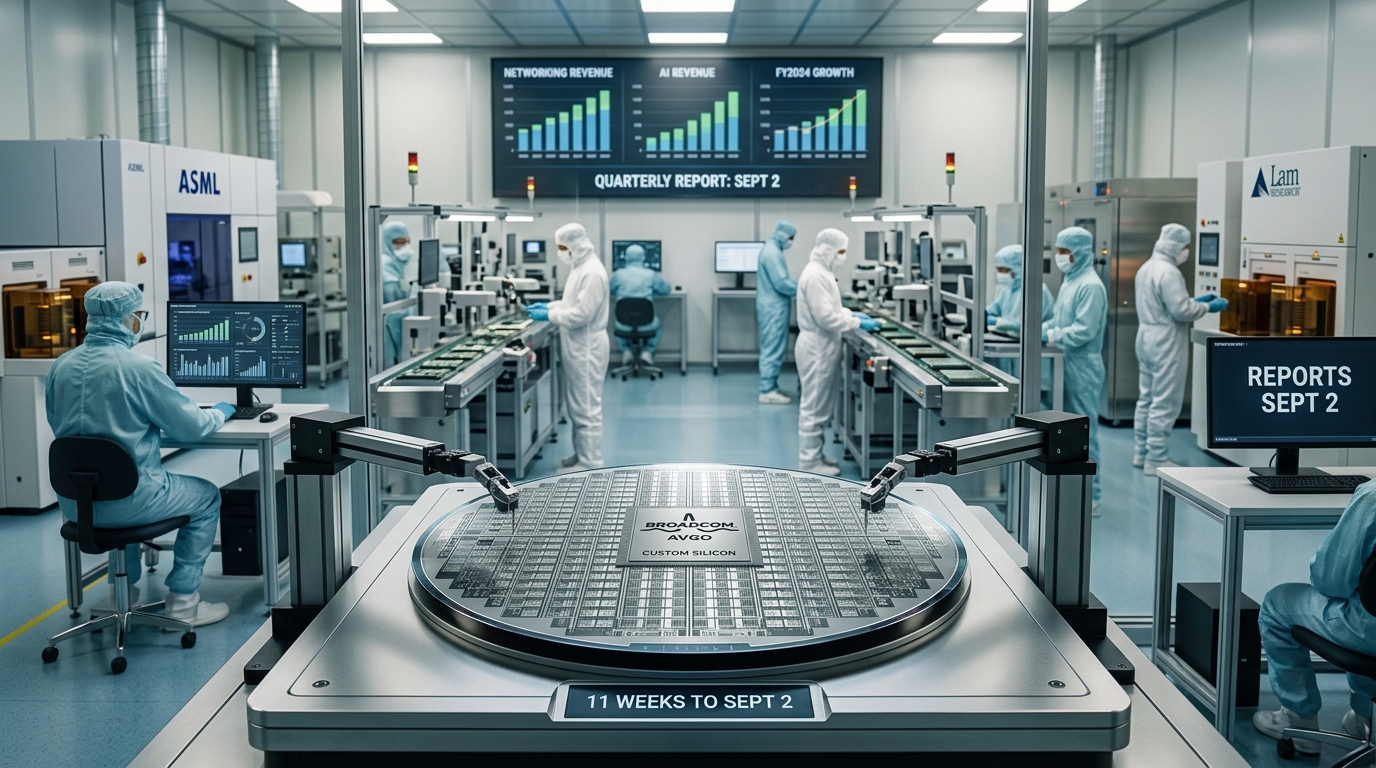
The GPU war gets all the headlines. The custom silicon war is where the real money is moving, and Broadcom (NASDAQ: AVGO) has been winning it quietly for three years. September 2, ten days from now, is when the market decides whether to believe the scoreboard.
There is a new wrinkle this week. On August 19, Marvell Technology disclosed an expanded custom chip agreement with Google that sent Marvell up nearly 10% and knocked Broadcom down roughly 4.6% in the same session. Broadcom closed that day at $362.48 and has since recovered to the $368 range. The question the September 2 earnings call must answer has sharpened: is Broadcom’s Google franchise durable, and can $16 billion in quarterly AI revenue arrive on schedule despite a louder competitive landscape?
Market Snapshot
The broader market is steady heading into the final week of August. The S&P 500 sits near 7,741, the Nasdaq near 26,492. The VIX has settled around 15.56, a reading that reflects calm rather than complacency. The dollar index holds at 99.70, crude oil trades near $76.24 a barrel, and gold remains elevated. Bitcoin has been range-bound in recent sessions.
The Federal Reserve held rates at 3.50% to 3.75% at its July 28-29 meeting, though the vote was 9 to 3, with three regional presidents dissenting in favor of a hike. That level of internal division has not been seen since 2016. Jackson Hole runs August 27-29 this week. Chair Kevin Warsh’s keynote on Friday morning is drawing close attention from bond traders weighing the September 15-16 FOMC decision.
Inflation has cooled from May’s 4.2% CPI reading, with July coming in at 3.4% year-over-year. The 2% target remains out of reach. That backdrop has not stopped hyperscalers from committing to record capital expenditure. Alphabet raised its 2026 capex guide to $195 to $205 billion from $180 to $190 billion on July 22. Microsoft, Amazon, and Meta are running parallel buildouts. The collective four-company 2026 capex is tracking toward roughly $725 billion, up approximately 77% from 2025. That spending must flow somewhere. A meaningful share flows to Broadcom.
Sector rotation has favored healthcare and financials in recent weeks. AI infrastructure names sold off through July and into early August, recovered partially, then took another hit from the Marvell-Google headline on August 19. AVGO closed at $368.45 on August 21, with an intraday range on August 23 between $365.05 and $375.12. The 52-week range runs from $287.17 to $495.00. The all-time intraday high of $495 was set on June 3, the same day the company reported Q2 results and the stock subsequently fell 12.6% in the same session.
Stocks in Focus
Broadcom is the primary focus. But two adjacent names are directly relevant to how this story develops over the next ten days.
- AVGO: Reports Q3 FY2026 results September 2 after the close. Management guided Q3 AI semiconductor revenue to $16 billion, up over 200% year-over-year, and total revenue to approximately $29.4 billion, up 84%. The stock sits 26% below its June 3 all-time high. Forty-nine analysts hold a Strong Buy consensus with an average 12-month price target of $526.30, implying roughly 43% upside from current levels.
- MRVL: Reports earnings August 27, one week before Broadcom. Marvell’s Google deal, potentially worth up to $120 billion in cumulative revenue through fiscal 2033 per Reuters, will be dissected on that call. The numbers Marvell attaches to the Google relationship will set the tone for how investors read Broadcom’s competitive position heading into September 2.
- GOOGL: The hyperscaler at the center of the week’s biggest AVGO-related development. Alphabet extended its TPU partnership with Broadcom through 2031 in April, then disclosed the Marvell agreement in August. Both relationships can coexist. Whether the market prices it that way is a different question.
Cathie Wood bought the August 20 dip, adding to AVGO alongside Cerebras and Rocket Lab shares per a TipRanks report. BMO Capital issued Buy ratings on AVGO, NVDA, MRVL, MU, and AMD this week, calling Nvidia a top pick but keeping Broadcom on the list. The analyst community has largely pushed back against concentration fears triggered by the Marvell-Google deal.
Company Deep Dive
Broadcom is two businesses under one ticker. The first designs XPUs, Ethernet switches, and co-packaged optics for hyperscale AI clusters. The second is an enterprise software company anchored by VMware, which runs the private cloud infrastructure of most of the Fortune 500.
CEO Hock Tan calls it a two-engine model. VMware Cloud Foundation generates recurring software cash flow that funds the XPU roadmap without straining the balance sheet. XPU wins deepen relationships with the same hyperscalers buying VMware subscriptions. The attachment rate compounds in both directions, and the infrastructure a hyperscaler builds on Broadcom silicon is not easily migrated.
The Q2 FY2026 results, filed with the SEC, showed revenue of $22.187 billion, up 48% year-over-year. GAAP net income rose 88% to $9.31 billion. Adjusted EBITDA was $15.244 billion at a 69% margin, above guidance and up 52% from a year earlier. Cash from operations was $10.493 billion for the quarter, and free cash flow reached $10.262 billion, representing 46% of revenue. Non-GAAP EPS of $2.44 beat the $2.40 estimate.
AI semiconductor revenue is the number traders are watching. Q1 FY2026 came in at $8.4 billion, up 106% year-over-year. Q2 reached $10.8 billion, a 143% increase. For Q3, management guided to $16 billion, which would represent over 200% growth from the same quarter a year ago. That is also more than the $12.2 billion Broadcom reported in all of fiscal 2024 combined.
- Q3 FY2026 revenue guidance: approximately $29.4 billion, up 84% year-over-year
- Q3 AI chip revenue target: $16 billion, representing over 200% year-over-year growth
- Fiscal 2027 AI revenue target: in excess of $100 billion
- Q2 AI bookings: over $30 billion, extending revenue visibility into 2028
- VMware Infrastructure Software Q3 guide: approximately $8.9 billion
- Free cash flow, Q2: $10.262 billion, or 46% of revenue
- Analyst consensus: Strong Buy, 49 analysts, average 12-month price target $526.30
The customer roster has expanded materially in 2026. Google has been the anchor, with a TPU co-design partnership extended through 2031 in April. In June, OpenAI and Broadcom jointly unveiled Jalapeño, OpenAI’s first custom inference chip, the first in a planned multi-generation platform. Broadcom, Apollo, and Blackstone established a $35 billion XPU financing platform to support Anthropic’s data center buildout using Broadcom custom chips. Bloomberg reported in August that Broadcom is in discussions to raise over $60 billion in additional debt financing to support chip procurement for Anthropic, OpenAI, and other AI customers.
One Date – November 27 – Could Reset the American Economy for Good
A $10 TRILLION shift is moving through Washington, D.C. Forensic accountant Joel Litman believes those who understand it before November 27 have a rare opportunity to avoid disaster and get positioned early.
The networking layer adds a second revenue stream most investors undercount. Broadcom’s Tomahawk 6 Ethernet switch, shipping in production volume at 102.4 terabits per second, and its Jericho fabric products together accounted for roughly 40% of Q2 AI semiconductor revenue. This is how Broadcom captures dollars from GPU clusters and XPU clusters alike. It gets paid on the pipes regardless of which accelerator wins the compute war.
VMware is further along than many investors acknowledge. Broadcom ended perpetual license sales post-acquisition and moved the business to subscription. In fiscal Q4 2025 commentary, management cited an infrastructure software operating margin of 78%. The recurring revenue base is already funding the AI hardware roadmap at scale.
Catalyst Calendar
- Aug 26, NVDA earnings: Nvidia reports Q2 results after the close. Any forward guidance on data center demand, supply, or pricing will directly influence how investors read the AI infrastructure spending cycle heading into Broadcom’s report.
- Aug 27, MRVL earnings: The first major read on the Google custom chip deal. Marvell will provide the economic framing for an agreement that rattled AVGO shareholders last week. The language management uses will either calm or amplify customer concentration fears.
- Aug 27-29, Jackson Hole: Chair Warsh’s first keynote as Fed chair. Bond market reaction to any shift in the rate trajectory will affect valuation multiples across the technology sector, including AVGO.
- Sep 2, AVGO earnings: Q3 FY2026 results after the close. Conference call at 2:00 p.m. Pacific, 5:00 p.m. Eastern. The $16 billion AI revenue guide and the $29.4 billion total revenue target are the two numbers that decide the market’s reaction.
- Sep 15-16, FOMC meeting: The next Federal Reserve rate decision. The outcome, shaped in part by Jackson Hole, will influence risk appetite for high-multiple technology stocks in the weeks following Broadcom’s report.
Technical Radar
AVGO closed at $368.45 on August 21. The August 23 session ranged from $365.05 to $375.12. The 52-week low is $287.17 and the all-time intraday high is $495.00, set June 3.
- Key support: $362 to $365, the level where the stock bottomed after the August 19 Marvell-Google selloff. A break below $340 would retest the lower end of the post-June trading range and shift short-term momentum decisively negative.
- Key resistance: $380 is the first level to reclaim after this week’s action. $395 to $400 represents the July consolidation range ceiling. Above that, $420 was the early August high before the Marvell headline interrupted the recovery.
- Trend context: AVGO is down roughly 24% to 26% from its June 3 all-time high, underperforming the Nasdaq over the same period. Relative strength has weakened materially since June, but the stock has held above the $360 range on two separate tests.
- Pre-earnings IV: Implied volatility in AVGO options typically expands in the final week before earnings and compresses sharply after the report regardless of direction. The June 3 session, where the stock fell over 12% on a beat-and-no-raise, is the reference point for sizing pre-earnings options exposure.
Risk Radar
- Customer concentration: A significant portion of AVGO’s AI semiconductor revenue flows from a small number of hyperscalers. The Marvell-Google deal disclosed August 19 has sharpened this risk in the market’s mind. No Broadcom project cancellation has been disclosed, and Broadcom’s Google TPU partnership runs through 2031. But Google is now funding a second custom silicon partner, and the market has repriced that reality.
- The $16B delivery risk: The Q3 AI guide of $16 billion came in below some analyst estimates of $17.2 billion at the time of Q2 earnings. That gap contributed to the post-Q2 selloff. If September 2 produces another shortfall relative to a number analysts have since revised upward, the reaction could mirror or exceed June’s 12.6% drop.
- VMware churn: Broadcom has focused on the top 2,000 global enterprise accounts and ended perpetual license sales. Aggressive subscription pricing has pushed some customers toward alternatives. VMware infrastructure software missed some analyst estimates in Q2. A second sequential miss would weaken the narrative around the software engine that funds the AI roadmap.
- Supply chain: Broadcom flagged foundry capacity at advanced nodes as a potential bottleneck for custom accelerator production. The Samsung MOU signed in July, covering high-bandwidth memory and 2-nanometer manufacturing through 2030, is partly a hedge against this. It remains a memorandum of understanding, not a firm order.
- Macro and policy: Jackson Hole and the September FOMC carry rate-path implications for high-multiple AI names. Three Fed dissenters voted for a hike in July. Any hawkish signal from Warsh this week could widen the pressure on technology valuations before September 2.
- Debt and financing exposure: The Wall Street Journal reported August 17 that nine major technology companies carry roughly $3 trillion in off-balance-sheet commitments tied to AI. Broadcom’s own debt-to-equity ratio of 71.5% is elevated relative to peers. The scale of the financing ambitions around Anthropic and OpenAI chip procurement, over $60 billion per Bloomberg, adds leverage risk to the model if AI spending decelerates.
The Cheat Sheet
Top Market Theme: Hyperscaler AI capex is accelerating, but the custom silicon supply chain is diversifying. Broadcom built its premium valuation on near-exclusive hyperscaler relationships. The Marvell-Google deal is the first meaningful signal that exclusivity is softening at the edges. September 2 is the first earnings call where management must address that dynamic directly.
Stock to Watch: AVGO. The combination of a verified $29.4 billion revenue guide, a $16 billion AI chip target that would exceed all of fiscal 2024’s AI revenue in a single quarter, a multi-year backlog extending into 2028, and a 26% discount to the June all-time high makes this the highest-signal earnings event in the semiconductor space this cycle. Ten days.
Sector to Watch: Custom AI silicon. The Marvell-Google deal has reframed the sector from a single-winner dynamic to a multi-supplier competition for hyperscaler dollars. That is not necessarily bad for the sector’s total addressable market, but it does change how individual names should be valued on concentration assumptions.
Biggest Risk: Google customer concentration, freshly tested by the Marvell deal. If Marvell’s August 27 earnings call quantifies the Google relationship in a way that implies meaningful Broadcom share loss, AVGO could enter its own September 2 report with a more skeptical audience than any prior quarter.
Biggest Opportunity: A clean September 2 delivery. If Broadcom posts $16 billion or better in AI semiconductor revenue, reaffirms the fiscal 2027 $100 billion target, and provides language that contextualizes the Marvell-Google development without alarming investors about Google TPU share, the gap between $368 and the $526 analyst average price target represents a significant compression trade for investors willing to hold through the volatility.
One Thing to Remember: The June selloff was a sentiment event triggered by a beat-and-no-raise. The stock dropped 12.6% on results that were objectively strong. At $368, the stock has already absorbed that punishment and a second hit from the Marvell headline. Position sizing, not directional conviction, is the risk management framework that survives what comes next on September 2.
Trading Cheat Sheet is for informational and educational purposes only. Not investment advice. Trading involves risk, including the possible loss of principal.