
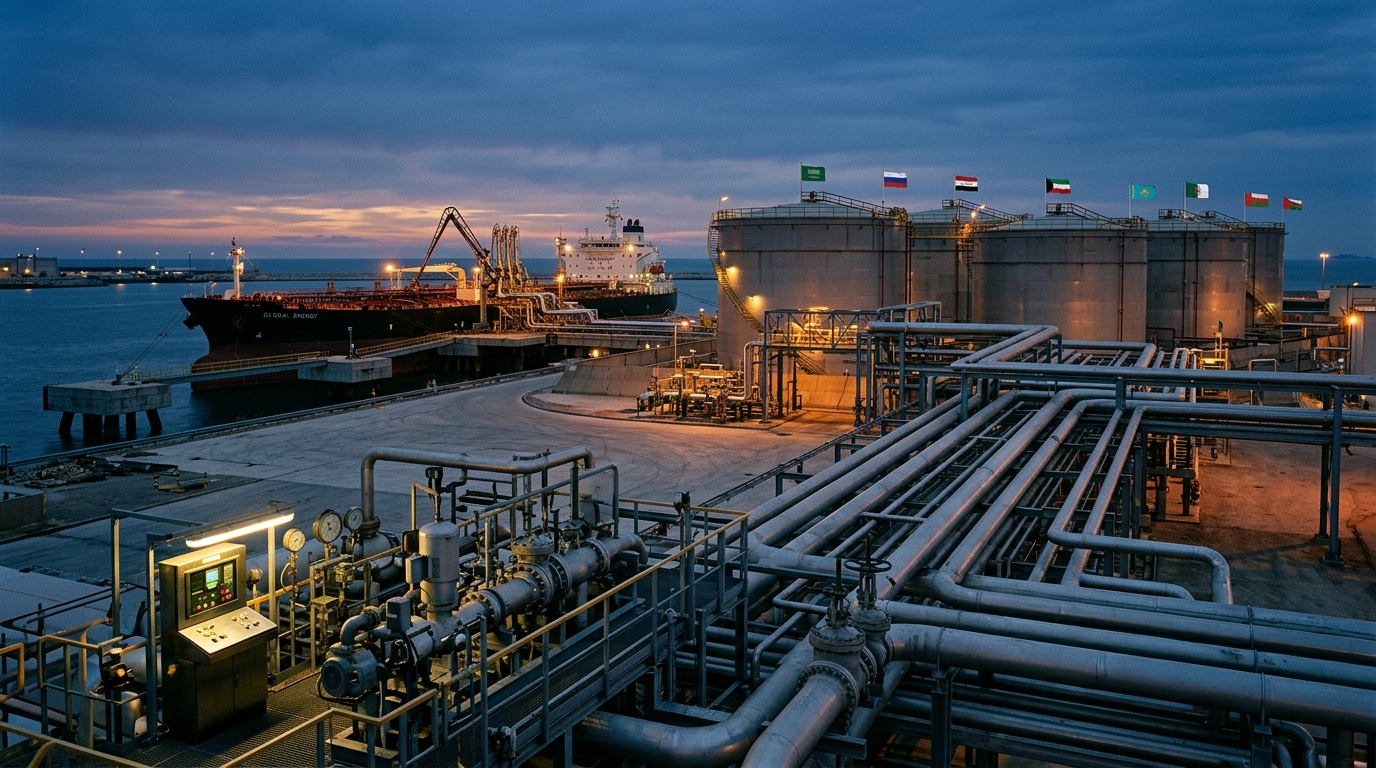
Sunday’s decision was framed as caution. Read it as an admission.
Seven OPEC+ countries, including Saudi Arabia, Russia, Iraq, Kuwait, Kazakhstan, Algeria, and Oman, agreed after a virtual meeting on September 6 to keep October production levels unchanged from September, citing market stability. That ends a run of monthly quota increases earlier this year. The official statement offered nothing on November or December. The next meeting is October 4.
The consensus interpretation is bullish: the group stepped back from flooding the market, Brent is near $97, and the geopolitical risk premium tied to the Strait of Hormuz has no obvious off switch. Hold oil into the next meeting. Simple enough.
Except the consensus is pricing the pause as a choice. The more interesting possibility is that it was partly a constraint.
The Quota-Production Gap No One Talks About
The October freeze follows OPEC+’s completion of a phased rollback of its 1.65 million barrel-per-day voluntary production cut, which concluded with the September 2026 quota adjustment.
The countries have been increasing monthly production quotas for much of this year, although actual output has lagged the planned increases, with wars in Iran and Ukraine disrupting exports from the Gulf, Russia, and Kazakhstan, limiting the extent to which higher quotas translated into additional supply.
Despite official production hikes, actual output across the alliance has lagged targets. A separate, broader set of OPEC+ cuts totaling 2 million bpd, first introduced in 2022, remains in place through December 31, 2026.
So the group froze October at 31.01 million bpd on paper while real delivery to market sits well below that number. The freeze is less a hawkish supply decision than an acknowledgment that there is no easy incremental barrel to release right now anyway.
The 2027 Fight Is the Actual Story
What sophisticated energy investors are watching is not October. It is what happens when DeGolyer and MacNaughton delivers its capacity audit.
Texas-based DeGolyer and MacNaughton, which is carrying out the capacity review for most members, is expected to submit its report to OPEC at the end of September. The assessment could set the stage for difficult negotiations before new baselines are agreed at the group’s year-end meeting, with some members including Iraq pushing for higher quotas to reflect increased production capacity.
The new quota framework will be based on audited Maximum Sustainable Production Capacity, defined as the level of output a country can sustain for a year and bring onstream within 90 days, replacing a patchwork of historical baselines long criticized as misaligned with actual capability.
Iraq believes its audited number will be higher than its current allocation. Saudi Arabia’s quota reflects years of voluntary cuts, not capacity ceiling. The outcome of this process could materially reshape the internal power dynamics of the alliance, as members with capacity assessments that differ significantly from their current quota entitlements may push for adjustments that alter the group’s overall production ceiling. That is the negotiation that will define oil supply through 2027 and beyond, and the October 4 meeting lands just days after the DeGolyer report arrives.
Stocks to Watch
Saudi Aramco carries the largest single block of spare capacity in the world. One April 2026 assessment put Saudi Arabia’s spare capacity at roughly 3 million bpd, with production sitting near 9.1 million bpd at the time. How Aramco’s audited capacity is classified in the new 2027 framework determines how much the Kingdom can produce without violating the next round of quotas. A higher certified ceiling is a direct earnings catalyst.
ExxonMobil (XOM) and Chevron (CVX) benefit from the opposite dynamic. Brent was trading near $97 on September 7. Both companies generate meaningfully higher free cash flow above $90 Brent, and neither is exposed to the quota compliance risk that hangs over OPEC members. At current prices, upstream margins for both are running near multi-year highs.
XLE and USO are the blunter instruments. Some of the geopolitical risk premium is already priced in, with traders monitoring Chinese imports, OPEC+ decisions, and Hormuz developments. If the October 4 meeting delivers a surprise increase driven by internal pressure from Iraq or Kazakhstan ahead of the baseline audit, both funds would absorb the selloff first and fastest. That is the near-term risk the freeze does not eliminate.
The October pause buys time. Whether OPEC+ uses it to prepare a coherent 2027 framework or to paper over a capacity argument that is already fracturing internally is the question that matters more than any single monthly quota decision.