October 11, 2026
Bonus Content: Flocean One Is Producing Water. The Cost Math Has Changed.
Fellow Investor,
Most traders don’t know it, but there’s a window of time every day that has a history of predictable price movements…
And I’ve developed a way to profit from them.
I’m not talking about picking up a few bucks here or there…
The kind of money you can make with my strategy is truly astonishing.
In fact, one user who I’ll call Jim, let me know he made…
$6,702 in his first month
$4,710 in his second month
$12,475 in his third month.
Now, of course, I can’t promise you’ll have the same level of success…
But it wouldn’t shock me one bit if you did… or even made more than that…
Because Jim raked in those paydays without having any special advantages over you…
Or any other regular trader.
Discover how to get in on the action here.
To your investing success,
Dave Aquino
Partner, Base Camp Trading
Flocean One Is Producing Water. The Cost Math Has Changed.
For decades, coastal desalination carried one inescapable penalty: enormous electricity consumption. A conventional seawater reverse osmosis plant can require roughly 3,500 kilowatt-hours to produce an acre-foot of fresh water. That cost is now under direct challenge, not from a laboratory prototype but from a working plant sitting 500 meters under the Norwegian Sea.
What crossed the threshold in June
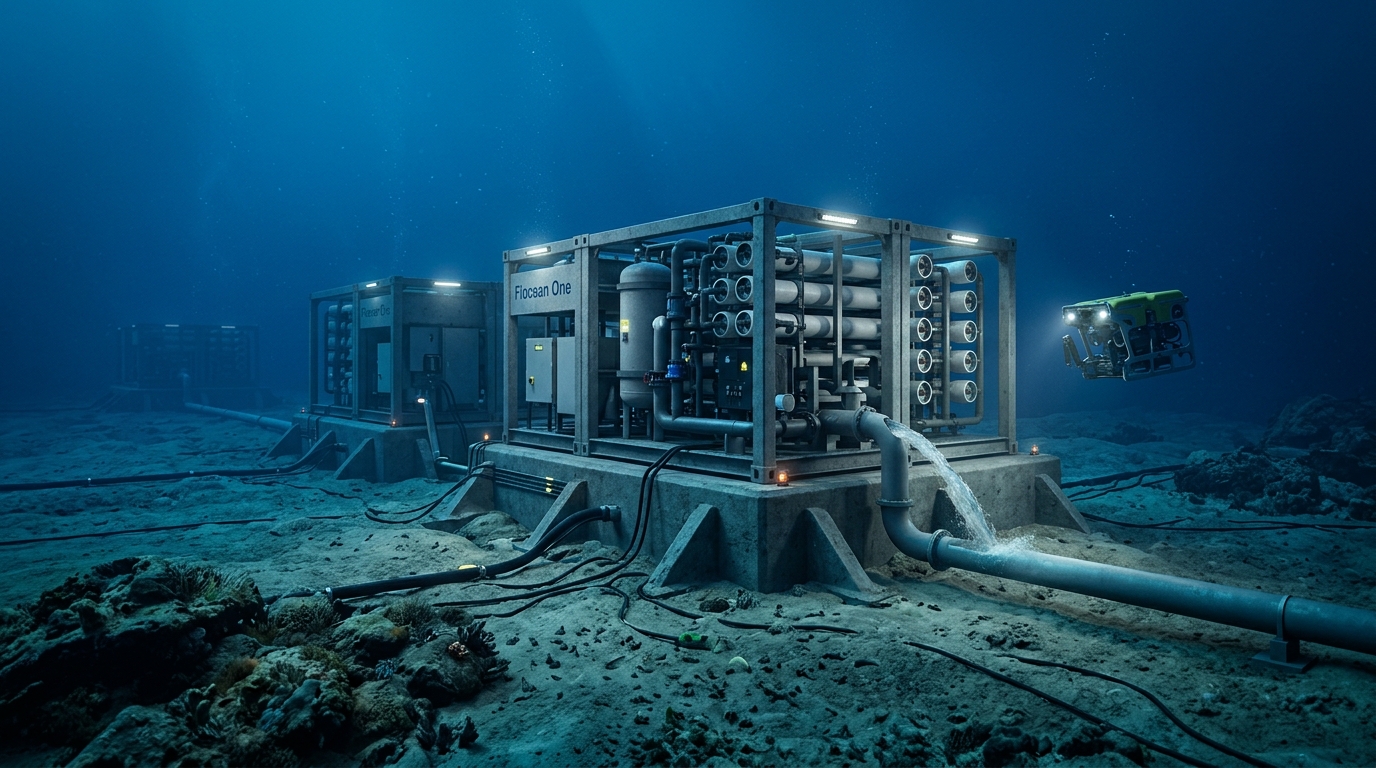
Flocean One, an industrial-scale subsea desalination system deployed at 500 meters depth off Norway’s west coast, achieved first water and is now producing freshwater at full capacity. The milestone matters commercially, not just technically. Until that point, financing conversations rested on test-site data and engineering modeling. An operating reference at full capacity changes the calculus, giving customers and capital providers the performance evidence that long-dated infrastructure deals require.
The physics driving the economics are straightforward. Reverse osmosis pods are submerged to depths of around 500 meters, where immense hydrostatic pressure does the hard work of separating water from salt. Purified water is then pumped back to shore. Unlike a coastal plant that must pump larger quantities of seawater, the subsea system pressurizes and pumps a smaller quantity of fresh water to shore, reducing energy costs by about 40%.
Where the capital is moving
Flocean is not the only firm racing to prove this out. Oslo-based Flocean, Waterise, and American OceanWell are all developing systems for deep-sea desalination. On the U.S. side, OceanWell plans to deploy roughly 60 of its modular subsea pods to a depth of about 400 meters, mounted to the ocean floor in Santa Monica Bay, off the coast of Malibu. OceanWell estimates its energy cost at approximately 2,250 kilowatt-hours per acre-foot of fresh water, compared to around 3,500 kilowatt-hours for today’s commercial onshore desalination plants.
Investor confidence is building. Flocean expanded its Series A to $22.5 million, adding Xylem Inc. as a strategic investor alongside Burnt Island Ventures, Freebird Capital, Katapult Ocean, and Nysnø Climate Investments. OceanWell separately secured $11 million in Series A funding, backed by Kubota Corporation. Xylem’s involvement is the more consequential signal: a Fortune 500 water infrastructure company does not take a strategic stake in a startup to get exposure to a concept. It takes a stake when it sees a distribution channel.
The angle the energy math misses
Flocean says its approach eliminates chemical pre-treatment, avoids coastal brine discharge by diffusing waste deep below sensitive ecosystems, and can cut capital cost per capacity unit by up to 8x in Western markets. That reduction in coastal land use also compresses permitting timelines, which have historically been the single longest lead item for conventional plants.
Flocean has paired the milestone with a development pipeline of more than fifteen projects, including agreements with Alver municipality in Norway and WaterConnect for the Maldives. The Maldives contract is worth watching: island nations with no aquifer access and steep diesel power costs are the clearest early market, and winning one at scale creates the reference asset that unlocks the next dozen.
The seabed plant is no longer a thought experiment. It is a funded, operating infrastructure class with a commercial pipeline and a Fortune 500 backer. Traders following water infrastructure should be tracking Xylem’s posture here more closely than the startup headlines.