October 12, 2026
Bonus Content: China’s sCO2 Turbines Are Running. The U.S. Is Permitting.
Hey,
With the Fed hiking rates for the first time since 2023, I thought I’d share this free gift with you.

Hurry, you’ll want to put this strategy into action this week.
In your corner,
Dave Aquino
Base Camp Trading
China’s sCO2 Turbines Are Running. The U.S. Is Permitting.
The race to replace steam with supercritical CO2 has a scoreboard, and the U.S. is not leading it.
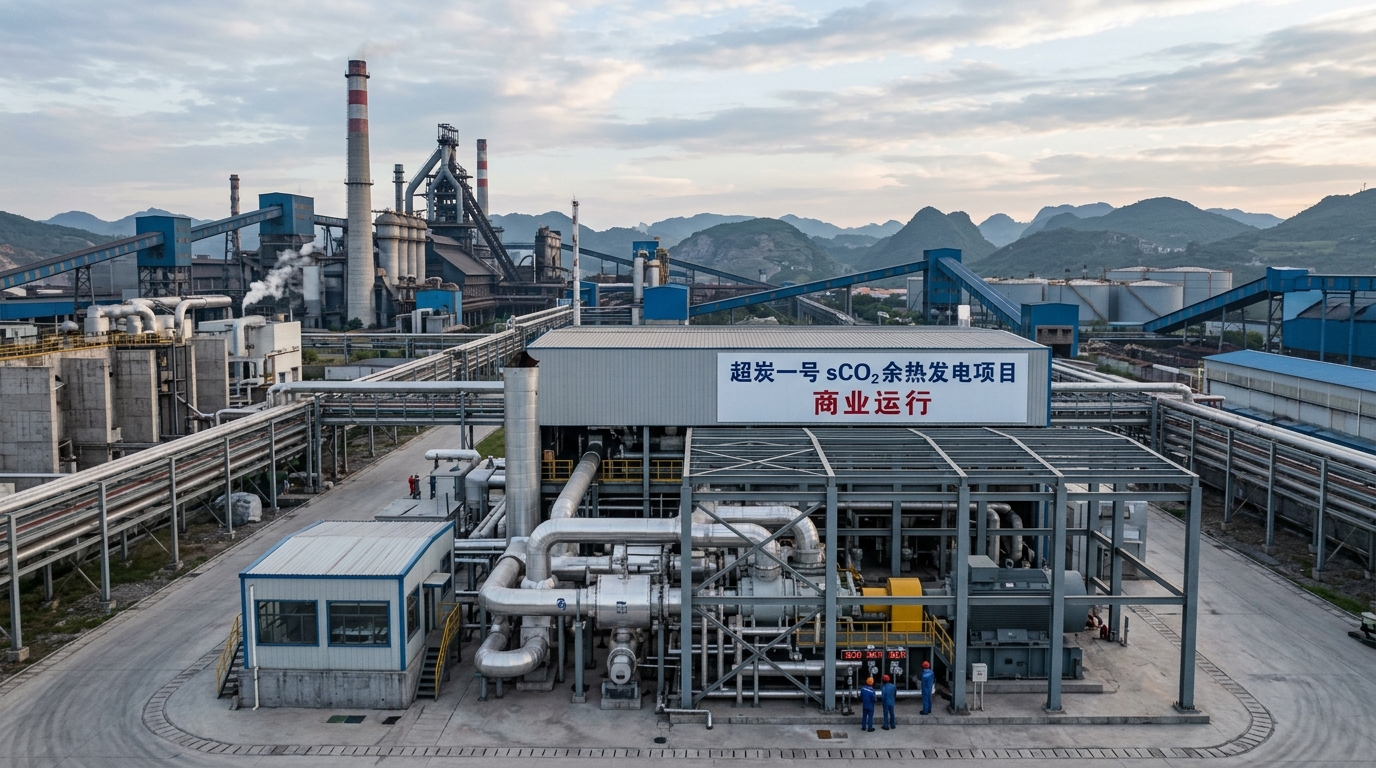
On December 20, 2025, China’s state-owned China National Nuclear Corporation began commercial operation of the first unit of Chaotan One, a 2×15 MW supercritical CO2 waste-heat power generation project, at a steel plant in Liupanshui, Guizhou Province. The second 15 MW unit was connected to the grid on May 30, 2026. The project converts waste heat into grid-connected electricity and, according to CNNC and Chinese state media, delivers over 85% higher generation efficiency and more than 50% higher net power output versus conventional waste-heat steam systems. That efficiency claim deserves skepticism, because long-term operational data barely exists, but the first-mover fact is not in dispute.
Meanwhile, NET Power’s utility-scale Allam-Fetvedt cycle project near Odessa, Texas, has slipped. In filings and investor updates, NET Power has guided to commissioning “between the second half of 2027 and the first half of 2028,” citing long lead times for critical components. The project was originally positioned to be online much sooner.
That gap matters beyond national pride. Whoever commercializes sCO2 machinery at scale first controls the component supply chain: the high-pressure heat exchangers, the compact turbomachinery, the specialized seals. China’s Chaotan One reflects a long development effort, but the more investable question is whether it holds up over years of continuous industrial use. If it does, Beijing’s manufacturers sit at the front of a very large queue.
The Retrofit Angle Traders Are Missing
The more immediate market opportunity is not the greenfield sCO2 plant. It is the retrofit.
Echogen, which builds sCO2 bottoming cycles for existing simple-cycle gas turbines, has mapped the addressable base. Using Orennia data, the company identified roughly 127,500 MW, nearly 95% of the U.S. simple-cycle gas turbine fleet, as potentially eligible for an sCO2 bottoming cycle. Total U.S. simple-cycle capacity stood at 136,074 MW as of May 31, 2026, based on U.S. Energy Information Administration data. Approximately 20% of that addressable pool sits in the older Frame 7E fleet alone.
The economics are what make this tradable. sCO2 turbomachinery is far smaller than equivalent steam equipment, which allows skid-mounted, modular deployment in under two years. Echogen estimates its systems deliver 30% to 50% more output from the same turbine and a 10% to 20% reduction in levelized electricity cost versus a comparable steam bottoming cycle. No new water treatment. No turbine halls. No years-long construction.
For comparison, GTI Energy’s STEP Demo in San Antonio achieved 4 MW of grid-synchronized power at 27,000 RPM during Phase 1 testing in 2024, supporting the case that the cycle can run at meaningful speed and load at the indirect-fired scale.
What Traders Should Watch
The sCO2 cycle is not a single product. Chaotan One recovers industrial waste heat. The Allam cycle burns natural gas in pure oxygen and uses the resulting CO2 as the working fluid, capturing its own emissions. Echogen bolts onto existing gas turbines. These are three different value chains, and they come with three different risk timelines.
The retrofit market is the most actionable in the near term, but it is also pre-revenue at scale. The technology’s durability under continuous commercial load is still an open question, and Chaotan One is now running that test in real time. The answer will arrive well before any U.S. utility-scale plant does.