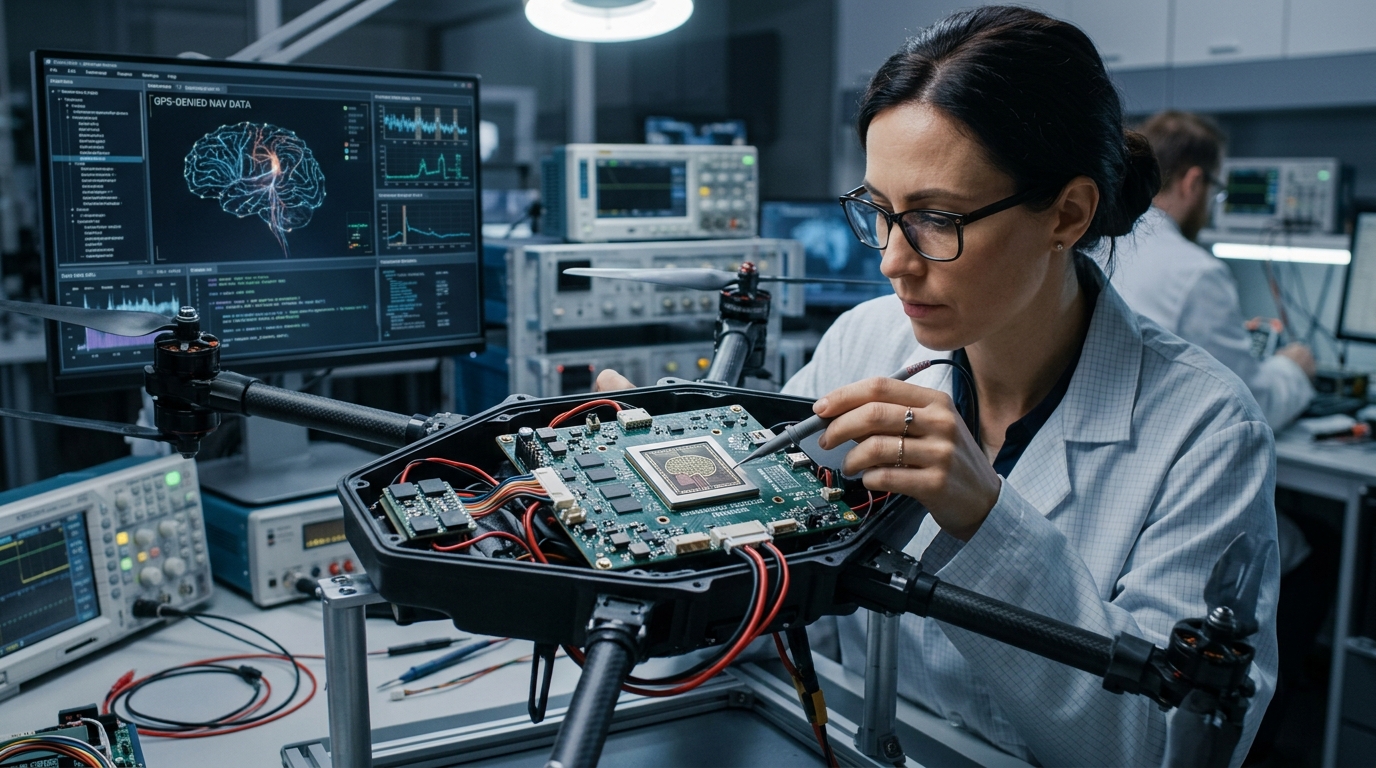
The most consequential shift in autonomous drone development right now is not software. It is the chip inside the hull. Several developments in 2026 have moved neuromorphic processors from laboratory curiosity to active defense procurement, and the investment angle is not the drones themselves but the handful of silicon suppliers now embedded in the contracts.
The Power Problem That GPS-Jamming Exposed
Conventional autopilots depend on continuous GPS lock and a persistent data link to a ground operator. Both are liabilities in contested airspace. Ukraine demonstrated this, and every major defense buyer took note. The solution the industry converged on is onboard intelligence: chips that process sensor data locally, with no uplink required. The obstacle has always been power. Standard AI inference hardware can sharply compress endurance on small drones, but the magnitude varies by airframe and payload.
Neuromorphic processors change that arithmetic. Modeled on spiking neural networks rather than the always-on arithmetic of conventional silicon, they activate only when sensor inputs change. Researchers at TU Delft reported a fully neuromorphic drone vision pipeline running on Intel’s Loihi chip that processed data up to 64 times faster than an embedded GPU while consuming three times less energy. That is not a lab number looking for a product. Defense primes are now writing it into silicon contracts.
Where the Contracts Are Landing
In March 2026, BrainChip announced that ForwardEdge ASIC, a wholly owned Lockheed Martin subsidiary, had selected BrainChip’s Akida neuromorphic architecture for integration into future custom ASICs targeting aerospace and defense edge processing. The collaboration focuses on embedding neuromorphic AI acceleration into future ASIC platforms for edge processing.
By June 30, BrainChip had announced commercial availability and initial production shipments of its AKD1500 reference chips, manufactured with GlobalFoundries on its 22FDX process. BrainChip said the AKD1500 consumes less than 300 milliwatts in PCIe mode and under 200 milliwatts in serial mode. Military-grade qualification is running concurrently.
On the platform side, Shield AI announced on October 8, 2026 that the U.S. Navy had executed a $150 million modification to its existing Other Transaction agreement to advance the X-BAT program, bringing combined U.S. government and company investment to $400 million. Shield AI says its Hivemind autonomy software has been integrated across more than 15 aircraft types.
The terrain-fingerprinting angle is less discussed but structurally important. Advanced Navigation and MBDA have described NILEQ as using neuromorphic sensors to derive and match terrain fingerprints as part of a resilient navigation system, framed in the context of AUKUS Pillar 2 work.
The Overlooked Supplier
The second-order opportunity sits one level below the drone builders. BrainChip trades on the ASX and OTCQX at a fraction of Lockheed’s market cap, yet its Akida IP is now embedded in a Lockheed Martin subsidiary’s silicon roadmap and shipping as production reference chips. BrainChip has also described a forward roadmap beyond AKD1500. Investors assigning value to autonomous drone adoption need to ask which chip wins the bill of materials. Right now that race is far less crowded than the drone airframe market itself.
Risks Worth Weighing
Neuromorphic navigation still requires a pre-loaded terrain database, which limits utility in novel operating environments. BrainChip remains a small-cap company with early-stage revenue relative to its qualification milestones. And the Pentagon’s procurement timeline for any program involving novel silicon can slip significantly. None of that changes the structural direction. GPS-denied environments are a permanent feature of modern conflict, and the chips that solve the power-navigation tradeoff are moving from research papers into production. The procurement clock is running.