October 14, 2026
CAT’s Skycatch acquisition closes a mapping gap
For years the knock on Caterpillar’s autonomous mining ambitions was the same: the trucks were impressive, but the terrain data feeding them was stale. A fleet that cannot see the mine as it actually exists right now is a fleet that stops, reroutes, and costs operators money. CAT spent 2026 closing that gap aggressively, and traders heading into the Oct. 29 earnings call have more to watch than just beat-or-miss on EPS.
Own Every Major AI Stock for $38. Get Paid Every Thursday.
The biggest AI stocks have been soaring and now cost hundreds of dollars a share. But there’s a single fund that owns all of them – Nvidia, CrowdStrike, Palantir, and dozens more – for just $38 a share. And it pays income every Thursday. Up to $1,051 a month.
The Acquisition That Changed the Physics
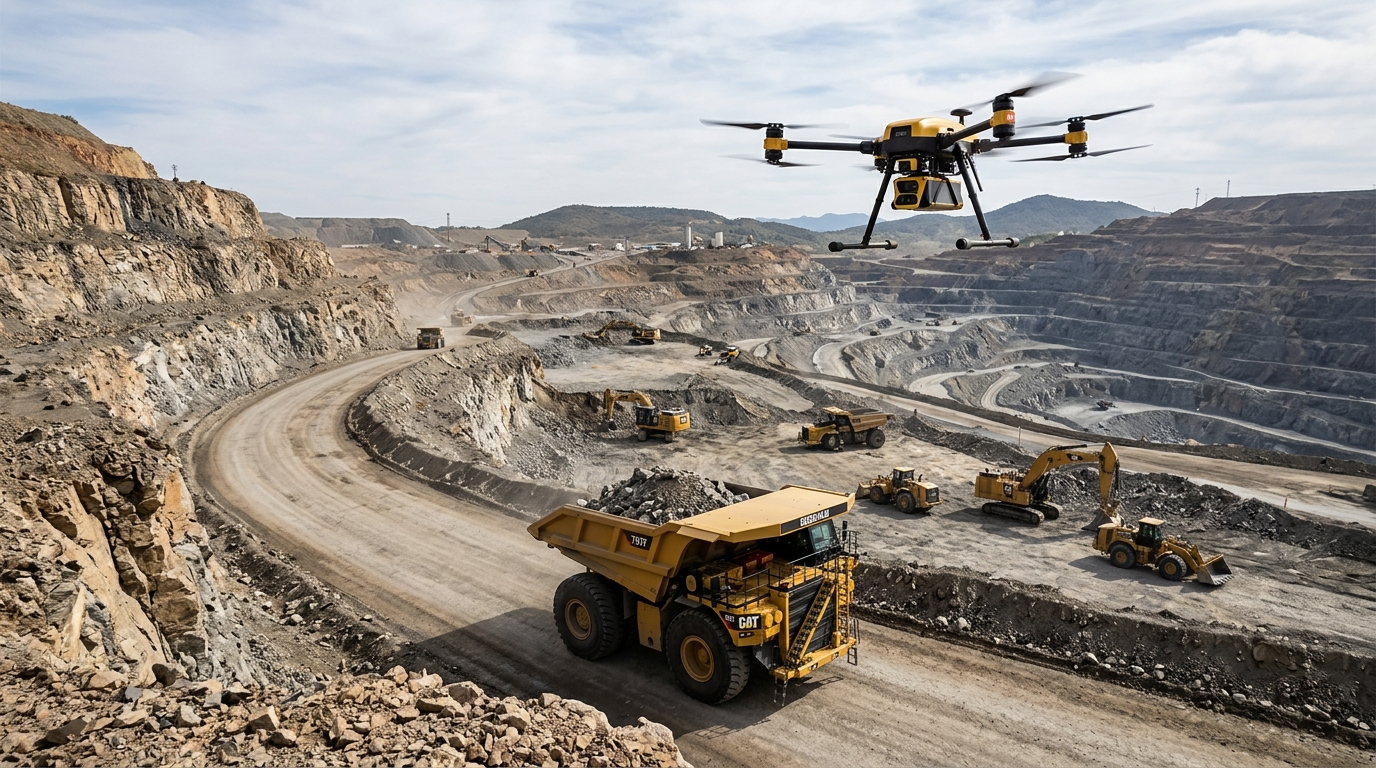
On July 7, Caterpillar acquired Skycatch, a spatial-data processing firm whose drones generate near-real-time 3D point clouds from survey passes. The strategic rationale was precise: Skycatch’s output is being integrated into RPMGlobal’s mine planning software and Cat MineStar fleet management, bringing higher-frequency surface models into planning and execution workflows. That closes what insiders called a “spatial latency” problem, the delay between a blast, a collapse, or a grade change and the moment an autonomous truck’s systems operate from an updated map.
Underground is where the LiDAR challenge is hardest. GPS does not work below surface, which means autonomous load-haul-dump machines rely heavily on onboard perception and local mapping. Specialized LiDAR and camera payloads operating in GPS-denied environments can use SLAM-style approaches to build 3D maps those machines navigate by. Without fresh maps, the whole autonomy stack degrades.
‘Please, Please, Please’: OpenAI CEO Sam Altman Begs Small Company for Help
As reported by Financial Times, those are the exact words OpenAI CEO Sam Altman spoke on an open line to a small company in Arapahoe County, Colorado… which now controls what could be the most important technology in the world. Altman is desperate to get his hands on it… and he’s not alone. This tech is now backed by Elon Musk, Jensen Huang, and more.
Click here to learn how you could invest in this breakthrough alongside Sam Altman and Elon Musk.
The GPS-denied perception problem is not unique to mining. Defense primes are writing onboard neuromorphic chips into contracts precisely because autonomous systems cannot rely on GPS lock in contested or underground environments.
The MicroVision Deal Fills the Truck-Level Gap
Skycatch handles site-level mapping. MicroVision is pitching what happens at the vehicle. In June, MicroVision announced it had signed a Master Development Agreement to collaborate with a construction and mining equipment manufacturer on integrating MicroVision lidar and perception into next-generation autonomous hauling solutions. Caterpillar was not named in MicroVision’s announcement, so the counterparty cannot be stated as Caterpillar based on that disclosure alone. Separately, Caterpillar has previously disclosed a collaboration with Luminar to integrate Iris LiDAR into its next-generation autonomous solution, and Luminar has described Iris as capable of detecting objects out to 600 meters with about 1-centimeter range precision.
Put Skycatch and truck-level sensing together and the architecture becomes clearer: drones map the environment continuously, trucks sense it locally, and MineStar arbitrates between both feeds to make fleet decisions. Caterpillar leaders have described a broader ambition of moving autonomy lessons into more dynamic environments beyond traditional mining, backed by about 1.6 million connected assets and roughly 16 petabytes of structured data in its Cat Helios platform.
5 Rules. Plain English. Zero Jargon.
You don’t need a psychology degree to stop revenge trading.
You need a few simple rules, set ahead of time, that you follow no matter how the day is going.
That’s what you’ll get in How To Stop Revenge Trading in 5 Steps. Plain English. Rules you can use tomorrow morning.
What the Financials Actually Show
CAT’s Resource Industries segment, the division that houses mining autonomy, posted $4.648 billion in Q2 2026 revenue, up 20% year over year, driven by higher equipment sales to end users. But autonomy itself does not yet appear as a standalone revenue line. It shows up as elevated SG&A and R&D inside Resource Industries. The order backlog was a little over $72 billion at the end of Q2 2026, up about 92% year over year, and commentary around that backlog in Q2 focused heavily on Power & Energy demand, including data-center-linked power generation and related infrastructure, rather than robot trucks.
That gap between the technology story and the earnings story is the trade. Wall Street consensus for Q3 is not a single fixed number across all providers, but several widely followed estimate aggregators have been showing about $6.93 in EPS for the quarter heading into the Oct. 29 call. Any language from management on when Skycatch integration and truck-level sensing partnerships begin contributing to segment revenue, rather than just depressing margins, changes the timeline the market is pricing. Until then, CAT’s autonomous mining platform is a cost line with a very large option attached.