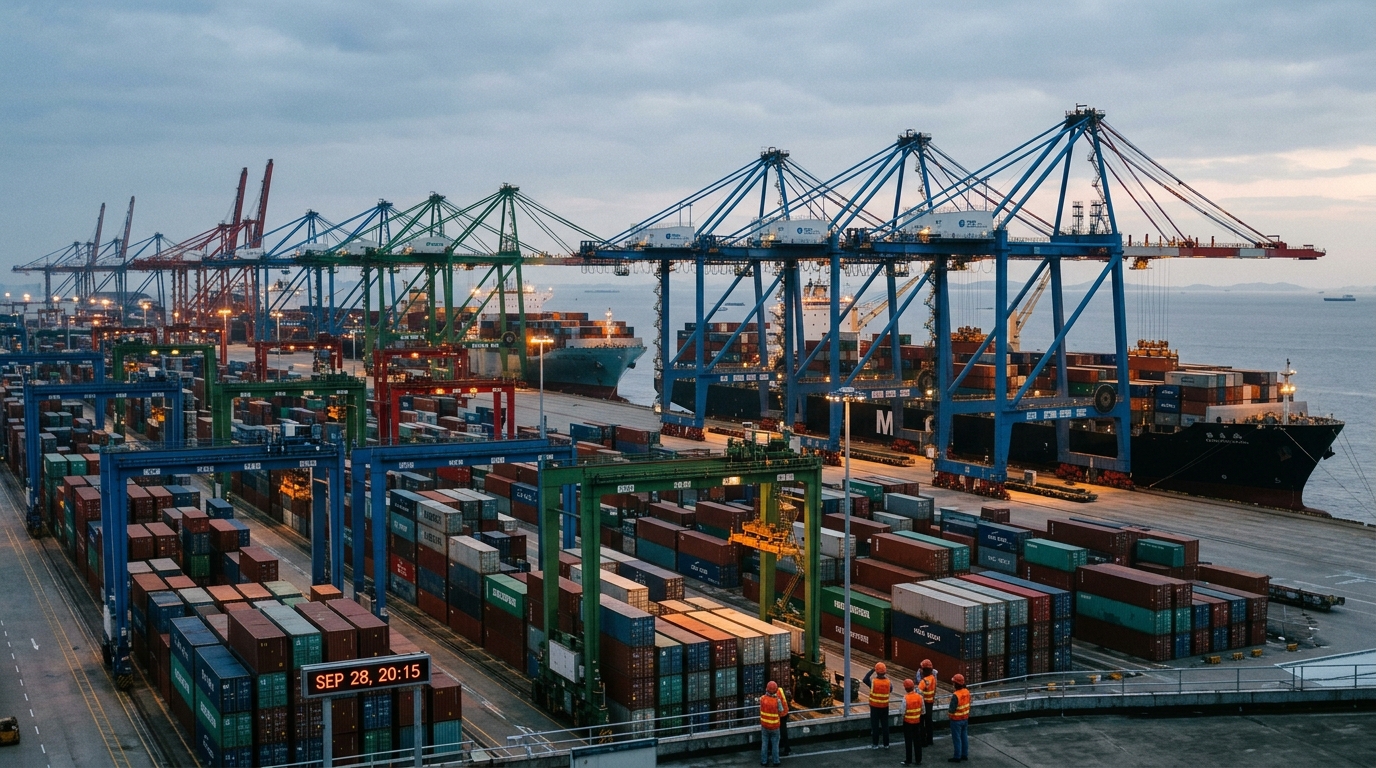
The number that landed from Beijing overnight is striking enough on its own terms. China’s customs agency reported that exports surged 36.3% in September from a year earlier, beating what economists had expected and accelerating from the 25% growth in August. For the first nine months, China’s trade surplus reached $938 billion, with expectations growing that it could surpass last year’s full-year $1.2 trillion record.
The question institutional investors are actually asking is not whether the number is big. It is whether it is real.
The Front-Loading Problem
Washington confirmed the US-China trade truce will run until January 10, 2027, extending tariff relief beyond the November expiry. That two-month window is the key context for reading September’s data. Treasury Secretary Scott Bessent said it is possible a broader economic package gets agreed by January, or that the current arrangement simply rolls forward again. Nothing beyond the extension itself has been confirmed.
For exporters on both sides of the Pacific, that ambiguity has a predictable effect. Every prior tariff deadline in this cycle produced the same behavior: shipments accelerate into the window, then crater after it closes. As Vizion documented during an earlier episode, shippers rushed to move product ahead of a deadline, then pulled back sharply as new tariff policies introduced widespread uncertainty. September’s record figure fits that pattern precisely. The truce expires January 10. September cargo booked in August and September was the last clean window to load vessels before the deadline compresses shipping timelines.
What the Composition Reveals
China’s integrated circuit exports rose 136% year on year to $45 billion in September. Export volume, however, rose just 1% to 32.7 billion units. Higher prices drove the increase in export value amid a memory chip shortage tied to the global expansion of artificial intelligence infrastructure. That split matters enormously. A 136% rise in dollar value against a 1% rise in unit volume is not an export boom in the conventional sense. It is a pricing cycle.
The value of China’s integrated circuit exports globally surged 136% in September from a year ago, but the number of units exported only rose by 1%, according to CNBC calculations of official figures. Strip out that price effect when the AI memory cycle eventually cools, and the underlying volume picture looks considerably more modest.
Autos tell a different story. China’s passenger car exports surged 64% in September from the same month in 2025, with around 919,000 units shipped, lifted by overseas demand for plug-in hybrids and pure electric vehicles. Domestic passenger car sales in China have fallen for most of the year, declining 27% in September year on year to over 1.6 million units. Chinese automakers are not exporting because global demand is exceptional. They are exporting because their home market has collapsed.
What Investors Are Missing
The hole in Q1 2027 is under-discussed. If a meaningful share of September’s volume was pulled forward to beat January 10, the first quarter faces a demand vacuum. That is not a China problem in isolation. Container shipping rates, which spiked into every prior deadline, have already begun to reflect pre-positioning. A Q1 cliff creates earnings risk for trans-Pacific carriers and for any company that drew down inventory in anticipation of sustained Chinese supply.
The more durable concern is the structural one. Strong exports have helped drive China’s overall economic growth this year, at a time when domestic consumption and investment remained sluggish, weighed on by a yearslong real estate sector downturn. That model requires open markets. The EU is already capping hybrid vehicle imports at 350,000 a year. The January deadline is not the only wall being built.
Stocks to Watch
Volkswagen (VOW3). The group delivered 6.011 million vehicles in the first nine months of 2026, down 9% from the same period last year, with much of the decline coming from China, where deliveries fell 30.2% to about 1.38 million units. The company reset its 2026 operating return on sales to at most 1%, from a prior target of 4% to 5.5%, with China demand still deteriorating. The restructuring includes about a €10 billion hit covering a Porsche stake write-down and provisions tied to job cuts.
Maersk (MAERSK-B) and global container carriers. The shipping lines priced a sustained truce. A January expiry without renewal resets that calculus for the first quarter.
CXMT and China’s memory complex. China’s chip exports hit $45 billion in September, up 136% year on year, fueled by AI demand and memory shortages. If the AI memory shortage eases, volume alone will not sustain those dollar figures. The Q4 earnings season will be the first real read on whether September’s pricing holds.