October 15, 2026
Self-healing concrete is scaling, and the CO2 and oxygen that help it work run through companies like Linde.
The most interesting thing about biomanufactured self-healing concrete is not the bacteria. It is the supply chain those bacteria need to stay alive during manufacturing, and who sits at the center of it.
Jim Rickards: “This AI Giant is About to Go Bust”
Jim Rickards just released shocking new research predicting this AI giant is about to go bust…
Triggering a full-blown AI meltdown that could wipe out 80% of the stock market.
He says this could be 10 times bigger than Lehman Brothers.
Click here to get the name of this company, completely free of charge…
And learn the five steps he’s recommending you take.
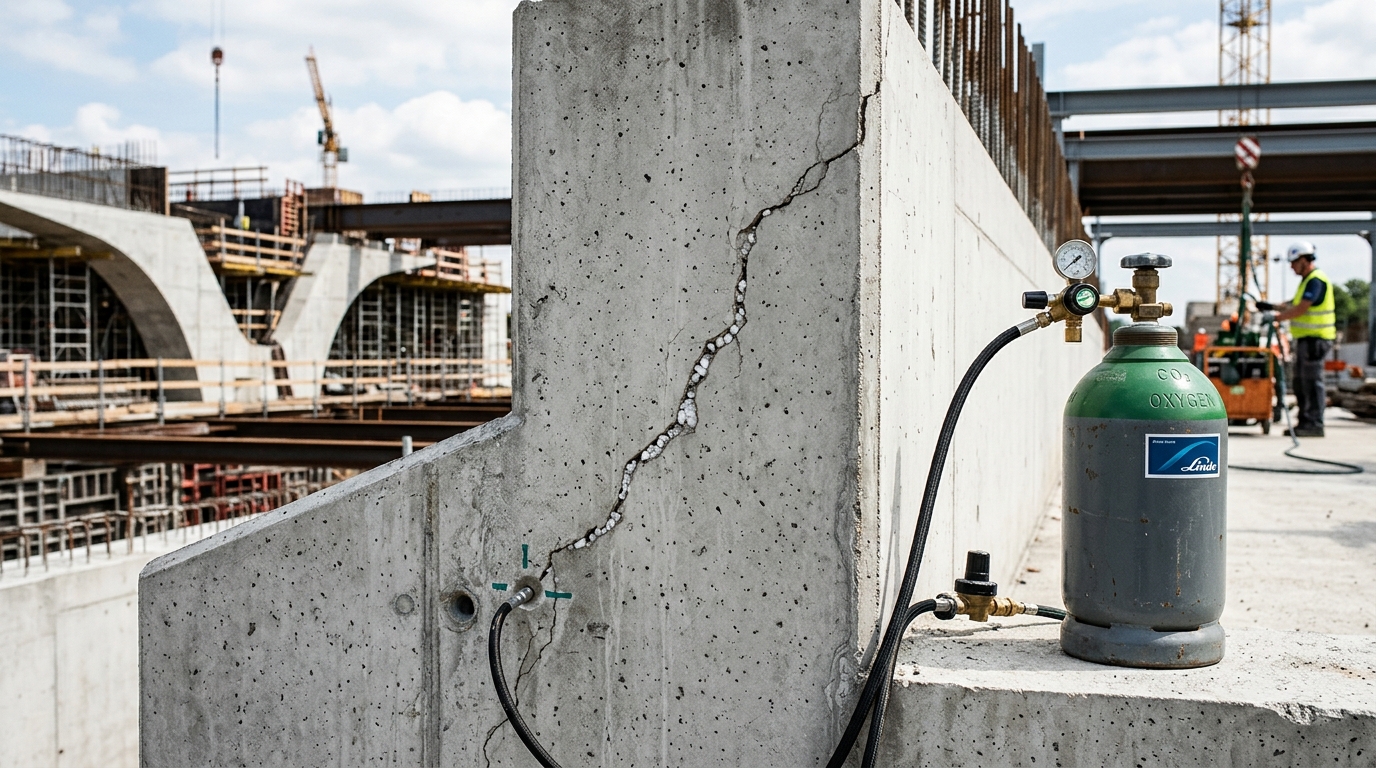
How it works, quickly: Bacterial concrete embeds dormant Bacillus spores directly into the mix. When a crack forms and moisture enters, the spores activate, consume calcium lactate, and precipitate calcium carbonate to seal the break autonomously. Research published in June 2026 reported that Bacillus megaterium-based bacterial concrete can repair cracks through microbial-induced calcium carbonate precipitation, extending structural life without manual intervention. The process is not experimental anymore; it is entering commercial procurement.
That commercial shift matters for traders because it creates a durable industrial-gas demand signal. The bacterium captures CO2 and combines it with calcium ions to form the carbonate that seals cracks. Controlled-atmosphere fermentation of the bacterial cultures, cryogenic storage of spores during transport, and inert-gas blanketing during encapsulation all require reliable, high-purity industrial gases. That is Linde’s core business.
Where Linde Fits
Linde provides hydrogen, oxygen, nitrogen, CO2, and noble gases via pipeline, bottles, or customer-adjacent plants. Bioprocessing customers already draw on that network for fermentation and cell-culture work. Self-healing concrete manufacturers are a natural extension: same gases, same delivery infrastructure, different end product.
Is the longest-running bull market on record finally running out of steam?
It looks that way. But truthfully? It doesn’t matter.
Because this strange formula gives you a way to study a defined setup during a short morning window… even if the market crashes.
One ticker retirement traders are quietly using every morning.
One short morning window between 9:30 and 10:45 AM.
One approach with entry and exit plans fully defined before you ever place a trade…
Don’t even think about making another trade until you see this free report.
Linde’s Q2 2026 sales reached $9.3 billion, up 9% year-over-year, with adjusted EPS of $4.50, up 10%. The sale-of-gas backlog stood at about $8.1 billion at June 30, 2026, which Linde described as a record level. For Q3, Linde guided to adjusted EPS of $4.45 to $4.55 in its Q2 materials.
Record backlogs are becoming a recurring theme across industrial suppliers tied to the same infrastructure buildout. GE Vernova’s $176 billion backlog and record quarterly orders show how durable multi-year demand signals translate into stock re-ratings for industrial suppliers.
The Market Growing Underneath
The global self-healing concrete market was estimated at about $168.4 billion in 2026 and projected to reach roughly $1.64 trillion by 2035, implying about a 29% compound annual growth rate, according to Precedence Research. Infrastructure is widely cited as the largest application category, but published share estimates vary by source and year.
Bridge rehabilitation programs across North America are accelerating procurement of healing systems, while the EU’s policy push on decarbonization continues to pressure contractors toward material innovations that extend structural service life. Both forces require more bacterial-culture manufacturing, and more bacterial-culture manufacturing requires more industrial gases.
7 IPO Prospects to Watch in the Second Half of 2026
The second half of 2026 IPO calendar is taking shape and instead of a scattershot list of early-stage hopefuls, the pipeline includes a handful of large private companies, each dominating a different segment of the economy. Our analysts studied the field and selected the 7 IPO prospects they believe merit close attention heading into the 2nd half of 2026…
The Trade Angle
Linde does not need self-healing concrete to move the needle on Q3 earnings. Growth in Q2 was largely supported by the electronics sector and AI-related infrastructure demand. But that concentration is exactly why the construction-materials angle is worth tracking: it is a genuinely distinct demand driver that hedges electronics-cycle risk inside the same gas-supply model.
Linde sits at the center of several secular tailwinds, including semiconductor fabrication, hydrogen, and industrial decarbonization, all of which require the specialty gases it supplies. Biomanufactured building materials are the next category trying to join that list. The Q3 earnings call is scheduled for Thursday, October 29, 2026, which is the first place to watch for any language on new-market project activity beyond electronics.
Watch: LIN Q3 results on October 29. Any mention of construction-materials or bioprocessing pilot contracts would signal that the self-healing concrete supply chain is already in Linde’s commercial pipeline, not just in research labs.