What does it take for TSMC to impress Wall Street right now? The world’s largest contract chipmaker just reported its sixth consecutive quarter of record profit, beat its own revenue guidance by nearly a billion dollars, posted margins above the top of its guided range, and guided the current quarter to growth that would have looked implausible two years ago. The stock fell anyway.
The numbers are not in dispute. Q3 net profit came in at NT$763.1 billion, up 68.7% from a year earlier, beating the LSEG SmartEstimate of NT$746.3 billion. Revenue hit $46.72 billion, up 41.2% year over year, clearing the top of TSMC’s own guidance range of $44.6 to $45.8 billion. EPS reached NT$29.43. Operating margin landed at 58.7%, above the high end of guidance. These are not soft beats.
The Margin Story Most Investors Are Getting Backwards
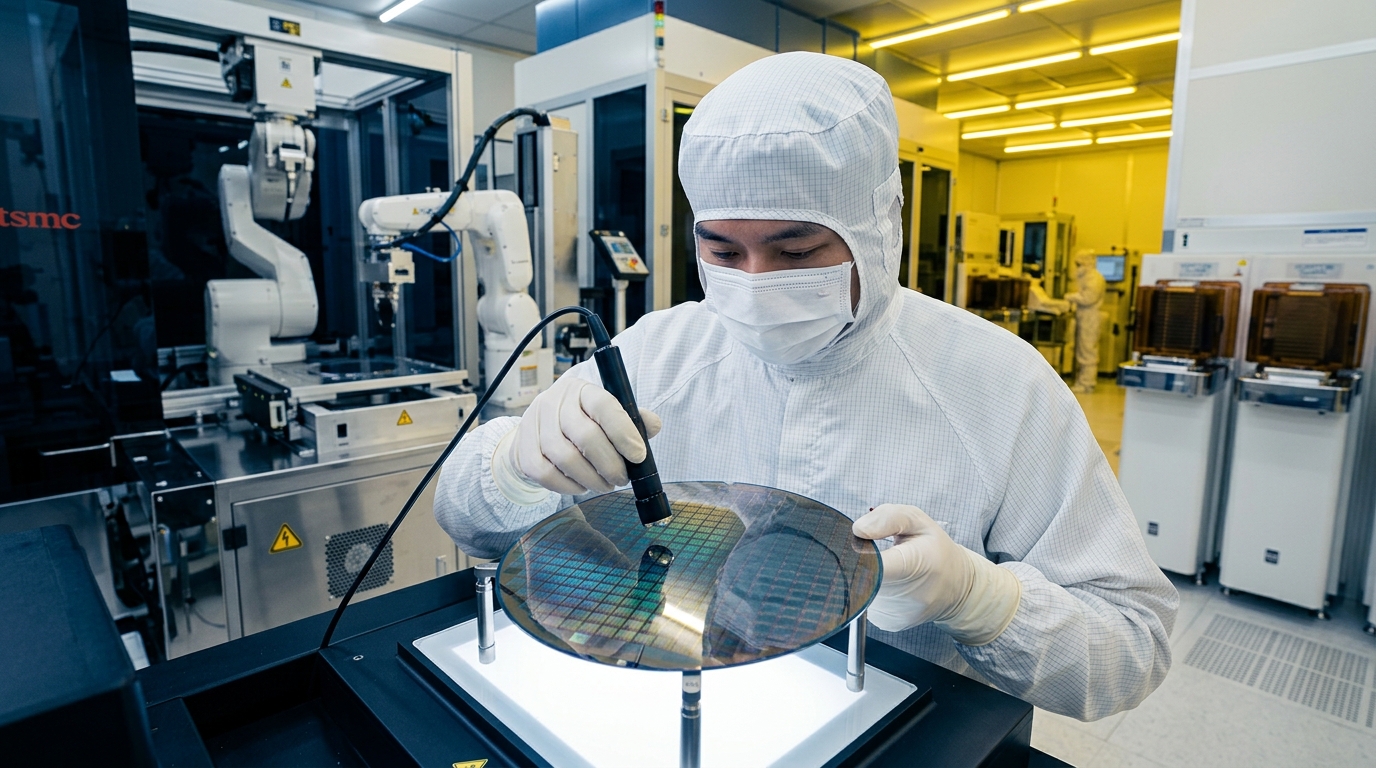
The detail worth sitting with is gross margin. At 66.4%, it came in above the midpoint of guidance despite the 2nm ramp actively diluting profitability. The 2-nanometer process contributed 8% of wafer revenue in Q3, while advanced nodes at 7nm and below accounted for 79% of total wafer revenue. New nodes always compress margins at launch: the equipment runs at lower utilization, yields climb gradually, and depreciation hits before pricing fully catches up. TSMC absorbed that drag and still posted 66.4%.
That matters because gross margin in Q2 was 67.7%. The sequential dip of 1.3 percentage points is exactly what CFO Wendell Huang said would happen. It is not a warning sign. It is the cost of entering the most advanced semiconductor process in commercial production today, and TSMC held margin well above the 65% floor of its own guidance range while doing it.
The Q4 Guide Is the Real Signal
TSMC guided Q4 revenue to $52.3 to $54.3 billion, a roughly 14% sequential increase at the midpoint. That guidance topped the prior analyst consensus of around $50.5 billion by a meaningful gap. Chairman and CEO C.C. Wei said demand is “extremely robust” and that the gap between AI chip supply and demand remains “still quite big.” TSMC expects full-year 2026 revenue growth to be around 44% in US dollar terms.
High-performance computing, which captures AI accelerator orders from customers including Nvidia and AMD, accounted for 68% of Q3 revenue. That concentration is a feature, not a risk, as long as hyperscaler spending holds.
Why the Stock Fell Anyway
The selloff is not about TSMC’s fundamentals. South Korea’s KOSPI fell about 8% on October 15, 2026, triggering a circuit breaker as Samsung Electronics and SK Hynix each slid around 10% amid renewed rate fears and broader semiconductor weakness. TSMC doesn’t make DRAM. Yet it trades in the same macro bucket, and hotter-than-expected US September CPI data pushed rate-cut expectations further out, triggering broad liquidation across semiconductor names. TSM had already fallen in six of the seven sessions through Wednesday, losing 11.5% cumulatively before this morning’s report.
There is also a legitimate forward concern. Overseas fab costs will widen margin dilution to 3 to 4 percentage points in coming years as US facilities in Arizona ramp. TSMC is investing $265 billion in US chip manufacturing and maintained its 2026 capital expenditure budget at $60 to $64 billion. That spending is a bet on structural AI demand, not a quarterly hedge.
What Investors Should Watch Next
The thesis here is simple: TSMC is the chokepoint for every AI accelerator that Nvidia, AMD, and the hyperscalers can deploy. Total revenue for January through September 2026 already reached NT$3,898.73 billion, exceeding TSMC’s full-year 2025 revenue of NT$3,809.05 billion, and Q4 guidance implies the acceleration is not slowing. The 2nm ramp is compressing margins temporarily, but the trajectory on advanced node revenue share points toward pricing power improving as yields mature. Watch Q4 gross margin execution against the 65 to 67% guide, 2nm utilization rates, and whether management revisits its capital intensity as overseas expansion scales. None of those are reasons to sell today’s numbers.