Below is an important message from one of our highly valued sponsors. Please read it carefully as they have some special information to share with you.
Dear Reader,
Jeff Bezos is terrified.
He will be down on his knees, hands out, begging Elon for mercy.
Because Elon is about to do something that will:
Cut Amazon out of the AI race ENTIRELY…
Completely DESTROY Blue Origin…
And take control of the potential $25 TRILLION DOLLAR PER YEAR AI INDUSTRY
And in his wake, potentially create 1,806,000 NEW millionaires over the coming years…
Starting December 8th.
And this is your chance to be one of them.
Elon Musk is currently quietly planning the biggest project of his entire career.
And a single FCC filing proves it, click here to see why.
This is bigger than Tesla, SpaceX, and X combined.
And I believe it will not only cement Elon as the winner of the AI race…
It will allow Elon to control the entire industry.
Something of this magnitude has never happened in the history of the human race.
And it’s happening FAST.
According to my timeline, you must act by December 8th.
I explain everything right here.
>>>This is your free Millionaire Maker Masterclass… and it starts right now.
Sincerely,
James Altucher
P.S. I am giving away a gift worth $1,000 to the first 1,000 people who watch and take action on my Masterclass offer today. No purchase necessary. ZERO credit card required. Just click here to watch my free video, and I’ll show you how to claim yours.
Target’s Freshest Supply Chain Problem Has Fins and Roots
Target expects to spend about $5 billion in capital this year, a significant portion aimed squarely at food. More than 130 stores are being remodeled, with many of those projects expanding grocery space and emphasizing fresher, food-forward layouts. A new food distribution center in Thornton, Colorado, now services 129 stores across 11 states, cutting replenishment times by up to two days. The company’s Q2 call confirmed its largest center-store grocery reset in more than a decade, with snack sales running more than 15% ahead of last year post-transition.
That is the conventional playbook. The more interesting question is what comes after conventional.
Here is the structural problem Target has not fully solved: fresh produce still travels thousands of miles before it reaches a refrigerated shelf. Extreme weather disrupted harvests across multiple regions in 2025, contributing to volatility in produce pricing. Target leadership has been explicit about its ambition to make food a destination guests can rely on for high-quality fresh offerings. Reliability built on long-haul logistics is, by definition, fragile.
This is where the aquaponic smart grid concept becomes genuinely relevant to TGT as a trade.
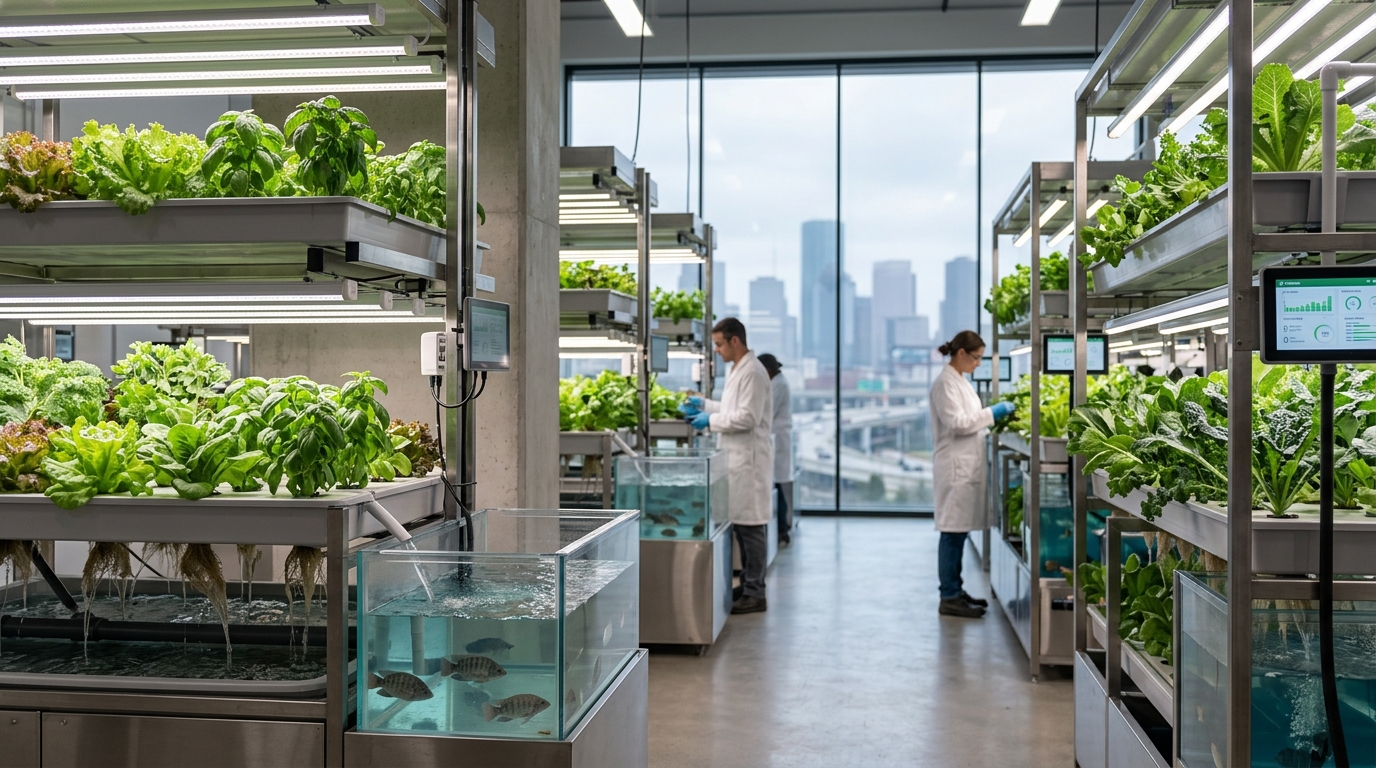
Aquaponics is a closed-loop system. Fish waste converts via bacteria into nitrates that feed plants; plants filter the water back for the fish. USDA materials say these systems can use up to 90% less water than in-ground growing systems. Because the biology is self-contained, a well-automated facility near a major metro hub can produce leafy greens and protein fish year-round, independent of season, weather, or transcontinental logistics.
Commercial aquaponic operators are already forming direct supply agreements with supermarkets and food-service chains. The model that matters for Target specifically is the peri-urban mega-facility: large, highly automated installations placed within distribution range of dense population centers, locking in stable pricing and guaranteed volume. The competitive moat Target’s new Chief Global Supply Chain and Logistics Officer, Jeff England, who joined Target in May 2026 after a long career at Walmart, will eventually need to source or build is resilience, not just speed.
The aquaponics market itself is estimated at about $1.3 billion globally in 2026, a fraction of the broader vertical farming space that some industry trackers estimate at about $7.5 billion in 2026. Forecast growth rates vary by source, but multiple market-research estimates cluster in the low-to-mid teens annually over the next several years. IoT sensors and AI-driven monitoring are reducing labor costs and yield variability, the two factors that previously made aquaponic systems too operationally complex for retail partners to trust.
Target does not need to build farms. It needs offtake agreements. For traders, the signal to watch is whether England’s supply chain restructuring language on the next earnings call shifts from distribution speed toward sourcing resilience. Any mention of regional produce partnerships or controlled-environment supply agreements near high-density metros would confirm the direction. That is the moment the aquaponic grid thesis moves from editorial angle to catalyst.
TGT’s food and beverage segment generated $24.1 billion in merchandise sales in 2025. Fresh produce is the highest-spoilage, highest-volatility slice of that. One severe growing-season disruption in California or Florida hits Target’s in-stock metrics in ways no Colorado distribution center can buffer. A smart aquaponic grid within 50 miles of Chicago, Houston, or Atlanta does.