CAT Handed Mining to an Offshore Veteran. The Seabed Is Why.
York ran offshore at CAT. Now he leads mining as seabed nodule contracts accelerate.
Caterpillar announced on October 15, 2026, that Denise Johnson, the executive who has led the company’s Resource Industries group and pushed autonomy across mining, will retire effective February 1, 2027. Her replacement is Derrick York, who takes over November 1, 2026. York spent his most recent years running Solar Turbines and before that led Caterpillar’s Oil, Gas & Marine division, subsurface, fluid-based, offshore-adjacent work. The contrast with Johnson’s decade of open-pit machinery is deliberate, whether Caterpillar will say so or not.
The timing is sharp. CAT reports Q3 results on October 29, 2026. Estimates vary by source, so the exact adjusted EPS number matters less here than the direction: expectations generally imply a sequential step down from Q2’s $8.17 adjusted EPS. That sequential drop would normally dominate the call. But the more important question is whether management begins framing seabed mining as a structural growth line rather than a speculative footnote, and York’s appointment suggests someone decided it was time.
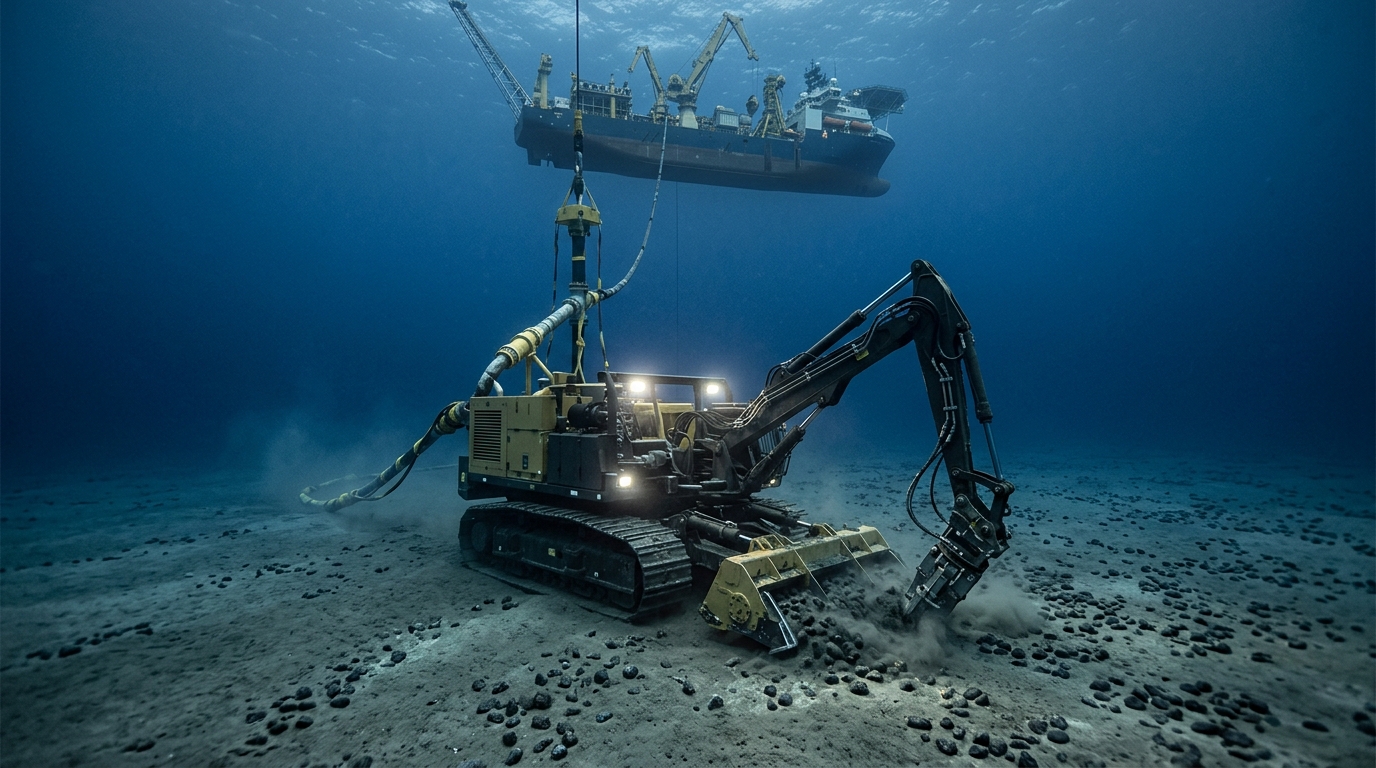
Here is what the commercial pipeline actually looks like. The Metals Company and Dutch subsea contractor Allseas signed a commercial agreement in May 2026. That system targets 3 million wet metric tonnes per annum, with commissioning expected to begin in Q4 2027, subject to regulatory approvals, including a commercial recovery permit from NOAA. The collector vehicles involved run on tracked drive systems adapted from terrestrial mining: the same category of hardware Caterpillar’s Resource Industries segment has manufactured for decades. No formal supply contract has been disclosed, but the engineering overlap is structural, not aspirational.
The regulatory runway has also accelerated faster than most traders have tracked. President Trump’s April 24, 2025 executive order directed NOAA to expedite permits, followed by a consolidated licensing rule finalized January 21, 2026. In late April 2026, TMC USA’s application received a “full compliance” determination under the Deep Seabed Hard Mineral Resources Act. BOEM separately proposed a mineral lease sale off American Samoa for November 19, 2026. NOAA and BOEM do not publish a running total of “more than ten” active DSHMRA applications, so it is safer to say the queue is growing as NOAA’s consolidated process is now live and multiple companies have signaled interest in filing.
CAT’s Q2 backlog hit a record $72 billion, up 92% year over year, with roughly 59% expected to be delivered within twelve months. Mining, Heavy Construction and Quarrying contributed $3.685 billion in Q2 segment revenue, up 22%. Most of the backlog attention goes to AI-data-center power generation. The seabed angle sits underneath that, which is where the opportunity lives.
Subsea collector vehicles require propulsion systems, hydraulic collection assemblies, slurry-handling equipment, and continuous monitoring electronics. These are not off-the-shelf products; they need engineering partnerships formed years before commercial production begins. If York uses the October 29 call to describe subsea-adjacent conversations, or if 2027 capex guidance references offshore mineral equipment development, the market will need to reconsider how much of the current backlog previews an industry that barely existed two years ago.
- Watch: Any Q3 language on subsea, offshore, or critical mineral equipment within Resource Industries guidance.
- Watch: York’s first public comments as division head regarding energy-extraction crossover markets.
- Risk: NOAA’s American Samoa lease sale faces political opposition and potential litigation risk. Any delay hits operator capex timelines and equipment order books.
- Risk: Nickel and cobalt remain soft. Two of the four key nodule metals have underperformed EV demand projections, complicating operator financing and, by extension, capital equipment orders.
CAT is not a deep-sea mining company. But the company that engineers the tracked machines crawling four kilometers below the ocean surface just handed that business to a leader whose career was built in energy extraction and offshore systems. October 29 is where traders find out how seriously to take the connection.