
November 5, 2026
Bonus Content: Brent Lost $24 in Four Days. Here Is Who Won and Who Is Bleeding.
They’re Preparing For A Market Hit –
Is Your IRA/401(k)?
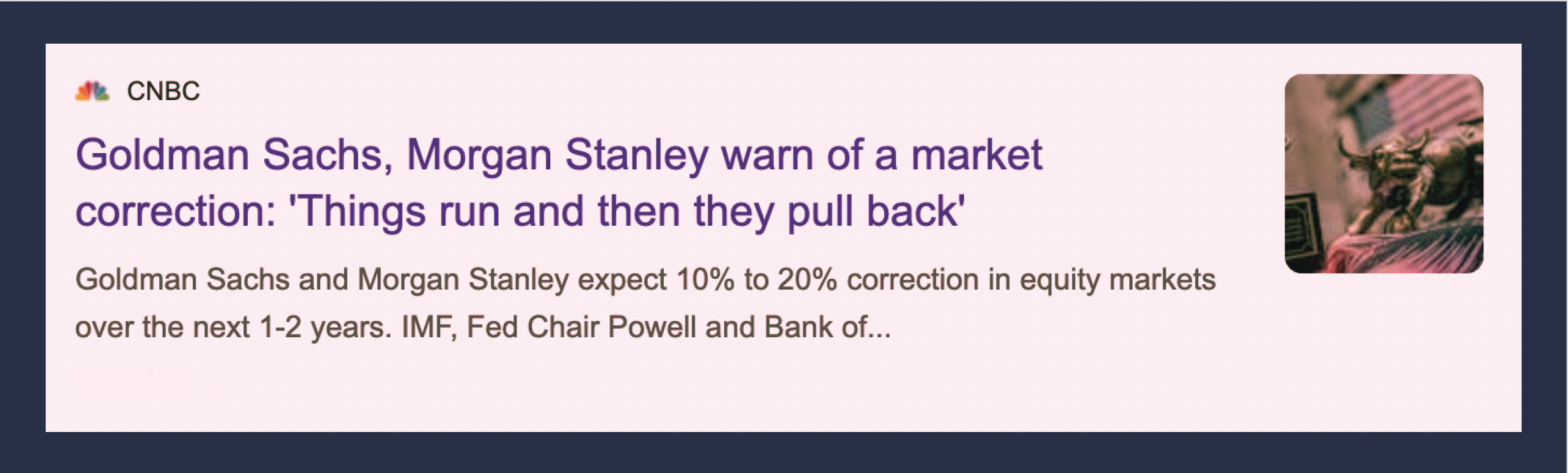
Wall Street is not guessing anymore.
They are bracing.
If you have not seen how people are positioning ahead of this, now is the time.
Goldman Sachs and Morgan Stanley both told clients to expect a 10 to 20 percent drop.
That is their best case…
not the worst case.
Look at what is breaking underneath:
- Consumer confidence just collapsed
- Bearish sentiment hit 60 percent
- Yields are spiking
- Liquidity is drying up
- China is showing liquidation pressure
- Regional banks are still one credit shock away
This is the same pattern every major crash starts with.
And it is happening while America’s debt math goes from bad to irreversible.
- Deficit at 7.5 percent of GDP.
- Sustainable level is 3 percent.
- Interest costs already over $1.1 trillion.
- On track to swallow 40 percent of federal revenue by 2030.
This is not a market cycle.
This is structural failure.
And your IRA or 401(k) is loaded with the same AI-heavy funds Wall Street is quietly unwinding.
The moment confidence slips, those funds fall first.
Retirement accounts absorb the damage.
And the public finds out last.
This is why the smart capital is shifting into real value.
Fast.
Gold and silver surged in 2025.
Major institutions see more strength into 2026.
Because once confidence breaks, paper burns.
Physical value holds.
There is one move that works before the hit… not after.
You can legally shift part of your IRA or 401(k) into physical metals tax and penalty free.
The steps are laid out here:
Download Your Wealth Preservation Guide >>

This window does not stay open long.
Once the break comes, repositioning is over.
Take the advantage now… or lose it forever.

Brent Lost $24 in Four Days. Here Is Who Won and Who Is Bleeding.

Market Snapshot: Oil
Brent crude futures were trading around $93.9 per barrel Thursday morning, while WTI fell to roughly $87 per barrel in early trade. That follows Wednesday’s brutal session: Brent fell about 8.7% to $94.62. It was oil’s biggest daily decline since April.
Oil’s drop over the last three trading sessions has been precipitous. On Friday, Brent traded as high as $118 per barrel; by Wednesday, its price was around $94. The catalyst was the midterm results and what traders read into them. Axios reported Wednesday that oil prices fell sharply as traders weighed signs, including a widely circulated post by Vice President JD Vance, that the midterm election would add pressure on the White House to find an offramp from the Iran conflict. “The elections are leading the market to conclude that Trump might now be inclined to make a deal,” said Andy Lipow, president of Lipow Oil Associates.
Analysts have cautioned that the correction may not mark the beginning of a sustained downward trend. Commercial oil inventories across major consuming economies are close to their lowest levels in 15 years, leaving the market vulnerable to supply shocks.
The Winners: Airlines
Wednesday’s crash in crude handed the airline sector one of its sharpest single-day moves of the year. Fuel is the largest operating cost for most carriers, so the math is direct and immediate.
Several airline stocks jumped sharply on Wednesday as crude fell. JetBlue’s leverage to oil is amplified by its fundamentals. JetBlue disclosed on October 26 that its third-quarter 2026 fuel expense increased 61% year over year to $868 million, and that its average fuel price was $3.91 per gallon, up 57% year over year. The company’s fourth-quarter 2026 guidance assumes fuel at about $4.64 per gallon, so any lasting drop in oil could feed straight into its earnings. Any sustained move lower in Brent rewrites the Q4 cost picture materially.
JetBlue’s fuel exposure is severe, but it is not the only carrier whose Q4 cost picture hinges on where Brent settles. United Airlines absorbed a larger absolute fuel shock yet built pricing power that could let it outperform if crude holds lower.
The Losers: Integrated Producers
Shares of leading U.S. oil producers ExxonMobil, Chevron, and ConocoPhillips slid on Wednesday. Chevron closed at $216.96, down $8.31, or 3.69%, on November 4. The drop in Big Oil stocks comes after shares of Exxon Mobil, Chevron, and ConocoPhillips had jumped sharply since the start of the year, reflecting the war premium that is now unwinding.
The Risk: This Trade Reverses Fast
Whether Vance’s comments signal a more dovish stance toward Iran remains unclear. Axios reported Wednesday that Raymond James analyst Pavel Molchanov called Vance’s post a key catalyst for the day’s oil-price plunge. The Strait of Hormuz is not yet reopened. Iran has not publicly committed to reopening the Strait, and negotiations over frozen assets and the broader conflict remain unresolved. Airlines are trading as though a deal is done. The oil market is simply trading as though a deal is more likely.
Cheat Sheet
- Brent: ~$93.9, down another 0.7% Thursday after Wednesday’s 8.7% crash
- WTI: ~$87, down 1.2% Thursday
- Airline winners (Wednesday): Several carriers surged as crude fell
- Producer losers (Wednesday): CVX -3.7%, COP under pressure ahead of Q3 earnings today
- Key risk: No Iran deal confirmation. Oil snaps back; airline trade reverses in hours
- Key opportunity: If Brent holds below $95 into next week, airline Q4 cost guidance becomes a source of upside surprises