November 6, 2026
Bonus Content: Nvidia and the Data Center Complex Are Selling Off. The Build-Out Is Moving Abroad.
Hey Trader,
Before the market opens again, read this…
My top trader, Thomas Wood, just released a new strategy he calls Opening Bell Trades.
This simple system is designed specifically to help regular investors generate income from his #1 trade setup.
I’m talking about finding monster winners like these…
- 113% on GOOGL
- 240% on META
- 70% on CAG
- 37% on MCD
- 139% on GLD
Best of all, he looks for these trades every morning starting at 9:30 AM and by 10 he’s done.
Everything you need to know about how this works is in a free report called “The Opening Bell Trade Guide”…
Take a few seconds and download FREE right now before this link stops working.
This report won’t be free forever, so grab it now while you can.
Once it’s on your computer, you’ll have it for good-no matter what we charge other traders for it later.
No credit card required. No strings attached.
>> Get Your FREE “Opening Bell Breakouts” Trade Guide Here
This guide shows you the exact 15-minute window trade he uses, and how to spot the setups the big funds are watching.
FREE: Discover One Simple Options Trade You Can Make Each Morning – and Be Done by 10 AM.
To better trading,
Drew Day
Founder & CEO
Base Camp Trading
P.S. Inside, you’ll see why Thomas uses weekly options and how to use them to trade stocks like GOOGL, META, and TSLA with as little as $75. Go here to save a copy of the “Opening Bell Trade Guide” before its taken down.
Nvidia and the Data Center Complex Are Selling Off. The Build-Out Is Moving Abroad.
The sell-off that started Wednesday is not about earnings. Financial media tied Nvidia’s two-day drop to election-related uncertainty and worries about data center demand rather than any company-specific news. The specific catalyst: Sanders and Rep. Alexandria Ocasio-Cortez introduced an AI data center moratorium bill, and communities voted for local versions of it on Tuesday. Rep. Yassamin Ansari wrote that pausing AI development needs to be a Day 1 House priority, and Greg Casar, chair of the Congressional Progressive Caucus, amplified the call with approval.
Market Snapshot
The Nasdaq fell 5.5% after Democrats’ midterm wins raised data center fears. Nvidia fell 9.26% to close at $181.60 on Thursday, November 5. Modine was down about 24%, Sterling Infrastructure about 19%, and Comfort Systems USA about 16%. Even the industry’s giants weren’t spared: Vertiv and GE Vernova were each down roughly 11% to 12%. CoreWeave credit spreads hit a record in late October.
Stocks in Focus
- NVDA: Nvidia fell 9.26% to $181.60 on volume of about 306.1 million shares. No fundamental break, the demand story is intact. This is pure permit-risk pricing.
- VRT: Vertiv reported Q3 net sales of $4.31 billion, up 61% year-over-year, with APAC up 50% and EMEA up 23% year-over-year. Asia Pacific generated $779 million in revenues last quarter. A U.S. freeze does not touch those contracts.
- GEV: GE Vernova’s total backlog reached $176 billion with improving margins. Orders are global; a domestic moratorium creates scheduling risk, not demand destruction.
- CRWV: CoreWeave is expanding its global AI cloud platform into the Middle East and Asia Pacific. Its planned network expansion targets India, Singapore, Indonesia, Japan, South Korea, and Australia; in October it added a 240 MW AI data center deal in India.
- ORCL: Existing capacity may become more valuable if new supply is constrained, while debt-funded neoclouds face much higher borrowing costs than hyperscalers. Oracle’s owned infrastructure is a hedge here.
Sector Watch
UBS said political uncertainty after the midterms could slow new U.S. data center construction, putting about 30% of expected 2028 capacity additions at risk, with Texas representing 18 gigawatts of that pipeline. The states where Democrats could restrict data center development account for roughly 45% of planned U.S. capacity, with Texas at about 25%, according to Goldman Sachs.
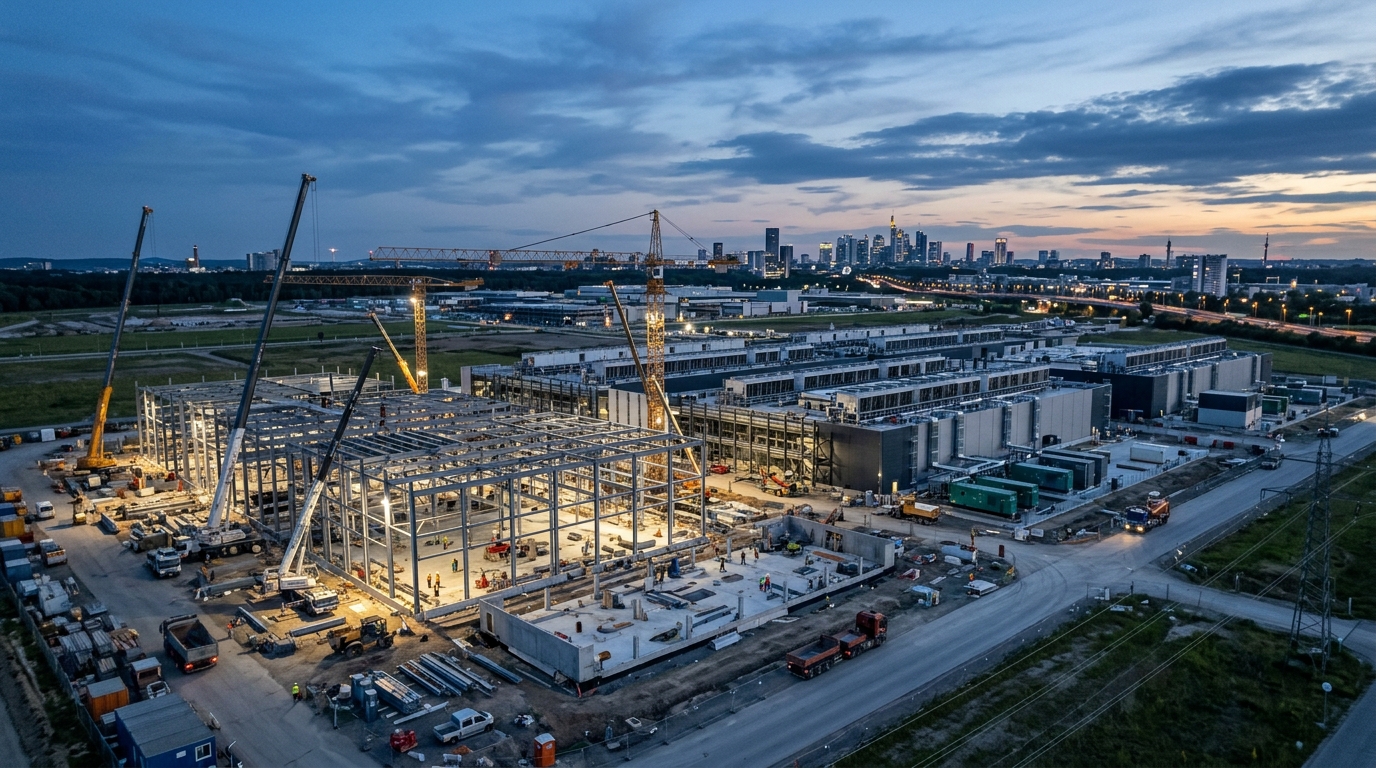
The critical point markets are mispricing: location is fungible. The Gulf is where the largest new money is going, anchored by a UAE-U.S. AI campus planned at 5 gigawatts in Abu Dhabi. Democrats are not united on the moratorium: some fear a ban could hamper AI advancement and undermine national security. The bill faces long odds in the Senate. What it already has done is accelerate the global diversification that hyperscalers were already running.
The rerouting thesis has a direct beneficiary. GE Vernova’s record $24.2 billion quarterly order intake and global turbine contracts show why a domestic moratorium reshapes geography rather than destroys demand.
Catalyst Calendar
- Sanders-AOC Moratorium Bill: Watch for a Senate floor motion and any co-sponsor count above 30. That is the threshold where hyperscaler capex guidance starts moving.
- Texas Legislature: Texas holds about 25% of planned U.S. data center capacity in widely cited Wall Street tallies. Governor-elect Gina Hinojosa’s first executive actions are the near-term event that matters most to VRT, GEV, PWR, and ETN order books.
- Hyperscaler capex calls: Watch guidance on future capital expenditures and whether companies start shifting more infrastructure projects outside the U.S. to Asia or the Middle East.
The Cheat Sheet
- Top Theme: U.S. permit risk is real but bounded; the global build-out is not stopping, it is rerouting.
- Stock to Watch: VRT, global revenues already beating expectations across APAC and EMEA; a U.S. freeze shifts orders to regions where Vertiv already operates at scale.
- Sector to Watch: AI power infrastructure, the dip in GEV and ETN prices the moratorium as if demand disappears, not as if it moves geography.
- Biggest Risk: Much of the capacity expected online in 2027 is already under construction, limiting near-term impact; tighter regulations become a more significant headwind from 2028. If hyperscalers cut 2027 capex guidance in response to political noise, that is a true earnings event, not just a sentiment event.
- Biggest Opportunity: Companies with the highest share of non-U.S. backlog: Vertiv’s APAC and EMEA segments, CoreWeave’s nine-country European footprint, and GE Vernova’s $176 billion global order book are all priced today as if Washington just shut down the entire AI trade.
- One Thing to Remember: The demand that cannot be built in Texas does not disappear. It gets permitted in Abu Dhabi, Johor, and Copenhagen, and the same equipment suppliers fill those orders.