
November 5, 2026
Bonus Content: Enphase Can’t Cut Its Way Out of This
Dear Reader,
I’m convinced that AI’s next phase will blindside millions of American investors.
And it has NOTHING to do with the recent “tech wreck.”
But I believe if you have any money in the stock market or a 401(k), it’s imperative you make one straightforward move immediately…
A move that I’ll explain, for free, right here.
This isn’t my first bold AI prediction.
- I recommended Nvidia all the way back in 2015, before it went on to surge over 21,000%.
And years before AI became a household term, I developed a 20-factor computerized stock-rating system to identify tomorrow’s winners on Wall Street… TODAY. - That system recently identified AI winners such as Sandisk, before it rose 300% in just a few months.
- It flashed bullish on data-storage company Seagate, before it rocketed 393% in months.
- And Micron Technology, before an 827% gain in just a year.
But there’s a reason most folks didn’t catch these ahead of time.
Each of these stocks took off thanks to a powerful ripple effect spreading through the AI economy.
And my research suggests that ripple is now moving somewhere new.
I’m sharing all the evidence to prove why AI’s next phase could generate the biggest and fastest financial windfalls I’ve seen in my 60-year career…
And the straightforward move I believe you should make now, before the next wave hits.
Get the full story and see the name of my No. 1 recommendation here.
Be well,
Marc Chaikin
Founder, Chaikin Analytics
Enphase Can’t Cut Its Way Out of This
Enphase Energy’s stock has been punished hard enough that value screens are starting to light up. ENPH last closed at $31.55 (November 4, 2026), and GuruFocus’ GF Value metric has been cited as roughly $52, implying a discount of more than 40% to that estimate. That gap would matter more if the fundamental problem were simply low demand. It is not. The deeper issue is structural: Enphase carries a fixed manufacturing cost base that actively destroys margin whenever volume falls, and volume keeps falling.
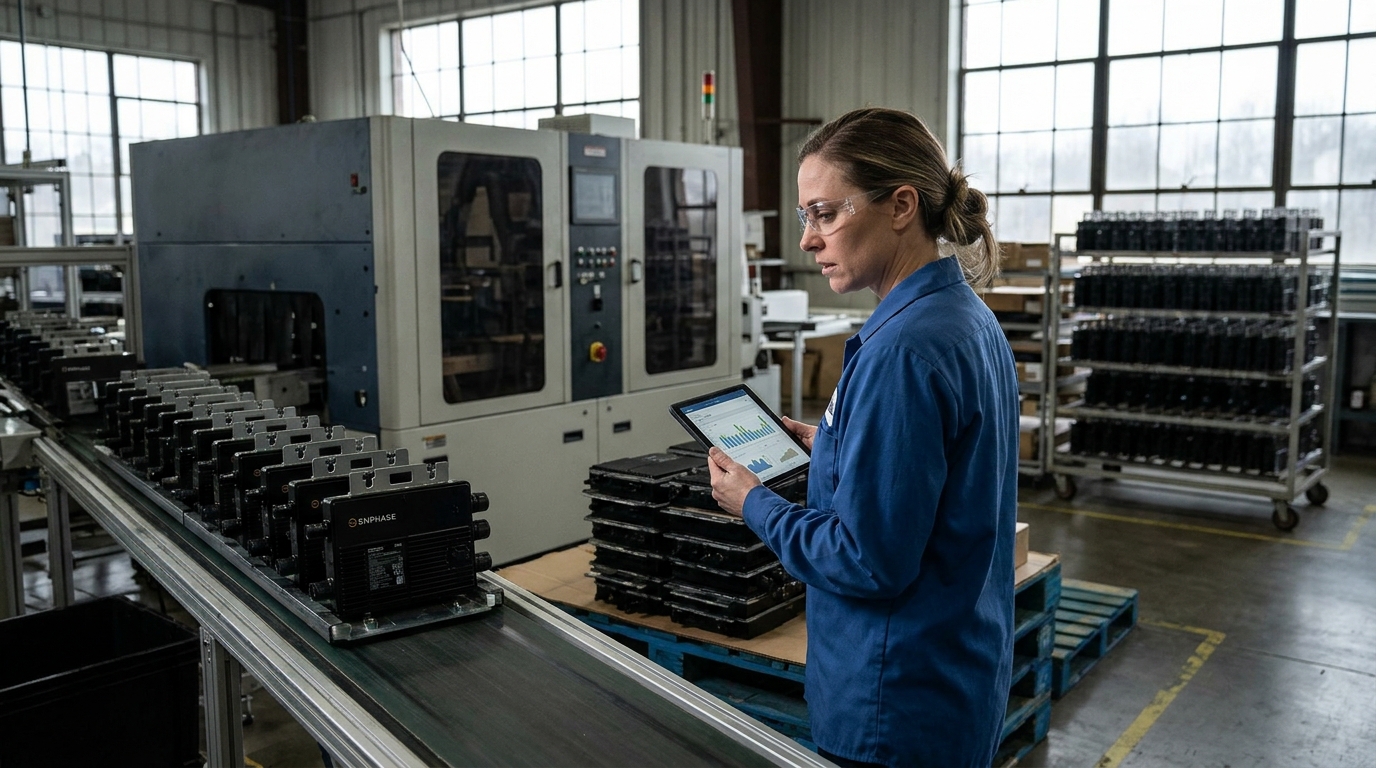
The company’s own 10-Q filings make this explicit. In Q3 2026, gross margin fell 4.5 percentage points year over year, driven by product price decreases and lower shipment volumes of IQ Batteries and microinverters that resulted in unfavorable absorption of fixed manufacturing and supply chain costs over a lower revenue base. That same theme appears across recent filings. This is not a one-quarter phenomenon; it is a recurring mechanical drag.
The revenue picture is bleak. Revenue fell 28% year over year to $293.3 million in Q3, underscored by a 35% decline in U.S. sell-through year over year. Then came the guidance, which did more damage than the quarterly numbers themselves. Enphase’s Q4 2026 revenue guidance midpoint of $240 million sits well below the Wall Street consensus cited by some services, and behind that outlook the company assumes sell-through falls 10% sequentially while it plans to ship $20 million below sell-through to drain channel inventory.
What makes this trap particularly tight is the demand catalyst that might break it. The core U.S. residential solar market continues to face headwinds from higher interest rates and the end of the Section 25D federal residential clean energy credit for new expenditures after December 31, 2025. Enphase’s residential microinverter and battery business is exposed to that dynamic more directly than a utility-scale competitor. When borrowing costs rise, homeowners defer or scale back the systems that carry Enphase’s hardware, and the demand signal into its channel softens with them. Both levers, rates and tax policy, sit entirely outside the company’s control.
The operating cost structure compounds the problem. Non-GAAP operating expenses have been guided and reported around the high-$70 millions per quarter, which means that as the top line contracts toward a $240 million Q4 midpoint, operating leverage works in reverse. Q1 produced a GAAP operating loss of $29.6 million when revenue hit $282.9 million. A Q4 midpoint $43 million lower than that implies the GAAP line stays under severe pressure.
Management’s pivot toward AI data centers via the IQ Solid-State Transformer is real but distant. Commercial shipments are expected to begin in 2028. Until then, ENPH is still trading on residential demand. The valuation discount is genuine, but a cheap price does not resolve a cost structure that punishes every quarter the demand recovery does not arrive.
The battery hardware supply chain adds another layer to the valuation question. Softening lithium prices and analyst target cuts across battery-materials names signal the same demand weakness weighing on Enphase’s IQ Battery shipment volumes.