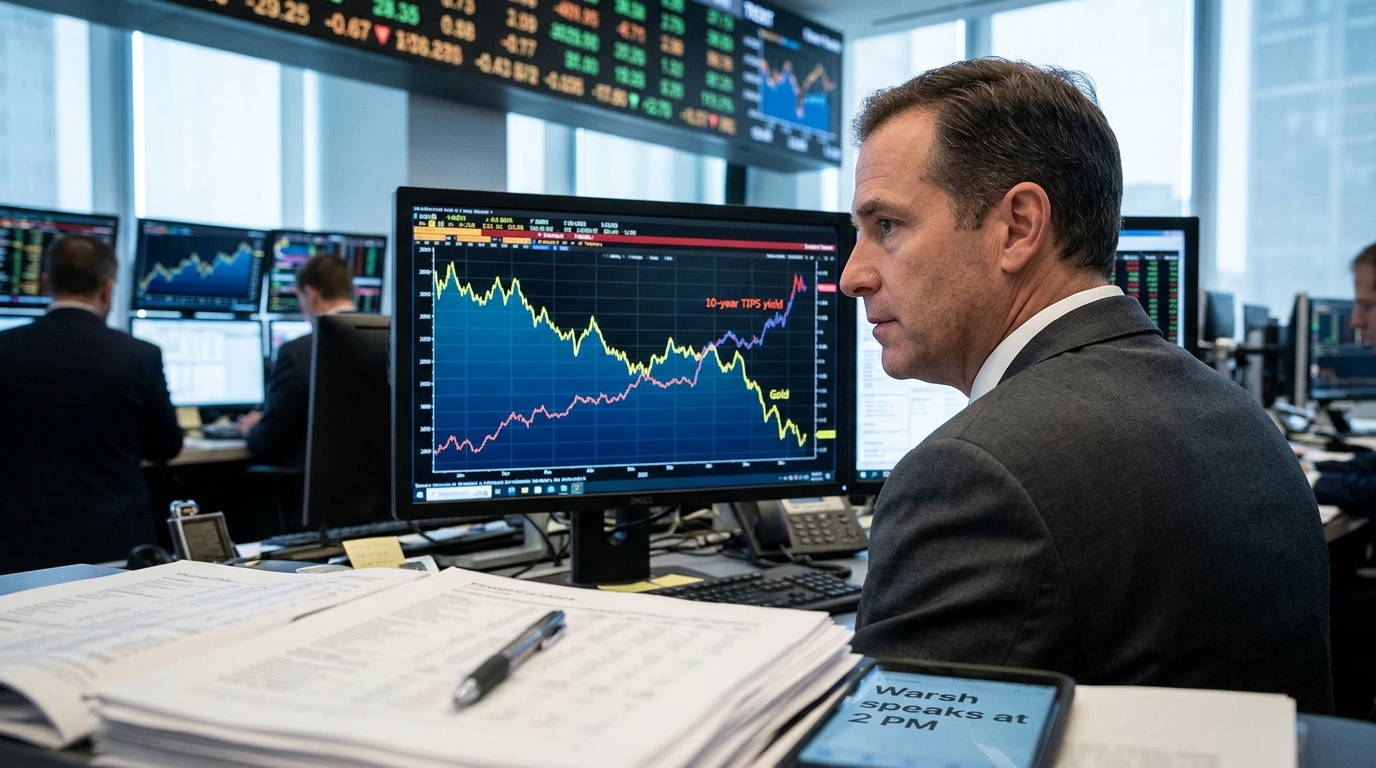
Spot gold traded near $3,856 this morning, down 1.13% from the previous day, and the chart tells a straightforward rates story: every leg lower since the metal touched $4,000-plus last Wednesday lines up with a bond market that is raising the cost of holding a zero-yielding asset in real time.
Gold has fallen to its lowest level since late September 2025, losing roughly 6.85% over the past four weeks. Silver tracked the move lower, with spot silver trading near $47.34, down about $1.24 on the session. The GLD ETF and the miners, Newmont (NEM) and Barrick Mining (B), face the same headwind at the open.
The Rates Argument
The proximate cause is not a mystery. The 10-year real Treasury yield climbed from 2.63% on November 6 to 2.86% on November 12, a 23-basis-point increase in six trading days. That rate is now near the upper end of its post-2003 range. For gold, which offers no coupon, that is a direct and measurable opportunity cost. Real yields do not have a fixed inverse relationship with gold, but they do represent a significant opportunity cost being paid.
The bond market is not waiting on the Fed to act. A quarter-point December hike is largely priced, with the 10-year Treasury yield around 5.10%. Futures pricing still implies a smaller chance of a half-point move at that meeting. The two-year yield jumped sharply last week, following hotter-than-expected inflation data and hawkish comments from Federal Reserve officials. This is a regime change from the one that pushed gold to record highs earlier in the year.
Warsh Today: Tone Matters More Than Words
Fed Chair Kevin Warsh gives opening remarks today at the Federal Reserve Board and San Francisco Fed conference tied to the Fed’s Productivity and Jobs Task Force. An explicit statement on rates is unlikely in short opening remarks; the tone is what counts. Two reads matter for gold traders. If Warsh frames AI-driven productivity as a reason the Fed can be patient, real yields could soften and gold could stabilize. If instead he stresses the costs of the AI boom, meaning power, chips, and scarce skilled workers, the market could read that as a sign of rates staying high for longer.
Warsh said at his October 28, 2026, press conference that Americans “are still dealing with inflation that has been running above the Committee’s objective for close to 6 years.” He has shown little appetite for softening that message ahead of a meeting where a hike is widely expected. New York Fed President John Williams and Minneapolis Fed President Neel Kashkari are also scheduled to appear later this week, so this afternoon is only the first of several chances for a hawkish surprise.
Miners and the Trade Structure
Equity-side exposure to this move runs through NEM and Barrick (B). Senior producers can offer investors strong balance sheets and a record of profitability, and in a sustained rising gold market they have the potential to significantly outperform gold. The inverse is also true: when spot breaks key support, miners amplify the downside through operational leverage. A breakdown in gold below $3,850 potentially exposes $3,500 as the next meaningful level.
Key levels today: $3,850 is the first line in the sand for bulls. A close below it on volume shifts the near-term bias firmly lower. On the upside, any recovery above $3,920 intraday would suggest the Warsh remarks came in softer than feared. Silver under $47.50 would confirm that the selloff has legs beyond gold-specific positioning.
The thesis here is not that gold is broken permanently. It is that the current rate environment is the wrong one for a momentum long. Until real yields roll over or the December meeting surprises to the dovish side, every rally in XAU is likely to find sellers. Watch the remarks closely. Warsh’s word choice on productivity costs, not his silence on rates, is what moves gold this afternoon.