
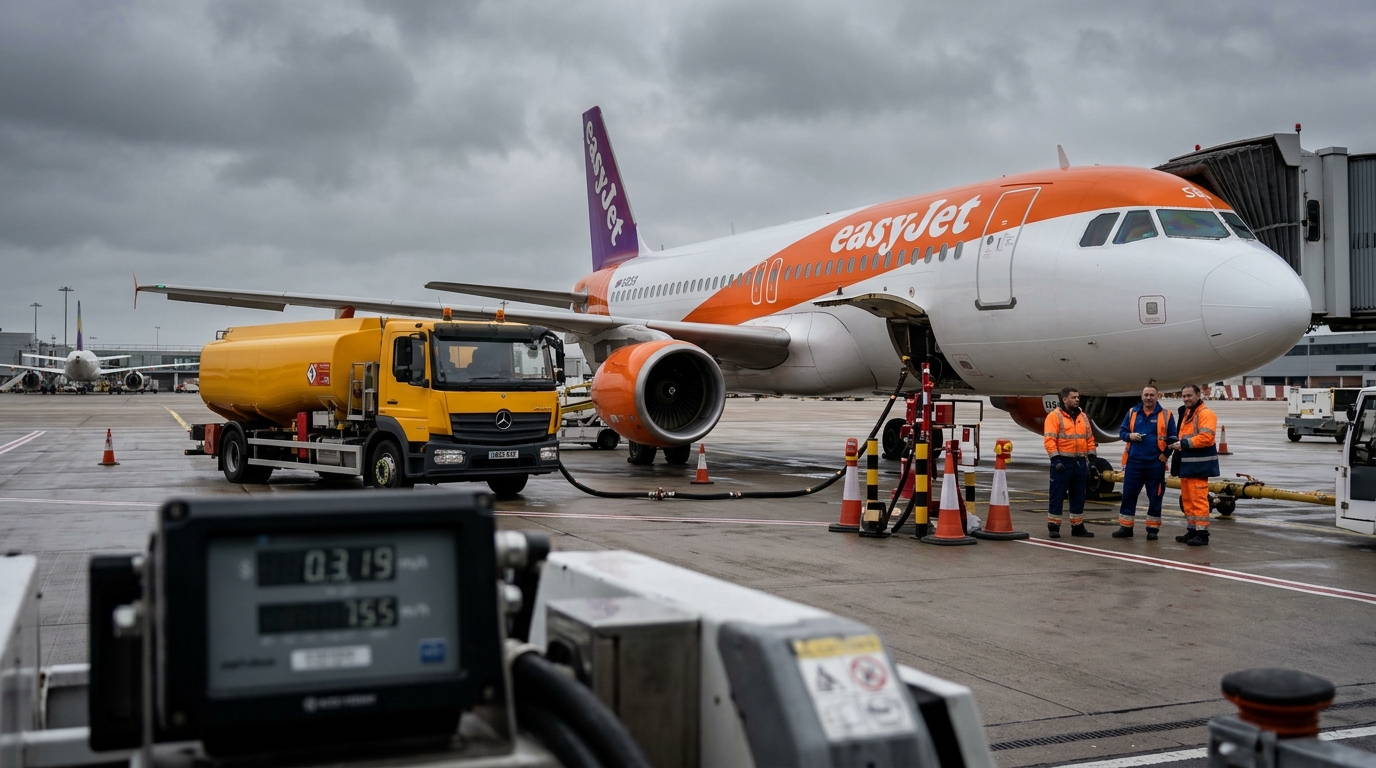
EasyJet reported its fiscal 2026 results on Tuesday, and the numbers deserve more than a headline glance. The airline arm swung to a £195 million headline pretax loss, reversing a £415 million profit a year earlier, and the collapse dragged the group’s headline pretax profit down 89%, from £665 million to £71 million. Revenue, meanwhile, rose 6% to £10.737 billion, but higher fuel and flight operating costs absorbed almost all of it.
The culprit is not complicated. Fuel costs rose 11% to £2.497 billion, adding £244 million to the annual bill. In the second half alone, fuel cost per available seat kilometer increased 12%, equal to another £211 million versus the same period a year earlier. Management pointed directly at the Middle East conflict as a driver of elevated jet fuel prices and softening demand from March onward.
The timing makes the lesson sharper. Brent crude traded in the mid-$90s per barrel in early Asian trade on Thursday, amid fresh shipping and infrastructure security concerns around the Strait of Hormuz and Saudi Arabia’s Ras Tanura complex. The same forces that damaged easyJet’s fiscal year are now still in motion. The airline’s customers next summer will fly in a world where the fuel backdrop may be worse, not better.
What Competitors Did Differently
This is where the investor lesson lives. Fuel is the largest single operating cost for any airline, and the difference between a carrier that hedges aggressively and one that does not can be measured in hundreds of millions of pounds within a single year. Ryanair’s stated policy is to hedge up to approximately 90% of forecast fuel consumption to lock in future costs, and at the end of March 2026 had already secured forward cover on about 80% of its estimated FY27 fuel exposure.
Lufthansa runs a hedging horizon of up to 24 months, and the group has said its hedging ratio for its passenger airlines was around 86% for 2026. IAG, the owner of British Airways and Iberia, operates a three-year rolling hedging policy with coverage reaching up to 75% of near-term requirements. These are not incidental details. They are structural decisions that determine how exposed a business is when a refinery in eastern Saudi Arabia comes under attack overnight.
EasyJet, by contrast, reported a net fuel hedging benefit of £515 million for the year, against a £137 million loss on hedges the prior year, which shows hedging activity was present, but clearly insufficient to offset a £244 million cost increase that overwhelmed a full year of revenue growth.
The Question to Ask Before You Buy Any Stock
EasyJet’s predicament is not unique to airlines. Any company where a single uncontrollable input, energy, raw materials, currency, commodity prices, accounts for a substantial share of revenues carries this risk. The question investors rarely ask before buying is: what proportion of that cost is locked in, at what price, and for how long?
Fuel hedging can protect airlines against price volatility by using financial instruments to secure prices in advance. Because fuel is one of the industry’s largest operating expenses, hedging provides cost predictability and can help carriers protect profit margins. But hedging can only mitigate, not eliminate, the impact of higher fuel prices. The gap between mitigation and elimination is where easyJet spent fiscal 2026.
With Brent still trading around the mid-$90s amid renewed disruption risk tied to Hormuz and regional infrastructure threats, the pressure is not fading. For investors who own airline stocks, or any business with a large commodity cost base, the annual report’s hedging disclosure section is not boilerplate. It is the single most revealing indicator of how well management is protecting the bottom line from events entirely outside their control.
Wealth Takeaway
EasyJet’s 89% profit drop was not caused by bad strategy or poor execution alone. It was driven in large part by a commodity price the company could not fully neutralize. Before adding any business to a long-term portfolio, check what percentage of its major input costs are hedged, over what time horizon, and at what price. That one habit can help you avoid the next easyJet before it shows up in a results statement.