
Last week, two local governments handed investors a reminder that the most consequential bottleneck in artificial intelligence infrastructure may not be chips or power, it may be the permit office down the road.
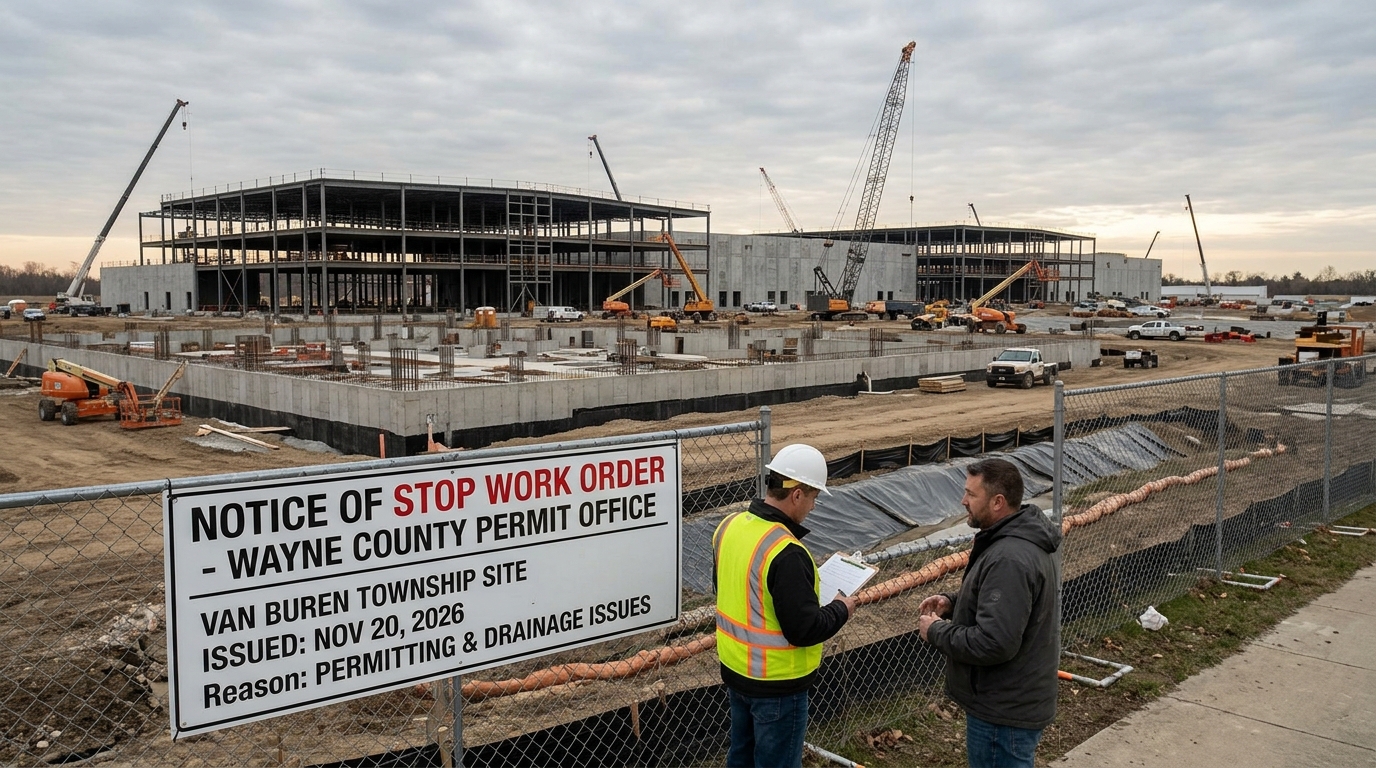
Wayne County ordered a halt on November 20, 2026 to construction of Google’s planned data center in Van Buren Township, Michigan, citing drainage, permitting, and erosion-control issues. The project, codenamed “Project Cannoli,” has been described in local reporting as a roughly 282-acre campus expected to require about 1 gigawatt of electricity, with an estimated value of about $2 billion. The development had won approvals from Van Buren Township, but county officials said the project began work without the required county permit for activity affecting county property or drain easements. The stop-work order cited several compliance issues, including work tied to county easements and erosion-and-sediment controls intended to keep mud and silt out of the county’s drainage system.
Three days earlier and 700 miles west, the Aurora City Council passed a temporary data center moratorium in a unanimous vote on November 23, 2026, after earlier efforts had failed. The council adopted a one-year pause on accepting, processing, or approving new data center applications in a defined area west and south of the planned Aerotropolis Parkway and Interstate 70 intersection, extending to Aurora’s city limits, while more comprehensive data center regulations are developed. The vote was accompanied by a corporate retreat: Vantage Data Centers said it would not move forward with its Trident data center plans at the initially proposed Windler-area location near Green Valley Ranch neighborhoods. Project materials for Trident have described a campus on about 108 acres and on the order of 500 megawatts.
The Bigger Trend
These are not isolated events. They are two data points in a dataset that has been growing at a pace most investors haven’t processed. Reporting this year has cited Data Center Watch data showing a surge in projects blocked or delayed amid community opposition in early 2026, including at least 75 projects worth about $130 billion in the first quarter alone. Aurora also joins a growing list of Colorado jurisdictions using temporary pauses or tighter rules on data center development, including Denver’s one-year pause from May 2026 to May 2027, and Boulder County’s temporary moratorium in unincorporated areas during its land-use code update process.
The opposition is bipartisan and hyperlocal. Concerns center on grid strain, flooding risk, noise, and the perception that large technology companies are extracting community resources while contributing little in return. In Colorado, state-level scrutiny has risen alongside local action: the Colorado Public Utilities Commission has required Xcel Energy to file a large-load tariff and adopt other measures aimed at limiting the risk that rapid data center growth shifts costs onto other customers. That regulatory dimension adds a state-level layer on top of the local one, meaning projects can face friction from multiple directions simultaneously.
The Investment Case
For holders of data-center REITs and utilities bought on the AI infrastructure story, this trend cuts in two directions and understanding the difference matters.
Local resistance is not automatically bearish for established operators. If it limits new supply while demand stays strong, existing facilities gain scarcity value. The line flips when restrictions delay the operators’ own pipeline. New zoning restrictions and rising construction costs can strengthen pricing power for operators with secured land, entitlements, and power, and both Equinix and Digital Realty have recently pointed to strong leasing momentum and bookings.
Equinix’s existing network of interconnected colocation facilities is genuinely difficult to replicate under tightening permitting conditions. Digital Realty has described a multi-year development pipeline measured in gigawatts, and it has also disclosed more than 5 gigawatts of future development capacity across its platform. Geographic diversification matters more than it did a year ago.
The more direct exposure runs through Google parent Alphabet and through private developers like Vantage and Panattoni, whose greenfield pipelines now carry regulatory risk that discounted cash flow models routinely miss. In Wayne County, the dispute has centered on a county construction permit that is separate from township land-use approvals, and the stop-work order shows how a single local permitting gap can become a schedule risk even after a project clears other votes.
Risks to Monitor
Permitting restrictions and moratoriums could weigh on future growth by slowing development timelines and pushing up costs, according to analyst commentary that has accompanied the sector’s recent run. The more important question for portfolio positioning is which companies absorb that cost and which pass it on. Established operators with permitted campuses may pass more of it on through higher lease rates. Hyperscalers building their own capacity, and the developers they hire, are more likely to absorb it through schedule delays and capital cost overruns.
Heavy capex needs, high leverage, and political scrutiny of data center power use and grid impacts add execution and regulatory risk for even the best-positioned operators. Valuations on data-center REITs reflect AI demand; they do not fully reflect the county-by-county friction now embedded in every new development timeline.
Daily Wealth Takeaway
The AI infrastructure story is real, but infrastructure requires permits, and permits require local approval. The investors who build lasting wealth around this theme will be those who distinguish between companies that own operating capacity and companies that are still trying to build it. Right now, that distinction is worth more than most models suggest.