
April 27, 2026
Boeing (NYSE: BA) — Deep Research Report
Analyst Ratings · Leadership · History · Innovations · Backlog · Technicals · Recent News
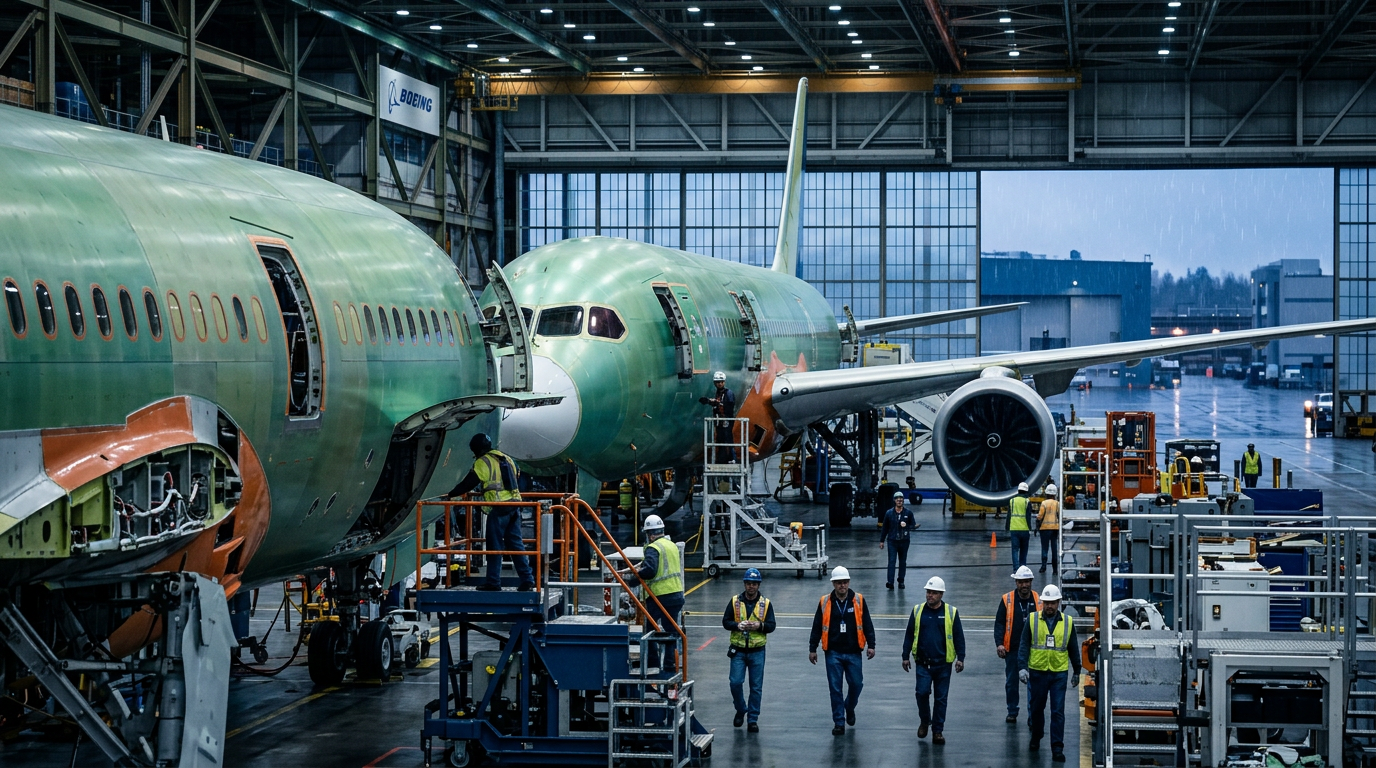
Boeing is one of those companies where the story is never simple. It’s simultaneously one of the most critical industrial names on the planet and one of the most battered. The recovery is real — but so are the remaining risks. Here’s everything you need to know right now.
Analyst Ratings
Wall Street is broadly bullish. The consensus across major platforms is a “Strong Buy.” Here’s how it breaks down:
| Source | Rating | Avg. Price Target | Target Range |
|---|---|---|---|
| TipRanks (16 analysts) | Strong Buy | $273.77 | — |
| StockAnalysis (19 analysts) | Strong Buy | $252.79 | $140 – $298 |
| Nasdaq (25 analysts) | Moderate Buy | — | 15 Strong Buy, 8 Hold, 1 Strong Sell |
| MarketBeat | Buy | $259.35 | — |
| Fintel (consensus) | Buy | $256.95 | $222.20 – $299.25 |
Of the 16 analysts tracked on TipRanks, 56% recommend a Strong Buy, 38% a Buy, and just 6% suggest holding. Based on the average price target, Boeing carries roughly 22.56% upside potential from current levels.
The low-end outlier: Wells Fargo sits at $140 — a meaningful gap from the $273 consensus. That spread tells you something real about how differently analysts are sizing the remaining execution risk.
Despite underperformance relative to the broader market over the past year, Wall Street as a whole is leaning constructive. The thesis isn’t that Boeing has fixed everything. It’s that the worst is behind them.
Intel spiked. Smart money is looking upstream
Intel just surged 23.6% after earnings, one of its biggest moves in decades. Investors are flooding into AI infrastructure. But chips aren’t the full story.
AI runs on data. And real, human data is becoming scarce. Mode Mobile is building directly into that gap with a 490M+ user ecosystem generating consented,< real-world behavior.
They’ve already driven $115M+ in revenue and helped users earn over $1B. As AI scales, data suppliers may capture outsized value. Mode is still private, with shares at $0.50.
Get in before the next wave of AI value is priced in.
Please read the offering circular at invest.modemobile.com. This is a paid advertisement for Mode Mobile’s Regulation A Offering.
Key Leadership
Kelly Ortberg — President & CEO
Boeing appointed Kelly Ortberg as CEO in August 2024, replacing Dave Calhoun. Ortberg brings over 35 years of aerospace industry experience — mechanical engineering degree from the University of Iowa, started as an engineer at Texas Instruments in 1983, and later rose to CEO at Rockwell Collins (now Collins Aerospace) before landing at Boeing.
After spiraling from crisis to crisis over much of the past seven years, Boeing is stabilizing. Even Ryanair CEO Michael O’Leary — one of Boeing’s most vocal public critics for years — recently said he believes Ortberg and Stephanie Pope are doing a great job and that the quality coming off the line has dramatically improved. That’s not nothing.
Stephanie Pope — President & CEO, Boeing Commercial Airplanes
Pope runs Boeing’s most critical revenue engine. She has been central to the effort to restabilize 737 MAX production and restore quality standards at the manufacturing level — the unglamorous work that actually determines whether the recovery holds.
Steve Parker — President & CEO, Boeing Defense, Space & Security
Parker has been with the aerospace giant for 37 years. He served as interim leader of the defense business unit since September 2024 before being formally appointed. Deep institutional knowledge — exactly what the defense segment needs right now given the F-47 program ramp.
Jay Malave — CFO (from Lockheed Martin)
Malave joined Boeing as Executive Vice President and Chief Financial Officer after transitioning from Lockheed Martin. Before Lockheed, he served as CFO at L3Harris Technologies and spent more than 20 years at United Technologies Corp. His hire signals Boeing is serious about financial discipline — the balance sheet cleanup is a multi-year job.
Company History & Background
The Boeing Company was incorporated in 1916 and is headquartered in Arlington, Virginia. Over more than a century it grew from a small Seattle seaplane operation into one of the world’s largest aerospace and defense companies — valued at a market cap of roughly $108.7 billion, designing, manufacturing, and servicing commercial jetliners, military aircraft, satellites, missile defense systems, and human spaceflight vehicles.
The modern Boeing runs across three segments: Commercial Airplanes, Defense Space & Security, and Global Services. The last two decades have not been kind. Here’s the honest timeline:
- 1997 — Boeing merges with McDonnell Douglas, cementing its position as the dominant U.S. commercial aerospace player.
- 2013–2019 — Boeing spent over $60 billion on dividends and stock buybacks — twice the development cost of the 787. The short-termism would come back to haunt them.
- 2018–2019 — Two fatal 737 MAX crashes kill 346 people. The MAX is grounded globally for 20 months in the worst crisis in commercial aviation history.
- 2020 — COVID-19 collapses aviation demand just as MAX recertification drags on. A brutal double hit.
- January 2024 — On Alaska Airlines Flight 1282, a door plug blows out on a 737 MAX 9 at 16,000 feet, leaving a door-sized hole in the fuselage. No fatalities — but the reputational damage is severe.
- March 2024 — CEO Dave Calhoun and board chairman Larry Kellner both announce they are stepping down.
- June 2024 — Boeing agrees to re-acquire Spirit AeroSystems, its longtime parts supplier, for $4.7 billion — bringing quality control back in-house.
- August 2024 — Kelly Ortberg takes the helm. The stabilization era begins.
Done Trading by 10 AM With Triple-Digit Gains
What if one simple pattern at the market open could hand you gains like 240% on META and 139% on GLD? The Opening Bell Trade Guide reveals the exact setup, the timing, and why this window keeps producing outsized wins. Download it free before we start charging for it.
Innovations & Key Programs
This is where Boeing’s long-term thesis actually lives. Strip away the headlines and the crises and you’re looking at a company running some of the most consequential aerospace programs in modern history. The product portfolio is genuinely world-class. The execution around it has been the problem.
787 Dreamliner
The 787 Dreamliner fleet surpassed 1 billion passengers carried — faster than any widebody commercial airplane in history and in under 14 years of service. The numbers are staggering: 1,175+ jets in operation, nearly 5 million flights flown, 30+ million flight hours logged, operating across 85+ countries at 520+ airports. On average, each 787 is airborne more than 12 hours per day. That is an extraordinary utilization rate for a widebody jet — and it’s exactly why airlines keep ordering more.
777X
The 777X is a long-range, wide-body, twin-engine airliner still in flight testing. Key advances over prior generations include GE9X engines, composite wings with folding wingtips, a wider cabin, and technologies carried over from the 787 program. First delivery is now guided for 2027.
Emirates boosted their 777-9 order by 65 jets in late 2025, bringing their total to 270 aircraft. The demand signal is crystal clear — this is a certification timeline problem, not a market problem. Those are two very different kinds of problems to have.
F-47 — America’s 6th-Generation Fighter
This is the defense story of the decade — and it landed in Boeing’s favor.
The Boeing F-47 is the planned U.S. Air Force air superiority aircraft under the Next Generation Air Dominance (NGAD) program — designed to be the first sixth-generation fighter and the successor to the F-22 Raptor. On March 21, 2025, President Trump announced Boeing had won the contract. It was the first time a new American air superiority fighter had been awarded in over three decades.
The contract is worth at least $20 billion for engineering and manufacturing development, with lifetime production orders potentially valued in the hundreds of billions. Air Force leadership has stated intent to acquire 185-plus F-47s, with a combat radius exceeding 1,000 nautical miles and a top speed above Mach 2. Worth noting: this is the first Boeing clean-sheet fighter design ever selected. The F-15EX and everything before it came from McDonnell Douglas via the 1997 merger. The F-47 is all Boeing.
Space & Defense Portfolio
Boeing’s Space Launch System core stage powered the Artemis II mission — completing the first crewed flight to the moon under the Artemis program in April 2026. On the defense side, Boeing Defense, Space & Security signed a seven-year framework agreement to expand PAC-3 Seeker production and announced a strategic partnership with Rheinmetall to bring the MQ-28 Ghost Bat unmanned combat aircraft to Germany. The international defense pipeline is building.
Order Backlog
Here’s the part that bulls point to constantly — and they’re right to. The backlog is staggering.
| Segment | Backlog (Q1 2026) | Notes |
|---|---|---|
| Total Company | $695 Billion (Record) | All three segments at record levels |
| Commercial Airplanes | $576 Billion | 6,100+ aircraft on order |
| Defense, Space & Security | $86 Billion | 27% from international customers |
| Global Services | $33 Billion | Record level |
Total company backlog hit a record $695 billion in Q1 2026 — all three segments at all-time highs simultaneously. The backlog equates to approximately 11.4 years of deliveries at the current production rate. Read that again. 11.4 years.
That’s not a demand problem. That is a production problem — and those are fundamentally easier to solve than demand problems, assuming management can execute.
Recent orders that pushed it here: Delta Air Lines placed its first-ever direct order for up to 60 787 Dreamliners. Aviation Capital Group ordered 50 737 MAX aircraft — the largest 737-10 order by a lessor ever. Alaska Airlines placed a record-breaking order for 105 737-10s and five 787s. And Boeing has 4,763 MAX aircraft in backlog as of March 2025 from that single program alone.
Technical Analysis — BA Stock
The tape has been interesting. BA ran roughly 88% from its April 2025 lows into early 2026 — which both validates the recovery narrative and forces a valuation conversation.
| Metric | Value |
|---|---|
| Current Price (approx.) | ~$213–$231 (recent range) |
| Avg. Analyst Price Target | $252–$274 (varies by source) |
| Lowest Target (Wells Fargo) | $140 |
| Highest Target | $298–$299 |
| P/E Ratio | ~55.89x |
| P/B Ratio | ~30.86x |
| Total Debt (Q4 2025) | $54.1 Billion |
| Cash & Equivalents | ~$20.9 Billion |
| TradingView 1-Month Signal | Strong Buy |
| Barchart Short-Term Signal | 16% Sell (weakest short-term) |
Boeing shares are trading at elevated multiples — P/E near 56x — which signals strong market expectations for profitability ahead. The problem is that weak free cash flow and $47B in remaining debt still hang over the story.
The divergence between the 1-month Strong Buy technical signal and the short-term Barchart sell reading is worth noting. It points to consolidation — not breakdown — after a big run. The longer-term momentum picture still looks constructive if key resistance holds.
On the balance sheet: cash and marketable securities stood at $20.9 billion at Q1 end, down from $29.4 billion at year-end 2025. Consolidated debt fell from $54.1 billion to $47.2 billion — a $6.95 billion paydown in a single quarter. Progress is real. But this is still a multi-year cleanup job.
Louis Navellier: Don’t buy OR sell another AI stock…
Until you’ve heard this urgent AI warning from the man who called Nvidia before its 44,000% rise…
According to Louis, a massive reset is coming in an obscure corner of the AI market.
This $100 trillion disruption could send some of the world’s biggest AI stocks to zero… and one off-the-radar stock soaring… starting now.
Recent News & Developments
Q1 2026 Earnings — April 22, 2026
Boeing reported a narrower first-quarter loss as higher commercial deliveries lifted revenue. Q1 revenue came in at $22.2 billion — up 14% year-on-year — on 143 commercial deliveries. GAAP net loss narrowed to $7 million from $31 million a year prior. Core loss per share improved to $0.20 from $0.49. Not profitable yet, but the trajectory is moving in the right direction.
China Trade War Headwind
China stopped accepting Boeing aircraft amid the trade war. Boeing said it would resell planes originally destined for Chinese airlines, with aircraft from Zhoushan repositioned back to Seattle and stored in Moses Lake, Washington. Real near-term friction. CEO Ortberg addressed it directly: the strong start to the year, combined with the half-trillion-dollar backlog, gives Boeing the flexibility to navigate the environment.
Production Rate Update
The 737 program is running at 42 aircraft per month — the rate cleared by the FAA in October 2025 following the cap imposed after the Alaska Airlines door plug incident. Ortberg has flagged plans to increase to 52 per month, though no formal timeline has been provided. That gap between 42 and 52 is where a lot of the cash flow story lives.
Jeppesen Sale to Thoma Bravo — $10.55 Billion
Boeing announced the sale of its Jeppesen navigation unit and parts of its digital aviation business to Thoma Bravo in an all-cash deal worth $10.55 billion. Strategic portfolio sharpening — proceeds directed at debt reduction and core production investment.
Ethiopian Airlines 787 Order
Ethiopian Airlines announced the purchase of additional 787 Dreamliners, expanding its widebody fleet for international growth. Africa’s largest 787 operator adding to its position is a clean demand signal for the program.
Artemis II Moon Mission
In April 2026, Artemis II completed its crewed mission to the moon powered by the Boeing-built Space Launch System core stage. A meaningful credibility moment for the space segment after years of Starliner setbacks.
Bull vs. Bear — The Honest Take
| Bull Case | Bear Case |
|---|---|
| Record $695B backlog — demand is not the issue | Still burning cash; free cash flow negative Q1 2026 |
| F-47 contract — $20B+ with hundreds of billions in lifetime potential | China trade war actively blocking aircraft deliveries |
| Ortberg executing — airline customers praising quality improvements | $47B in debt remains a major structural overhang |
| 737 MAX production ramp underway; 777X certification nearing | 777X and 737-7/10 certification delays continue |
| Artemis II success — space credibility restored | High P/E multiples after 88% stock run from lows |
| Revenue up 14% year-over-year in Q1 2026 | KC-46A tanker program still generating losses |
Boeing’s problems are well-documented — the market has priced in a lot of the bad news over the last few years. What gets less attention is that the company has spent the last 18 months systematically working through them. One production milestone at a time, one leadership upgrade at a time, one contract win at a time.
The backlog says customers still believe in this company. The F-47 says the Pentagon does too. The question — the only real question — is whether execution can finally match the ambition.
That’s the trade.