June 9, 2026
MOD: The Chiller Stock Sitting Inside the AI Power Crisis
Modine Manufacturing Is Quietly Becoming the Thermal Backbone of AI Infrastructure
MOD Trading Cheat Sheet
- Ticker: MOD (NYSE)
- Sector: Industrials / Data Center Infrastructure
- Catalyst: $4B long-term chiller supply agreement (2027-2029) + Q4 FY2026 earnings beat
- Q4 Data Center Revenue: $400M+ — up 158% year over year
- Full-Year Data Center Revenue: $1.1B — up 73% year over year
- Q4 Adjusted EPS: $1.71 vs. $1.51 consensus (+13.2% beat)
- FY2027 Data Center Growth Guidance: 60% to 80%
- FY2027 Adjusted EBITDA Guidance: $650M to $680M
- Key Product: TurboChill 3+MW free-cooling chiller (Airedale by Modine)
- Capacity Move: Doubling global chiller production by end of FY2027
- Upfront Payment Received: $165M from unnamed hyperscale customer
- Upcoming Event: Performance Technologies spin-off merger with Gentherm pending
- Primary Risk: Near-term margin compression in Q1 FY2027 + single customer concentration
There is a constraint that no software optimization can solve. You can compress a model. You can quantify weights. You can distribute compute across a thousand nodes. But you cannot compress heat.
Every GPU cluster running a next-generation AI workload converts electricity into computation and heat in roughly equal measure. The heat has to go somewhere. And as cluster densities push into the multi-megawatt range per rack row, the physical infrastructure required to reject that heat at the building level has become one of the most constrained resources in the entire AI supply chain. Not software. Not chips. Chillers.
While investors have chased GPU makers, hyperscaler stocks, and fiber plays, a manufacturer in Racine, Wisconsin has been quietly signing agreements that would make a defense contractor take notice. Modine Manufacturing Company (NYSE: MOD) just reported fiscal Q4 2026 results that deserve a real look.
The SpaceX IPO Could Move More Than Just Stocks
When major IPOs hit Wall Street, money doesn’t just flow into new shares.
Funds rebalance. Institutions reposition. Retirement accounts often move with them whether investors realize it or not.
A new free 2026 Gold Guide explains how some Americans are moving part of their retirement savings into physical gold tax-free and penalty-free.
Why the Grid Constraint Changes Everything
Power Usage Effectiveness, or PUE, has become the defining metric for data center operators. A PUE of 1.0 means every watt from the grid goes to compute. In practice, cooling, lighting, and power conversion take a cut. The lower the PUE, the more compute you can run on a fixed power budget.
That fraction matters enormously right now. U.S. grid capacity is not expanding fast enough to meet AI infrastructure demand. Hyperscalers are signing power purchase agreements years in advance and still waiting on utility interconnection approvals. In that environment, shaving fractions off a PUE score means more usable compute without adding a single new megawatt. Operators are not just trying to be efficient. They are trying to survive a capacity ceiling.
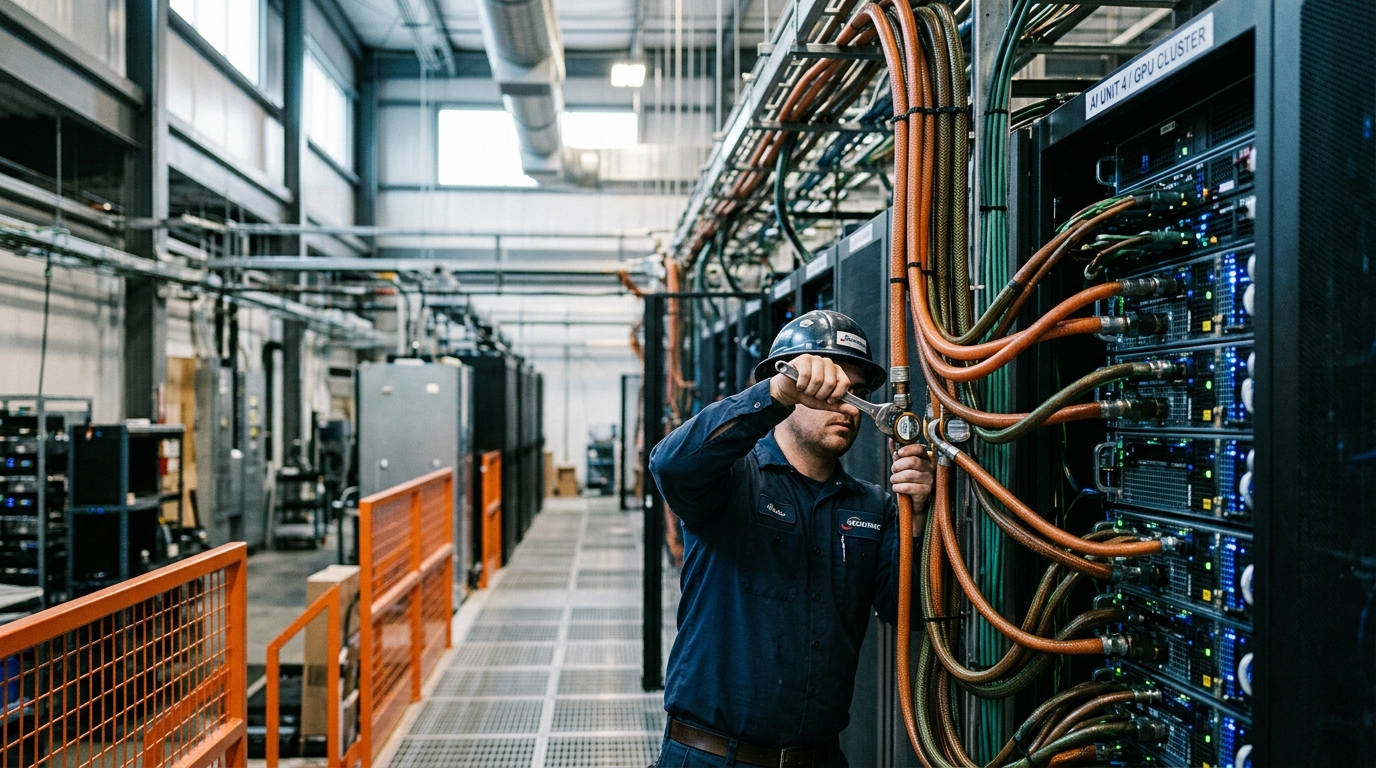
The part people skip: the solution is not just moving fluid through a chip. It is rejecting massive heat loads at the building level using ambient free-cooling chillers that dramatically reduce the need for energy-intensive mechanical refrigeration. This is the category Modine has spent over two decades engineering.
Airedale by Modine, the company’s critical cooling brand, has pioneered concurrent free-cooling technology for more than 20 years. The core concept is deceptively simple: use ambient outdoor air to reject heat whenever conditions allow, and stage mechanical cooling only when necessary. The result is a materially lower energy footprint across the full operating year, and a PUE profile that hyperscale operators are increasingly demanding as a baseline spec before a facility even breaks ground.
The Product Built for This Moment
In January 2026, Airedale by Modine unveiled the TurboChill 3+MW. Not a refresh. A ground-up response to the thermal demands of GPU-dense AI clusters operating at densities conventional chiller platforms were never designed to handle.
CEO Neil Brinker cited the specs on the Q4 earnings call: the 3-megawatt chiller delivers 50% more cooling capacity in only 9% more physical footprint. That ratio matters when data center land and power delivery infrastructure are both constrained. Operators get more thermal rejection in the same physical envelope, which translates directly to more usable rack density without expanding the building.
Paired with Airedale’s Cooling System Optimizer, which can configure and stage up to 20 TurboChill units as a single coordinated block, the architecture is built for hyperscale deployments where system consistency and uptime are non-negotiable. This is not standard HVAC equipment with a data center label attached to it. The product was engineered specifically for high-density, mission-critical AI environments, and that focus is showing up directly in the revenue figures.
When BlackRock, Goldman, and Carl Icahn Are All In – Pay Attention
BlackRock. Goldman Sachs. Carl Icahn. They all quietly bought the same small stock sitting on $9 billion in private SpaceX shares.
Tim Bohen spotted it too – and made a free video breaking it down before Friday’s IPO deadline.
Q4 2026: What the Numbers Actually Show
Modine reported fiscal Q4 2026 results on May 26, 2026. Almost every line beat expectations, and the data center segment in particular was not close.
- Net sales of $954.4 million – up 47% year over year, beating the $907 million consensus by more than 5%
- Data center revenues exceeded $400 million – a 158% year-over-year increase, delivered despite severe weather that eliminated 20 production shifts
- Full-year data center sales of $1.1 billion – up 73% for the full fiscal year, with Climate Solutions segment revenues up 43%
- Adjusted EPS of $1.71 – up 53% year over year, beating the $1.51 consensus estimate by 13.2%
- Record adjusted EBITDA of $146.1 million for the quarter – up 40%, marking the fourth consecutive year of 20% or more annual EBITDA growth
The weather detail is worth sitting with for a second. North American chiller production increased fivefold year over year and still got cut short by 20 lost production shifts. Strip that out and the organic output trajectory is steeper than the reported numbers suggest.
What’s interesting is that physical production was already moving before the ink dried on the big agreement. Modine shipped its first chillers from the new Jefferson City, Missouri facility during Q4, and began shipping air handling units and coolant distribution units from its Franklin, Wisconsin plant. This is not a company announcing plans. Production is already out the door.
The $4 Billion Deal and What Its Structure Tells You
Alongside the earnings report came the announcement that will likely define how analysts model Modine for the next three years. The company secured a long-term capacity agreement committing to supply more than $4 billion of Airedale by Modine cooling products during calendar years 2027 through 2029.
The customer was not named. But here is the part that matters more than the dollar figure: the customer paid Modine $165 million upfront to fund the capacity build required to fulfill the commitment. A hyperscale operator transferred real capital to a chiller manufacturer before a single unit was ordered under the new agreement. That does not happen because cooling equipment is a commodity afterthought.
This financing model shows up in defense contracting and semiconductor fab agreements. The buyer pre-funds the supplier’s production capacity because lead times are long, alternatives are limited, and the cost of not securing supply is higher than the cost of the upfront payment. The fact that it is now appearing in chiller procurement tells you something real about where free-cooling infrastructure sits in the AI buildout priority stack.
CEO Brinker confirmed on the call that the agreement is with an existing customer and is specific to chillers. Not a broad facilities contract. Not a multi-product services deal. A targeted, chiller-specific commitment in the exact product category where Modine has spent two decades building its engineering depth.
The Expansion Phase and What Comes Next
To meet the incoming volume, Modine is executing what management described as the largest capacity expansion in the company’s history. Chiller production capacity is expected to double by the end of fiscal 2027, with additional lines coming online in fiscal 2028. The company has committed $100 million toward expanding U.S. data center product capacity, partially funded by that $165 million customer payment.
Management guided for data center revenue growth of 60% to 80% in fiscal 2027, and indicated that 50% to 70% annual growth is sustainable beyond that. Total company net sales are expected to grow 20% to 35% for fiscal 2027, with adjusted EBITDA of $650 million to $680 million – up from $471 million in fiscal 2026. If achieved, that would mark a fifth consecutive year of record results.
There is also a structural change coming at the portfolio level. Modine is in the process of spinning off its Performance Technologies segment through a merger with Gentherm. Once complete, what remains is a focused Climate Solutions and Data Centers business. The data center story gets cleaner and easier to underwrite. Whether that simplification drives a valuation re-rating is an open question, but the direction of travel seems deliberate.
The AI Bottleneck Nobody Saw Coming
Everyone talks about AI chips.
What’s getting less attention is power.
Goldman Sachs estimates electricity demand tied to AI is rising 15% annually, and many new facilities could face power shortages within a few years. One company already has $1.5 billion in orders for equipment these projects can’t operate without.
The interesting part? Investors still value it like a traditional industrial business.
With the SpaceX IPO approaching, that disconnect may not last.
Where the Risks Actually Live
This is not a clean story. It should not be presented as one.
Management was direct on the Q4 call: Q1 fiscal 2027 margins in both commercial HVAC and data centers are expected to be down year over year. Capacity expansion overhead, tariff pressure, and new production line ramp costs are compressing near-term margins even as revenue accelerates. Favorable comparisons should begin in Q2 and build through the back half – but the next 90 days are not going to look pretty on the margin line.
Execution risk on the $4 billion commitment is real. Guaranteeing that production volume across a three-year window requires clean supply chains, no weather disruptions, and near-flawless ramp execution across multiple new facilities simultaneously. The $165 million upfront payment funds the build, but capital does not eliminate operational complexity.
Customer concentration deserves attention too. The long-term agreement is with one unnamed customer. If that relationship faces any disruption – a shift in capital allocation, a technology direction change, or a renegotiation – the revenue visibility picture changes significantly and fast.
And the stock has already moved. Shares jumped roughly 17% to a new all-time high on the day the $4 billion deal was announced, and MOD had more than doubled year to date heading into the Q4 report. A meaningful portion of the good news is already reflected in the share price. Anyone looking at this now is not getting in early.
The Bigger Picture
For years, chillers were treated as standard facility equipment. Purchased in ordinary construction cycles, spec’d from commodity suppliers, installed and forgotten. That model is breaking down under the weight of AI cluster densities that conventional chiller platforms were never designed to handle.
Securing cooling capacity has become as strategically important as securing power capacity. The $165 million upfront payment is the market pricing that reality. You do not pre-fund a supplier’s manufacturing build for commodity equipment.
Modine sits at the intersection of three durable forces: the continued expansion of AI compute infrastructure, the grid constraints that make PUE optimization a hard requirement rather than a preference, and the industrial manufacturing depth that creates real barriers for new entrants. Free-cooling chiller engineering is not a software feature. You cannot spin up a competing production line in six months.
The company has been solving thermal management problems for over a century. The current AI infrastructure cycle is just the largest, most concentrated version of that problem the market has ever produced. Whether management can execute cleanly through the margin pressure of the next two quarters will tell you a lot about what this stock looks like in 2027.
That part is still being written.