June 9, 2026
NVDA and the Custom Silicon Problem Nobody Is Pricing Correctly
Q1 FY2027 numbers, the ASIC threat, and what August will actually tell us
First a note from America’s Gold Co
Dear Reader,
When the SpaceX IPO hits, trillions of dollars inside the financial system will move.
Not toward you.
Fund managers liquidate. Institutions rebalance. Wall Street reshuffles to capture the payday of a decade. Your retirement sits inside that machinery. You don’t get a vote on which direction it moves.
You never did.
That’s the part no one is talking about.
Physical gold held outside the banking system works differently. No fund manager can rebalance it. No institution stands between you and it. No IPO frenzy touches it.
We put together a Free 2026 Gold Guide explaining exactly how to move a portion of your retirement outside the system tax-free, penalty-free, and in days.
It costs nothing. Takes 30 seconds to request.
While everyone else is looking at SpaceX, this is the move to protect your wealth from what’s coming.


NVDA and the Custom Silicon Problem Nobody Is Pricing Correctly
There’s a number that keeps coming up this week and it’s worth slowing down on. $81.6 billion. That’s what Nvidia reported for Q1 FY2027, reported in May 2026. One quarter. Up 85% from the same period a year ago.
Here’s where I’m at with this: the number is almost too large to mean anything without context. So consider that the entire U.S. semiconductor industry did roughly $100 billion in annual revenue about a decade ago. Nvidia just did 80% of that in three months. Data Center alone came in at $75.2 billion, up 92% year-over-year. GAAP net income was $58.3 billion, up 211%. Gross margin held at 74.9%. These aren’t growth metrics anymore. They’re a different category of business performance entirely, and I’m not sure the market has fully figured out how to value something that’s compounding this fast.
And yet the stock is sitting near $208. Mid-range. 52-week band runs from $140.86 to $236.54.
Last week’s sector-wide selloff erased roughly $1.3 trillion in chip-related market value. Buyers stepped back in. NVDA is recovering. But the central question around this stock has gotten louder, not quieter, and that’s actually what makes it interesting right now.
- Q1 FY27 Revenue: $81.6B (+85% YoY, +20% QoQ)
- Data Center Revenue: $75.2B (+92% YoY)
- GAAP Gross Margin: 74.9%
- GAAP Net Income: $58.3B (+211% YoY)
- GAAP Diluted EPS: $2.39 (+214% YoY)
- Full FY2026 Revenue: $215.9B (+65% YoY)
- Market Cap: ~$5.05 trillion
- 52-Week Range: $140.86 – $236.54
- Next Earnings (est.): August 25, 2026
The part people skip when talking about these numbers: approximately 50% of Data Center revenue in Q1 came from AI clouds, enterprise, industrial, and sovereign customers. Not Google. Not Amazon. Not Microsoft. The other half. That’s a meaningful shift from 18 months ago when NVDA’s growth story was almost entirely tethered to three procurement decisions. A company that’s diversified that customer base without slowing down is structurally different from what most of the bearish commentary is modeling.
The CUDA ecosystem is the other layer of this. Competitors can build faster chips. They can throw more transistors at the problem. What they can’t easily do is replace the developer toolchain that the entire AI training and inference industry was built on top of. That’s a software migration problem, not a silicon problem, and it plays out over years not quarters.
THE EIGHT–LETTER WORD
Five years ago it appeared in zero S&P 500 10–K filings. Today it appears in 60. McKinsey calls what comes next “the most significant opportunity in a generation.” Morgan Stanley sizes the market at $5 trillion. Almost no one has noticed.
Now here’s where I’d actually push back on the default bullish read.
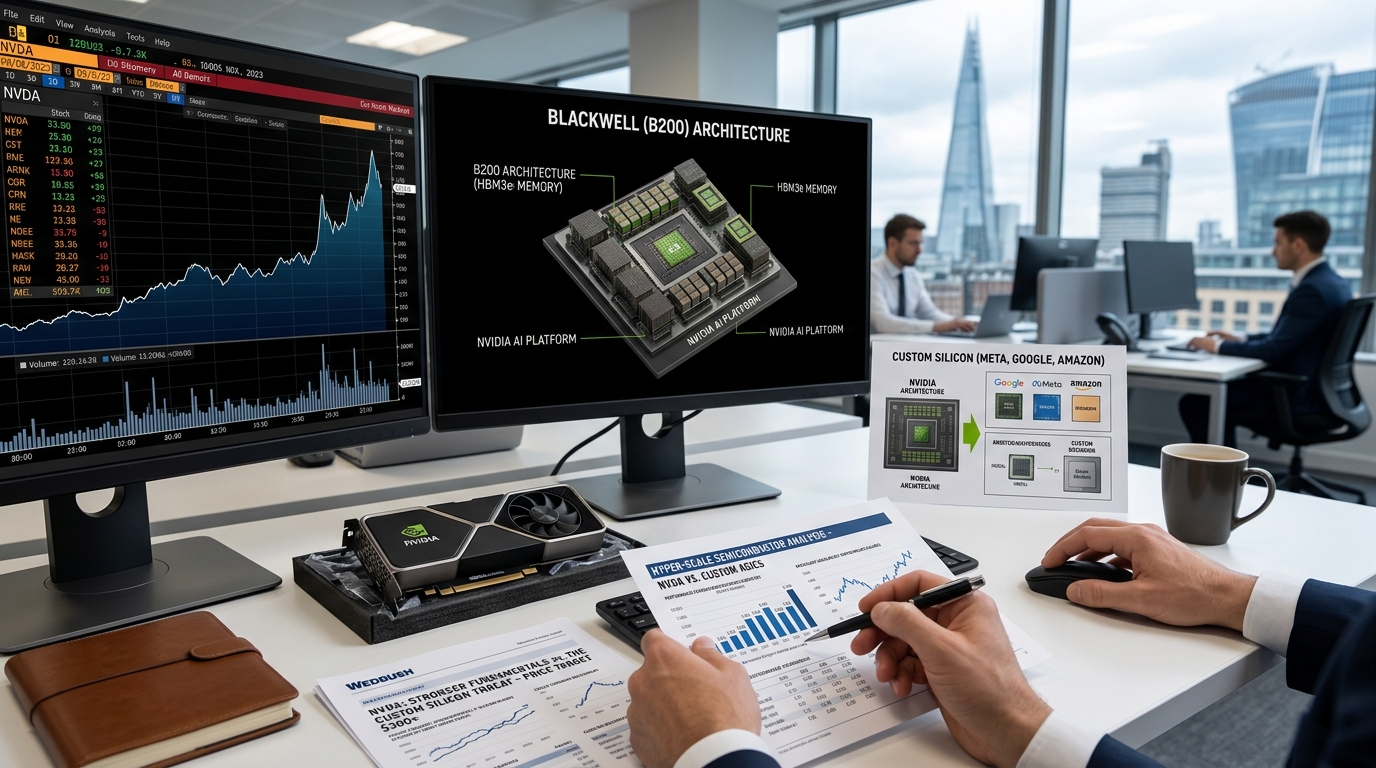
The custom silicon buildout at the hyperscalers is real, it’s live, and it’s moving faster than most sell-side coverage reflects. Google’s Ironwood TPU (v7) is not a lab project. It’s running at scale inside Google’s production infrastructure. Amazon’s Trainium series is deployed across AWS. Microsoft’s Maia 200 was built on TSMC 3nm with over 140 billion transistors and is optimized for their specific model architecture. Meta is allocating up to $135 billion on AI infrastructure in 2026 alone, with Broadcom custom ASICs as a core component of that spend. These are operating fleets, not prototypes.
ASIC-based AI server shipments are projected to hit 27.8% of the market in 2026, growing at 44.6% year-over-year. For comparison, merchant GPU shipments are projected to grow at 16.1%. Broadcom alone carries a $73 billion AI backlog and is targeting $100 billion in annual AI chip revenue by 2027. That’s not noise. That’s a structural market share shift happening in real time.
Slight tangent, but it actually matters more than most people are giving it credit for: OpenAI is now developing its first custom AI chip with Broadcom, targeting 2027 deployment. OpenAI. The company that essentially commercialized large language models and in doing so created most of Nvidia’s near-term demand. When that customer starts designing its own hardware, you’re watching a long-cycle transition begin, not a short-term hedge.
What matters is the use-case split. Custom ASICs are optimized for known, fixed inference workloads. They’re not built for rapid model iteration, novel architectures, or the kind of flexibility that training at the frontier requires. That’s still Nvidia’s lane. The two product categories are increasingly serving different demands, which means the market isn’t purely zero-sum. At least not yet.
- Bank of America: Buy – $275 (reiterated on AI platform momentum)
- Wedbush: Buy – $300+ (Blackwell ramp and sovereign AI expansion)
- Wall Street Consensus (62 analysts): Strong Buy – avg. 12-month target ~$298–$305
- Implied upside from ~$208: approximately 43–47%
The Next AI Winner Isn’t Making Chips
Most investors still think the AI boom is about semiconductors.
But a growing number of data centers are running into a different problem: not enough power.
One company has quietly built a $1.5 billion backlog supplying equipment these facilities depend on, yet Wall Street continues to value it like an old-school industrial stock.
On the technical side, $205–$210 has held as support twice in recent weeks. Resistance is clustered in the $226–$236 range, just below the 52-week high. The VWAP from the May earnings gap sits near $218 and is worth watching as an intraday line of reference. Institutional accumulation tends to show up as a stock reclaiming and holding levels like that. A close above $236 on above-average volume would be the first clean signal that this recovery has legs toward the analyst consensus range. Below $205 on volume, the picture changes.
Three things I’m watching going into August. Q2 FY27 guidance was set at approximately $78 billion, excluding China Data Center compute entirely. H20 export restrictions are already baked into that number, so the bear case on China isn’t really a surprise risk at this point, it’s a known headwind. What would actually move the stock is any modification to those controls, in either direction. Second, hyperscaler capex commentary in upcoming earnings calls. Any sign of slowdown from Alphabet, Amazon, or Microsoft would hit NVDA sentiment faster than almost anything else. Third, and this one is longer cycle, progress on open-source ML compiler frameworks like Triton. That’s the actual software moat competition. Not the chips.
August 25 earnings will be the first report without China Data Center in the comparison base. That makes it a cleaner read than anything we’ve had in the last two quarters.
Where to Put $100 Before Trump’s New Tech Law Rolls Out
Everyone is talking about Trump’s new tech law.
Financial Times says this tech puts America “on the verge of a financial revolution.”
Yahoo Finance says it could unlock $400 trillion.
Jeff Brown was consulted by Congressional offices in Washington, D.C. to advise on it.
He says the real number is even bigger – as much as $2.6 quadrillion could pour onto a new type of investment exchange in the days ahead…
Click here and Jeff will show you how to claim your stake starting with just $100.
Here’s my actual read: the market is making a specific bet right now. Not that custom silicon won’t take share. It will. The bet is that Nvidia’s total addressable market is expanding fast enough through enterprise, sovereign AI, robotics, and autonomous systems that a 15 to 20 point workload shift toward ASICs still leaves NVDA with a larger absolute revenue base than it has today. That’s a reasonable bet. It’s also one that requires the Blackwell Ultra ramp and the Vera Rubin platform to deliver on schedule, hyperscaler capex to stay elevated, and the CUDA ecosystem to hold. That’s a lot of things that need to go right simultaneously.
August will either validate that bet or complicate it considerably.
For informational and educational purposes only. Not investment advice. Trading involves risk, including loss of principal.