
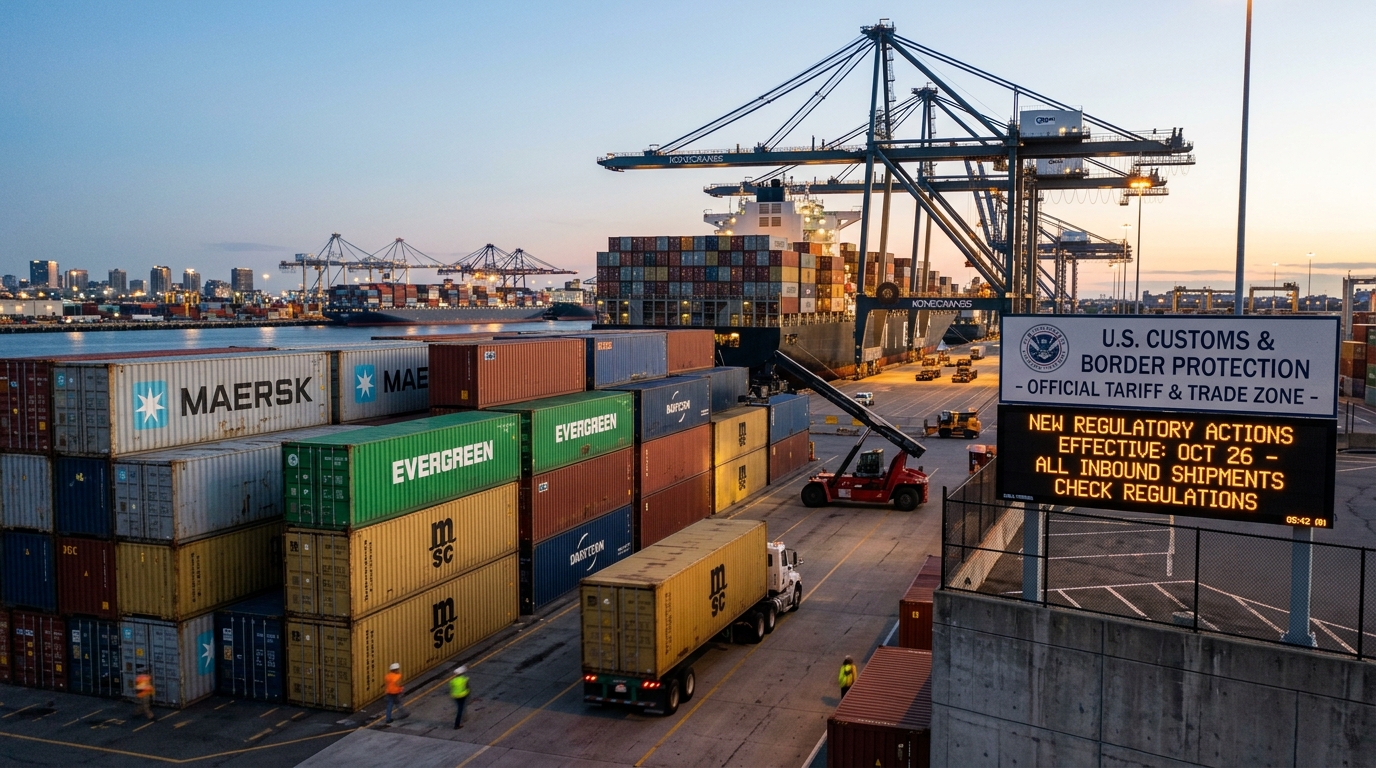
Three days ago, the tariff architecture that governed the last five months of global trade quietly expired — and the replacement that snapped into place the same night is broader, more legally durable, and in some ways more disruptive than what came before. Most traders have not fully priced any of it.
Here is where things actually stand.
The Legal Foundation Collapsed and Then Rebuilt Itself
Start with the timeline, because the sequence matters more than any single headline. On February 20, 2026, the Supreme Court ruled 6-3 in Learning Resources, Inc. v. Trump that the International Emergency Economic Powers Act does not authorize the president to impose tariffs. The IEEPA duties — the sweeping global framework that had defined trade policy since early 2025 — were struck down. Already-collected IEEPA duties became potentially refundable — but the ultimate size of any refunds depends on how the government implements the ruling and how courts handle refund claims.
Within days, the White House invoked Section 122 of the Trade Act of 1974, imposing a flat 10% global surcharge to replace the invalidated rates. That bought the administration roughly five months. Section 122 carries a hard 150-day statutory expiration. No extension is possible without an act of Congress. Congress did not act.
So at 12:01 a.m. ET on July 24, 2026, Section 122 expired — and in the same breath, new Section 301 tariffs covering 60 economies took effect simultaneously. The administration had spent the prior months building the replacement architecture through a legally intensive investigation process, specifically to avoid another Supreme Court rejection.
This is not a minor procedural shift. Section 301 carries no statutory expiration date. What IEEPA could not hold, and what Section 122 could only borrow time for, Section 301 is designed to make durable.
The New Tariff Layer: Who Gets What
The forced labor Section 301 action is the centerpiece. USTR concluded that all 60 investigated economies failed to impose and effectively enforce a prohibition on the importation of goods produced with forced labor — the finding USTR used to justify the action.
The result is a two-tier structure: additional tariffs of 10% or 12.5% depending on the economy and product treatment described by USTR, layered on top of existing Most-Favored-Nation rates and any applicable antidumping and countervailing duties — meaning importers in stacked-duty situations face compounding exposure that is not always visible in headline rate comparisons.
The scope is almost total. The action covers the top 60 U.S. trading partners, covering 99.4% of U.S. imports. Major affected economies include China, the European Union, Mexico, India, Vietnam, Japan, South Korea, and Taiwan, among others. USTR did expand the final exemption list after public comment, covering raw materials and supply-chain-critical goods — but importers who assumed they were protected by USMCA need to read carefully. Goods entered duty-free under USMCA are exempt from the forced labor Section 301 tariffs. Goods not USMCA-qualifying are not.
There is an in-transit grace window — but it closed July 28, 2026. For any cargo that did not clear that threshold, the new duties apply.
The USMCA Clock Is Also Running
Simultaneously with all of this, the foundation of North American trade is in active renegotiation. On July 1, 2026, the United States declined to renew the USMCA in its current form, triggering an annual review process that can now run through July 1, 2036. Canada and Mexico had both signaled they were prepared to support a 16-year extension. The U.S. declined anyway.
The practical read: USMCA remains fully in force and its preferential tariff treatment is still available today. Current automotive, agricultural, and manufacturing trade flows continue under existing rules. But the policy certainty that defined North American manufacturing investment for the past six years is gone. Annual reviews mean annual uncertainty. Supply chain decisions that require 3-5 year visibility are being made against a backdrop where the rules of origin, labor enforcement requirements, and tariff exposure for North American manufacturing could shift each year.
Negotiations are running on two separate tracks. Public reporting confirms that bilateral U.S.-Mexico talks are underway on major issues tied to USMCA and related trade frictions, and that the U.S. decision has put the North American framework into rolling annual review through 2036 — but specific claims about which numbered round occurred, where it was held, and the exact agenda items in the week of July 20 are not consistently documented in primary sources.
The administration has signaled a possible two-track bilateral approach — separate deals with Mexico and Canada — that could produce diverging rules across the region. For any company with integrated North American supply chains, that scenario is materially more complex than anything USMCA’s unified framework created.
Canada Gets Its Own Escalation
Buried under the forced labor tariff implementation, one of the most aggressive standalone trade actions of the year just landed on Canada. On July 20, 2026, President Trump invoked Section 338 of the Tariff Act of 1930 — a rarely used provision — to impose 50% additional tariffs on specified Canadian goods, effective August 19, 2026.
The stated basis: Canada’s alleged discriminatory treatment of U.S. exports, with the administration pointing to disputes involving autos, alcoholic beverages, and dairy.
The scope of affected goods extends well beyond what made the headlines. Public reporting and economic analysis put the covered trade exposure at roughly $20 billion annually. The named proclamation categories are dairy, alcoholic beverages, and motor vehicles. But scroll into the annexes and the list broadens: wine, hockey sticks, cement, plywood, furniture, fishing rods, seeds, clothing, swimming pools.
The legal mechanism is uniquely aggressive. Section 338 empowers the president to act by proclamation to impose duties of up to 50% in response to discriminatory treatment, without the kind of USTR Section 301 investigation process used for the forced-labor tariffs. And critically: USMCA compliance does not provide an exemption. Covered goods are subject to the Section 338 duty even if they otherwise qualify for preferential USMCA treatment. Carveouts exist for several major categories, including energy, potash, goods already subject to Section 232 tariffs, and certain other categories such as fish or critical minerals.
For companies that thought USMCA was a shield, August 19 is a hard date.
The Pipeline Still Being Loaded
Forced labor tariffs and Canada escalation are not the end of the Section 301 queue. The USTR also has an active investigation into structural excess manufacturing capacity across 16 economies — China, the EU, Singapore, Switzerland, Norway, Indonesia, Malaysia, Cambodia, Thailand, Korea, Vietnam, Taiwan, Bangladesh, Mexico, Japan, and India — initiated in March 2026. That investigation is still ongoing. No tariffs have been announced from the overcapacity investigation yet, but final action could arrive in late 2026, following the public consultation process.
Separately, USTR opened a Section 301 investigation against Germany in June, specifically targeting what it characterizes as unfair pharmaceutical pricing policies that force the United States to bear a disproportionate share of global research and development costs. A public hearing is scheduled for September 22, 2026. Comments were due August 10.
The pattern is consistent. Section 301 is now the administration’s primary and most legally durable tariff vehicle following the IEEPA ruling. More actions are coming. The overcapacity investigation alone could hit 16 of the world’s largest export economies with additional duties beyond what the forced labor action already imposes.
Sector Breakdown: Who Is Most Exposed
The forced labor tariff scope hits broadly, but USTR’s public materials and commentary around the action highlight supply chains where forced labor risks are frequently alleged — including cotton, textiles and apparel, and certain solar supply chains — and where the administration is using tariff pressure to force sourcing restructuring. Specific “most exposed” sector lists vary across summaries and are not always presented as a definitive ranking.
Apparel and retail face a particularly complex situation. USTR proposed a textile mechanism that would allow certain apparel and textile imports to enter at a reduced Section 301 rate based on the relevant trading partner’s purchases of U.S. textiles and cotton products. That mechanism introduces a dynamic duty structure where outcomes turn not just on origin and product classification, but on bilateral sourcing volumes and purchasing history — a compliance layer that did not exist before.
Automotive and North American manufacturing face the most layered exposure. The USMCA renegotiation puts rules of origin under active pressure. The Section 338 tariffs on Canadian goods take effect August 19. The overcapacity investigation covers Mexico, Japan, and Korea — three of the largest auto exporters to the U.S. market. Rules of origin, labor enforcement, and tariff pressure are all moving at the same time across the same supply chains.
Electronics and semiconductors got partial relief. The forced labor Section 301 action exempts products already subject to Section 232 tariffs. Goods subject to Section 232 for autos and for steel and aluminum are similarly excluded from the new forced labor duties. That is not a full exemption, but it does reduce the stacking exposure for some of the highest-volume technology imports.
Technical Framework: Levels and Positions to Watch
Three things matter right now for positioning around trade policy risk.
First: cumulative duty stacking is the real exposure metric, not the headline rate. A product from Vietnam facing existing antidumping duties, plus MFN rates, plus the new Section 301 forced labor tariff, arrives at landed cost numbers that look nothing like any single-layer analysis would suggest. Importers and investors in import-dependent sectors need to model the full stack, not the marginal tariff.
Second: August 19 is the next hard catalyst date. That is when the Section 338 tariffs on Canadian goods take effect. Companies with Canadian supply chains in dairy, alcoholic beverages, and the broader annex categories that got less press coverage have approximately three weeks to complete compliance review and sourcing adjustments.
Third: late 2026 is when the overcapacity investigation could resolve. If USTR takes affirmative action in the overcapacity probe, it could impose tariffs on top of the forced labor duties — creating additional stacking for China, the EU, Vietnam, Japan, Korea, and the other economies in scope.
Scenario Modeling
Bull Case
Trade deal momentum offsets escalation. The administration has announced a number of reciprocal trade agreements and frameworks with multiple partners. If bilateral deals continue to expand and exemption lists broaden through the exclusion process, effective tariff rates stabilize in the 10-15% range for most of the global trade volume. The overcapacity investigation resolves without major new tariff action, and USMCA renegotiation produces a durable bilateral framework with Mexico by mid-2027. Equity markets price in normalized trade friction rather than escalating disruption. Supply chain diversification investments made in 2025-2026 begin to show operational benefits.
Base Case
Layered tariffs become the structural baseline. The forced labor Section 301 duties stay in place and are not broadly challenged in court — Section 301 is widely considered more legally durable than IEEPA or Section 122. The overcapacity investigation adds another tariff tranche in late 2026, focused on specific manufacturing sectors. Canada retaliates in some form against U.S. goods ahead of August 19, extending the bilateral friction. USMCA negotiations drag into 2027 with no resolution, keeping North American supply chains in year-over-year uncertainty. Effective tariff rates for most U.S. importers settle in the 15-25% range depending on country of origin and sector, compressing margins across retail, consumer goods, and industrial manufacturing.
Bear Case
Escalation cascades beyond the current framework. Canada retaliates aggressively against U.S. exports, triggering a further Section 338 or Section 232 response. The overcapacity investigation produces broad new tariffs on EU and Asian manufacturing — a scenario that compounds forced labor duties and creates 30%+ effective rates on key import categories. Courts begin accepting legal challenges to Section 301 authority, creating a new uncertainty cycle parallel to the IEEPA litigation. Effective tariff rates spike above 30% for a meaningful share of U.S. import volume, inflation reaccelerates into Q4 2026, and corporate margin pressure becomes the dominant earnings theme for consumer-facing sectors.
Active Trader Strategy Framework
A few frameworks worth sitting with.
Import-dependent consumer discretionary names — particularly those with concentrated exposure to Vietnam, India, and China — face a period of compressed margin visibility. The forced labor Section 301 tariff stacks against existing duty structures. Earnings calls through Q3 will start quantifying the incremental cost impact. Watch for guidance cuts in apparel, footwear, and consumer electronics supply chains.
Domestic manufacturing plays carry a different dynamic. U.S. manufacturing expanded for its sixth straight month in June 2026. The structural tariff wall — whatever its legal form — continues to shift incentives toward onshore and near-shore production. Companies with predominantly domestic supply chains face a relative cost advantage that grows as import tariffs rise.
North American industrial names with Canadian exposure need August 19 modeled explicitly. The Section 338 list is broader than the headline categories. Any company sourcing Canadian dairy, auto-linked goods, alcoholic beverages, lumber, furniture, or industrial materials should have a landed cost revision in progress. If that analysis has not started, it is late.
The USMCA legal uncertainty creates a long-duration risk for integrated North American manufacturers — autos, aerospace, food processing. It is not an immediate binary catalyst. But rules of origin tightening over successive annual reviews is a multi-year cost headwind that does not show up in current analyst models.
Watch the overcapacity investigation resolution timeline. When USTR files findings in the 16-economy structural capacity probe, that is the next major tariff catalyst. Position sizing ahead of that determination date deserves consideration.
The Part People Are Underweighting
Here is what gets lost in the noise of headline tariff rates: the administration now has two major Section 301 investigation pipelines visibly active — excess manufacturing capacity (ongoing across 16 economies) and pharmaceutical pricing against Germany (hearing September 22). The forced labor Section 301 process concluded with tariffs taking effect at 12:01 a.m. ET on July 24, 2026. Section 338 is also now on the table as a no-Section-301-process escalation tool.
The trade policy toolkit has never been this simultaneously active. Section 301 is considered more legally durable than the tariffs the Supreme Court struck down. Unless a new court challenge successfully limits its application — which would require a different legal theory than the IEEPA ruling — the current architecture is designed to persist.
That changes the calculus for supply chain investment. Companies that treated tariff exposure as a cyclical, negotiable, or litigable risk are now looking at a potentially structural one. The investment implications of that distinction have not fully worked their way into equity valuations.
For informational and educational purposes only. Not investment advice. Trading involves risk, including loss of principal.