
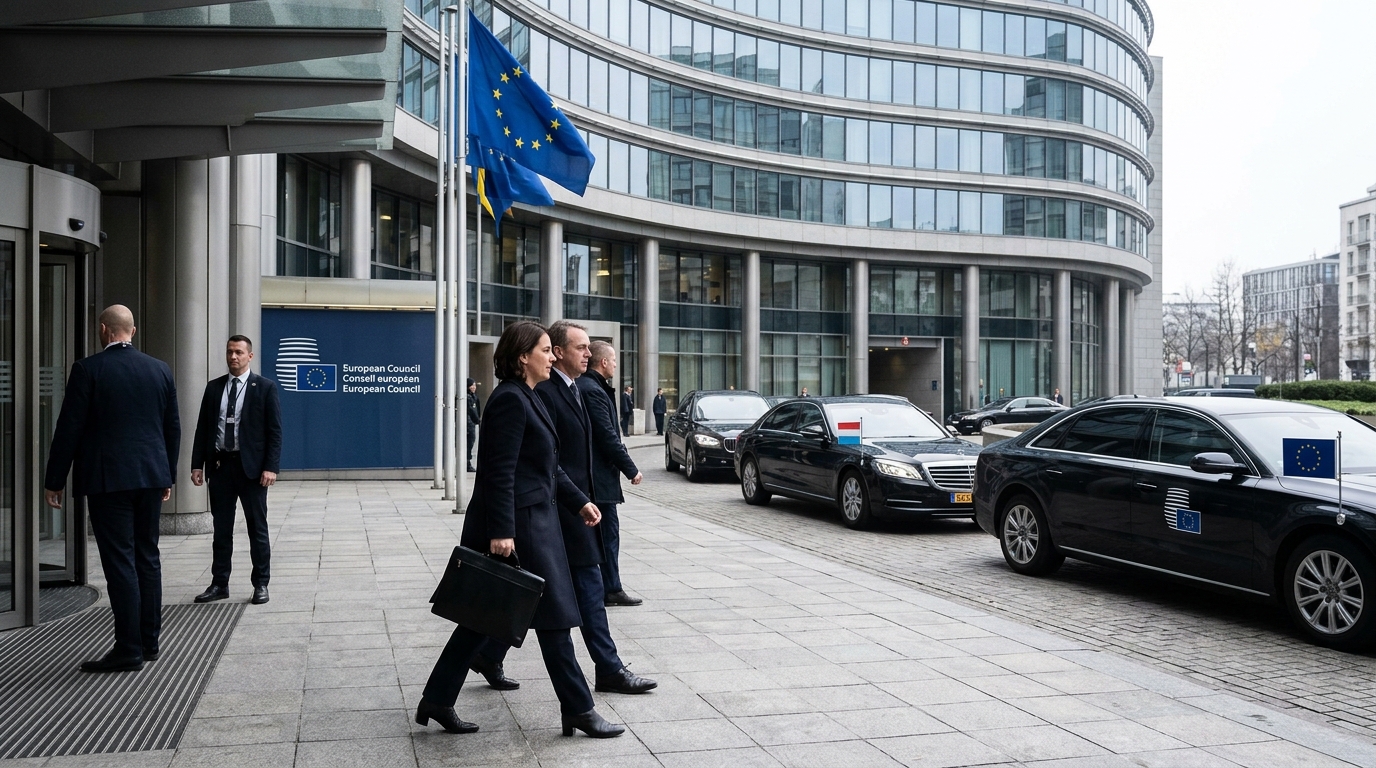
The European Commission’s push for a more collective answer to hybrid threats is back on defence ministers’ agenda in Brussels this morning. EU defence ministers gather in Brussels on Monday to discuss military support for Ukraine and, under current affairs, to exchange views on hybrid threats. The timing matters less than the direction: Europe is formalising its willingness to treat arson, drone incursions and infrastructure sabotage as a shared problem, not a bilateral one between Moscow and whichever country just had a warehouse set on fire.
Countries remain split over how to confront the Kremlin’s sustained acts of sabotage, arson and destabilisation, but a growing number are seeking collective processes for punishing Russia over attacks that do not meet NATO’s benchmark to trigger its Article Five mutual defence clause. European institutions have been developing EU-level “readiness” and response frameworks that borrow from NATO’s consultation logic, but the specific “Emergency Security Protocol” described in the original draft is not a defined, verifiable EU instrument. That is not a guarantee of action. It is, however, the institutional architecture that makes sustained defence investment politically defensible at the bloc level.
The Bigger Trend
Since February 2022, multiple open-source trackers and official-linked reviews have put the count of Russia-linked or Russia-attributed kinetic hybrid incidents in Europe at roughly 150 cases through early 2026. A NATO-style mutual response doctrine inside the EU would be significant less for any single retaliation than for lowering the threshold at which grey-zone acts trigger a bloc-level answer, since ambiguity over response has been the structural weakness exploited in past episodes. Every time that threshold falls, the political case for more detection hardware, more electronic warfare, more seabed monitoring and more counter-drone investment gets easier to make.
On the procurement side, the EU’s Defence Readiness work has set nearer-dated milestones than the original draft suggested for drones and counter-drone capability development. Separately, the European Commission has proposed five European Defence Projects of Common Interest spanning drones and counter-drone systems, maritime and seabed defence, space, air and missile defence, and eastern flank security, with a combined funding ambition of around €190 billion by 2036. That figure is not a promise. It is a procurement ambition that companies are already bidding against.
The Investment Case
European defence companies from Rheinmetall to BAE Systems, Leonardo, Thales and Saab have benefited from a surging order book since Russia’s 2022 invasion of Ukraine, as governments ramp up military spending. The revenue growth over that stretch has been historic. The original draft’s specific average revenue and order-intake growth percentages across 2021 to 2025 could not be verified as stated, so they have been removed.
The more important question for long-term investors is whether the backlog holds. It does. Rheinmetall reported record results for 2025 and, as of its 2025 annual guidance, projected 2026 sales growth of 40% to 45%, with revenues expected between €14.0 billion and €14.5 billion. (Rheinmetall has since updated its 2026 sales guidance range in 2026 reporting, so investors should treat the range above as the company’s earlier 2026 outlook rather than a standing forecast.) The original draft’s detailed first-half 2026 figures for Thales could not be verified as written, so they have been removed. Thales and Leonardo remain central players in European defence electronics across radars, avionics, satellites, cybersecurity and electronic warfare, the exact capabilities a hybrid-response framework puts at the centre of procurement.
Sweden has made major investments under its Defence Resolution for 2025 to 2030, including emphasis on naval sustainability and air defence, which can support demand for Saab’s portfolio. The AUKUS nuclear submarine programme positions BAE Systems as a key contractor leading the UK’s SSN-AUKUS design and build, and BAE Systems Australia was selected alongside ASC to build Australia’s SSN-AUKUS submarines, a multi-decade industrial programme that is largely not a “Brussels-cycle” bet.
Building Wealth Around This Idea
This is not a trade on today’s Brussels meeting. Rearmament is a structural, 10-to-15-year trend. McKinsey calculates that European NATO core defence spending has doubled since 2019 and, under fiscal-capacity assumptions, could reach about €800 billion by 2030. Investors who want diversified exposure without single-company risk have ready options. The WisdomTree Europe Defence UCITS ETF holds Thales, BAE Systems, Rheinmetall, Leonardo, Safran, Rolls-Royce and Saab as major positions. For those who prefer individual names, the five companies at the centre of Europe’s hybrid-response spending, Rheinmetall, Leonardo, Thales, Saab and BAE Systems, each have different risk profiles, geographies and technology concentrations. Position size modestly; the theme has years to develop but individual contract timelines are lumpy.
Risks to Monitor
EDDI in its current form, although a step in the right direction, may underdeliver. The current approach focuses on multi-year funding for effector production through major European contractors but can lag on the detection and integration architecture that turns capabilities into a working system, which is likely to become a binding constraint. Diplomatic splits can slow programme timelines. Defence stocks have rallied, and some are richly valued. Investors should compare price-to-earnings ratios, margins and cash flow stability carefully. A ceasefire in Ukraine, or a shift in U.S. policy toward European burden-sharing, could cool near-term order flow even if the structural case remains intact.
Daily Wealth Takeaway
The most durable defence of a portfolio position is the same as the most durable defence of a continent: depth. Europe’s hybrid-threat response is not one programme or one vote. It is a multi-decade commitment now being written into law, budgets and procurement contracts. Companies supplying the radars, drones, cyber tools and undersea sensors to execute that commitment have order backlogs measured in years. The investors who treat today’s Brussels debate as the starting gun are already late. The investors who treat it as confirmation of a theme they own patiently are exactly where they should be.