TITLE: Toast Is Down 47% From Its High. The Google Deal Changes the Math.
SUBTITLE: A record 9,500 locations added, ARR at $2.4 billion, and an agentic ordering protocol co-built with Google. The stock still prices in a POS company.
BODY (HTML):
Hey there, bargain hunter. The stock is sitting roughly 47% below its all-time closing high of $65.22 from November 2, 2021. The business just posted the strongest quarter in its history. Those two facts are the entire debate in TOST right now, and a deal announced three days ago just made that debate a lot more interesting.
Scoreboard
Q2 2026 results, reported August 4:
- Revenue: $1.91 billion, up 23.1% year over year, beating the $1.87 billion consensus estimate by 1.8%
- GAAP EPS: $0.26, beating the $0.20 consensus by 28.2%
- Adjusted EBITDA: $221 million vs. $195 million expected, a 13.3% beat
- Net income: $154 million, up from $80 million in Q2 2025
- Gross Payment Volume (GPV): $60.7 billion, up from a year ago
- Annual Recurring Revenue (ARR): $2.4 billion, up 24.5% year over year
- Net new locations added: a record 9,500 in the quarter, bringing the total to roughly 180,500
- Operating margin: 8%, up from 5.2% in Q2 2025
- Full-year 2026 adjusted EBITDA guidance raised to $790 million to $810 million
The stock moved about 4.7% higher on August 5, which is the polite way of saying the market liked it but did not exactly pop the champagne. As of August 9, TOST trades near $34.50, still sitting in the middle of its 52-week range of $22.26 to $49.66.
The Real Reason the Stock Has Not Caught Up
This is not a story of a broken business. Toast beat revenue estimates for the fourth consecutive quarter, beat EBITDA by 13%, added more locations in a single quarter than it ever has, and raised full-year guidance. And the stock is still down roughly 30% over the past year.
Two things are holding the valuation back. The first is free cash flow. Q2 2026 free cash flow came in at $130 million, down from $208 million in Q2 2025. Operating cash flow fell to $144 million from $223 million a year earlier. Management’s explanation is deliberate: Toast has been aggressively building a hardware inventory cushion, pulling memory chip orders forward to protect its shipment capacity through 2027 as memory market prices move against it. CFO Elena Gomez said on the Q4 2025 call that the company expected approximately 150 basis points of negative impact from higher memory chip costs on hardware margins, especially in the second half of 2026.
The second issue is spend. Sales and marketing rose 22% year over year in Q2. R&D climbed 23%. Operating expenses excluding bad-debt items were up 19%. That is the signature of a company still in growth mode, not a mature compounder, which limits how the market will frame valuation multiples.
Neither problem is a sign the business is deteriorating. The free cash flow decline is an accounting artifact of a strategic inventory decision, not a collapse in unit economics. Management said it expects free cash flow conversion to improve in the back half of 2026 as inventory normalizes.
Deep Dive: What Toast Actually Is
Toast is not a POS company. Or rather, it started as one and has spent five years systematically becoming something larger.
The platform today combines point-of-sale hardware, payment processing, online ordering, kitchen display systems, drive-thru technology, payroll, scheduling, inventory management, food cost analytics via xtraCHEF, catering and events software, guest loyalty tools, and, since October 2025, Toast IQ, a conversational AI assistant built directly on each operator’s own sales, labor, menu, and operational data.
The business model is a hybrid of recurring SaaS subscription fees and a payments take rate on every dollar that flows through its terminals. That is the economic engine behind ARR of $2.4 billion and GPV of $60.7 billion. Toast earns a clip on every burger sold at roughly 180,500 locations, and that clip compounds as it adds locations and as those locations do more volume.
Non-GAAP subscription services and financial technology solutions gross profit reached $529 million in Q1 2026 alone. That is the high-margin, durable revenue stream that justifies the growth-investor framing. The hardware line, which is sold at near-cost or below to win new customers, is the strategic loss leader that feeds the recurring engine.
Toast is detected on 38.6% of all U.S. restaurant websites with any detectable tech stack, more than double Square’s 18.3% share in the same dataset. That is market dominance by any reasonable definition.
The Google Deal and the UCP: This Is the AI Angle Nobody Is Pricing
On August 6, two days after its earnings release, Toast announced something that got far less attention than it deserved.
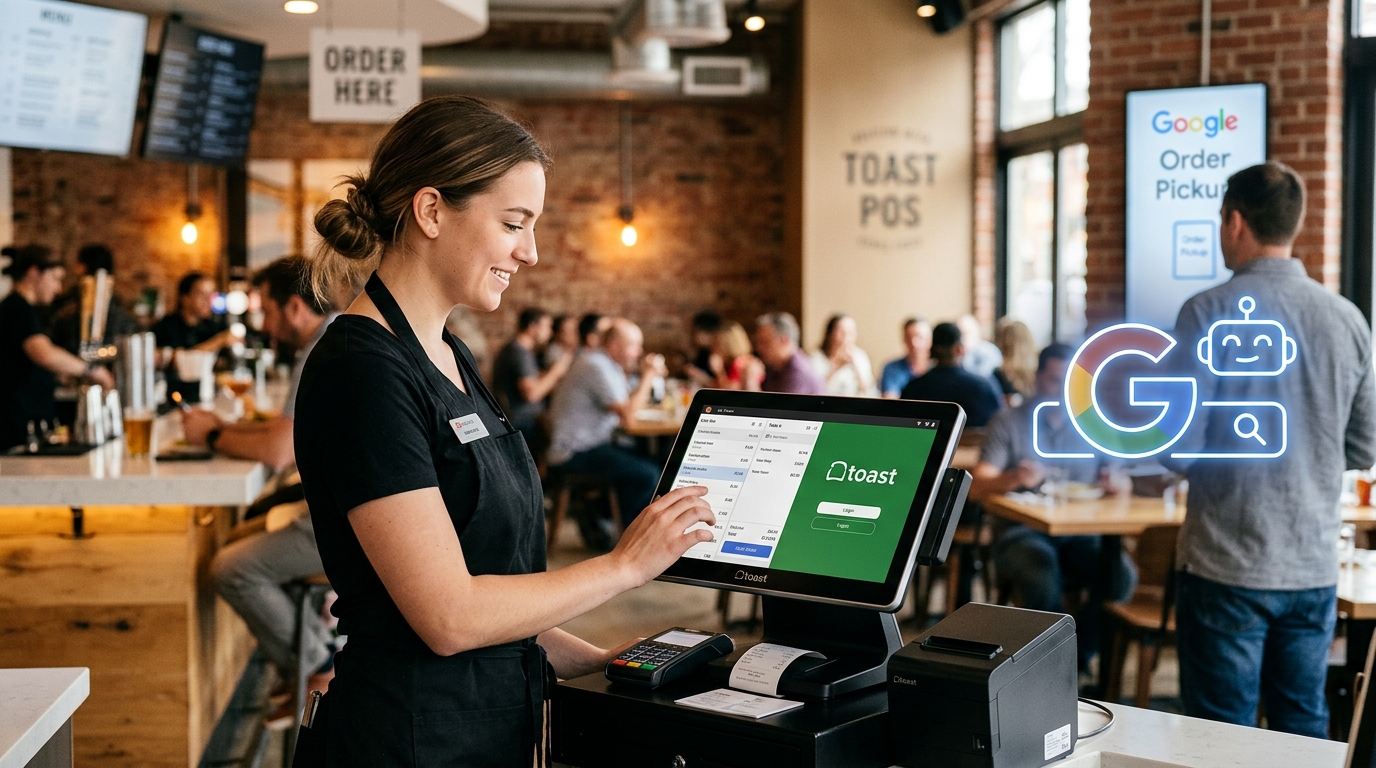
Toast deepened its integration with Google to bring agentic food ordering to conversational experiences in Google Maps. When a diner asks by voice or text for a restaurant recommendation or a specific dish, Google can surface a Toast restaurant’s menu and carry that request through to a completed order without the customer leaving Google.
More consequentially, Toast confirmed it is a co-developer of the Universal Commerce Protocol (UCP) for Food, an open standard defining how AI agents discover, order from, and check out with restaurants across Google surfaces. The protocol is designed so that as agentic ordering scales, restaurants remain in control of their menus, pricing, and guest relationships, and orders route through first-party systems, which means no third-party commission fees for operators and the payment still flows through Toast’s rails.
This is not a widget integration. UCP for Food is an attempt to define the commerce infrastructure layer for AI-driven restaurant ordering at an industry scale. Toast, alongside Google, is helping write the rules for how AI agents interact with the food industry. The agentic food ordering integration is expected to broaden in late August 2026.
The hotel endorsement mentioned alongside Q2 adds another dimension. In May 2026, Toast announced it became an Alliance Partner in Preferred Hotels & Resorts’ program, positioning Toast as a recommended provider of POS technology for member properties across the United States, United Kingdom, Ireland, and Canada. That is Toast crossing into hotel food-and-beverage, a TAM it barely touched before 2026.
Data Section
Revenue and growth:
- Q2 2026 revenue: $1.91 billion, up 23.1% year over year
- Q1 2026 revenue: $1.63 billion, up 21.9% year over year
- Full-year 2026 EBITDA guidance midpoint: $800 million
Profitability and margins:
- GAAP operating margin Q2 2026: 8%, up from 5.2% in Q2 2025
- GAAP operating margin Q1 2026: 6.7%, up from 3.2% in Q1 2025
- Adjusted EBITDA Q2 2026: $221 million, 11.6% margin
- Q3 2026 guidance: Adjusted EBITDA of $210 to $220 million
- Long-term management target: 40-plus percent adjusted EBITDA margin
Balance sheet and capital return:
- Toast has an active share repurchase program; as of May 6, 2026, approximately $208 million remained under the then-current authorization
Platform metrics:
- Total locations: approximately 180,500 (171,000 as of Q1 2026, plus 9,500 net new in Q2)
- ARR: $2.4 billion, up 24.5% year over year
- GPV: $60.7 billion in Q2 2026
- Recurring gross profit streams grew 28% year over year in Q2
The watch items:
- Free cash flow Q2 2026: $130 million, down from $208 million in Q2 2025, due to hardware inventory buildup
- Hardware memory chip cost headwind: management flagged a heavier impact in the second half of 2026
- Toast IQ Grow monetization: adopted quickly, but long-term revenue contribution is still early
Is It Cheap?
Depends entirely on which frame you put around it.
At roughly $34.50, TOST trades at a forward P/S of about 2.04 times, compared to the Zacks Internet Software Market industry average of 3.76 times. On that basis, the stock is trading at a meaningful discount to software peers, even after the post-earnings bounce.
The forward P/E is approximately 22.7 times, and the PEG ratio sits at 0.70, a figure that implies the market is not giving Toast full credit for its earnings growth rate. The EV/EBITDA is 38.4 times on trailing figures, but that denominator is rising fast: adjusted EBITDA grew from $133 million in Q1 2025 to $179 million in Q1 2026 to $221 million in Q2 2026. The trajectory matters as much as the level.
The more honest framing is that TOST is not classically cheap. It has never been classically cheap. What it offers is a business compounding recurring revenue at more than 24% per year, expanding EBITDA margins, demonstrated pricing power, and a structural position in an AI commerce protocol that is just now going live. The question is whether the market is correctly pricing that combination at a roughly $20 billion market cap, roughly 47% below the company’s 2021 peak, in a week when its AI integration with Google just launched.
For context, ValueAct Capital raised its TOST stake to 12.9 million shares as of March 31, 2026. ValueAct does not take positions in businesses it thinks are overvalued.
Bull, Base, Bear
Bull
The UCP for Food protocol becomes the standard rail for AI-driven food ordering across Google. Toast’s 180,000-plus locations sit at the center of that infrastructure. GPV per location stabilizes or rises as ordering volume shifts toward AI-surfaced channels. The hotel partnership opens the hospitality food-and-beverage TAM. EBITDA margins expand toward the 40% long-term target. The stock re-rates toward $50 to $60 as the market recognizes it is no longer just a POS company.
Base
Location growth continues at 6,000 to 9,000 per quarter. ARR compounds at 20% to 25% annually. Memory chip headwinds persist through 2026 but do not impair the recurring gross profit trajectory. Agentic ordering through Google delivers modest GPV uplift. The stock drifts toward analyst price targets over the next 12 months. (Individual analyst targets move frequently, so treat any single-firm target as a point-in-time snapshot, not a truth.)
Bear
Restaurant consumer spending softens as broader economic conditions weaken, compressing GPV per location and take-rate economics. Hardware memory costs prove worse than management guided, creating a free cash flow gap larger than investors expect. Competitors, including Square, erode Toast’s differentiation in ordering through Google surfaces. Sales and R&D spend fail to convert into meaningful ARR acceleration. The stock revisits the 52-week low near $22.
Action Plan
This is a quality growth business at a price that is off its high by nearly half, with multiple catalysts landing in the past week: a record quarter, a hotel partnership, and an AI-driven ordering integration with Google that is expected to broaden in weeks.
For the conservative bargain hunter, the most defensible approach is a partial position here at $34 to $35, with a plan to add on any dip toward $28 to $30 if memory chip fears or a broader market selloff create a re-entry. That range sits closer to the 52-week low and gives you a meaningful margin of safety on a business that generated $154 million in GAAP net income in a single quarter.
For the more aggressive bargain hunter, the Google UCP angle is the real bet. If agentic commerce becomes a dominant restaurant ordering channel over the next three years, the company that co-wrote the protocol and sits at 180,000 locations is not priced at $20 billion. Full size here, with a 24-month horizon and a stop on a sustained close below $22.
Do not ignore the free cash flow decline. It is real. But it is explained. Watch Q3 2026, due out in November, to see if cash conversion improves as management guided.
Cheap Investor Scorecard
- Location growth rate: Track quarterly net adds. Q2 set a record at 9,500. Below 6,000 is a warning sign.
- ARR growth: Currently 24.5% year over year. Watch for deceleration below 20%.
- Recurring gross profit stream growth: 28% in Q2. This is the cleanest signal of platform economics.
- EBITDA margin trajectory: On track for roughly 12% full-year 2026. Path to 40% is the long-term thesis. Any quarter where margin reverses matters.
- Free cash flow conversion: Q2 fell to $130 million from $208 million. Management expects improvement in H2 2026. Verify in November.
- GPV per location: Flat to slightly negative in recent quarters. Recovery here signals healthier restaurant spending and is worth tracking monthly through Toast’s own trends data.
- Google UCP for Food adoption: No hard metric yet. Monitor whether the agentic ordering feature drives measurable GPV uplift when it broadens in late August.
- Hardware margin: Memory chip costs are the known headwind in H2 2026. Watch the hardware and professional services gross profit line for signs the optimization work is closing the gap.
- Insider activity: Multiple executives filed Form 4 sales in early August. Not a crisis signal, but worth monitoring if selling intensifies at current prices.
- Analyst consensus: Analyst counts and rating buckets change often. The direction of revisions after earnings matters more than the exact tally.
Bottom Line
If Toast is just a POS company, $34 is generous. If Toast is the infrastructure layer for AI-driven restaurant commerce at 180,000 locations, co-authoring an open protocol that can define how AI agents order food across Google surfaces, then $34 is a discount to what this business could be worth by 2028.
The Q2 numbers support the second framing. The Google deal, launched this week, makes it harder to dismiss. The free cash flow decline and memory chip costs are real headwinds, but both are self-described and time-limited. The stock has fallen 47% from its high while the business compounded recurring revenue north of 24% and turned consistently profitable.
Watch the late-August Google Maps expansion carefully. If the agentic ordering feature moves volume for Toast operators, you will know before Wall Street formally updates models. That is the early tell this thesis is working.
This article is for informational purposes only and does not constitute investment advice. All investing involves risk, including the possible loss of principal. Past performance is not indicative of future results. Do your own research before making any investment decisions.