
September 2, 2026
The Aug. 31 framework deals for PAC-3 MSE and THAAD parts are quietly assembling a defense revenue stack for years.
Market Snapshot
Defense stocks drifted Tuesday as broader markets absorbed a mixed macro backdrop. The VIX held in the low 16s, suggesting modest complacency heading into a historically volatile month, while the 10-year Treasury yield hovered near 4.4%. Gold remained firm above $2,700 and crude edged higher on lingering supply concerns. Futures for the major indices pointed to a flat open.
In sector terms, defense outperformed modestly last week, though neither Lockheed Martin (LMT) nor General Dynamics (GD) made much noise on August 31 despite signing agreements that could anchor their missile-defense revenue for the better part of a decade.
Stocks in Focus
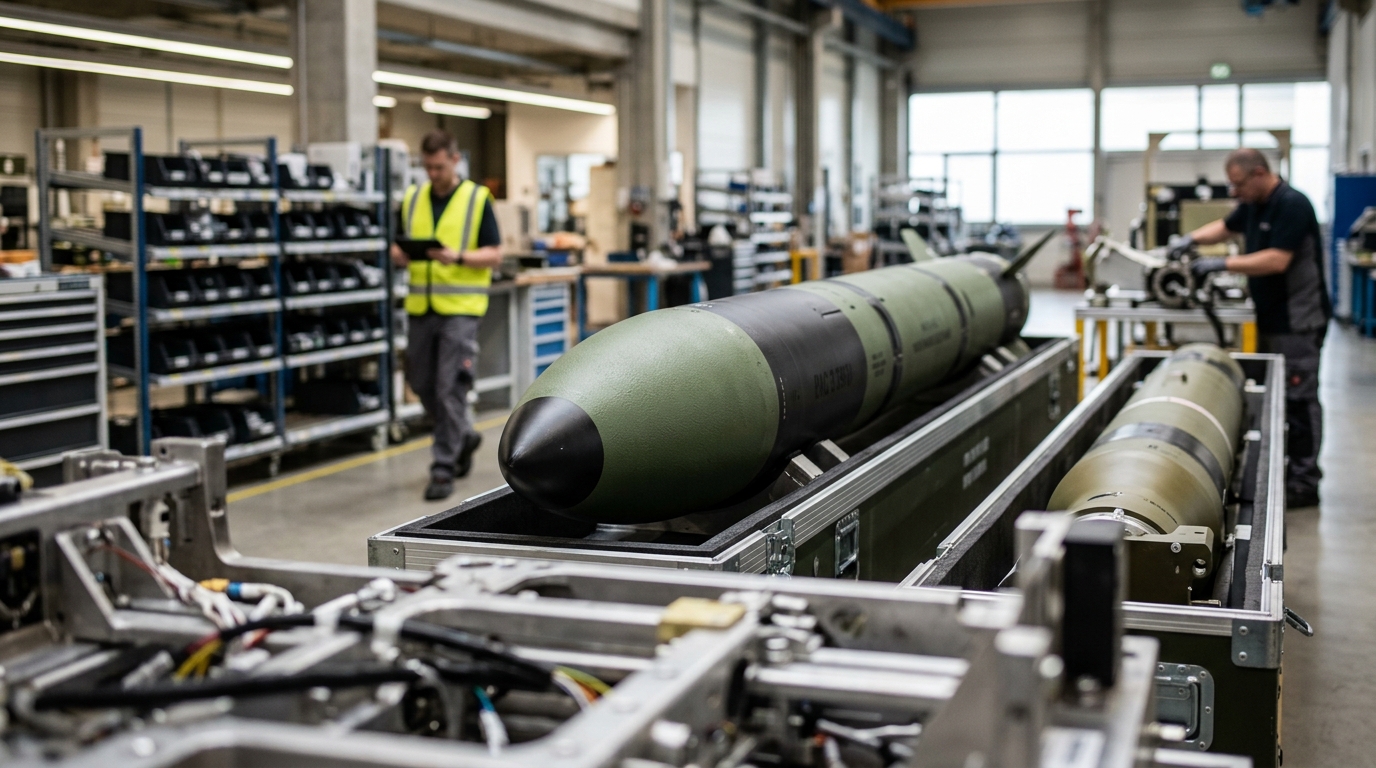
Lockheed Martin (LMT) and General Dynamics (GD). The Pentagon signed seven-year framework agreements with GD and LMT aimed at expanding production and accelerating deliveries of components for THAAD and PAC-3 MSE missile interceptors. The target: a tripling of PAC-3 MSE interceptor production capacity and a quadrupling of THAAD interceptor production capacity. Both stocks slipped less than half a percent on the day. That reaction tells you something about how Wall Street processes framework agreements without attached dollar amounts.
The agreements are designed to support multiyear procurement contracts with guaranteed minimum annual procurement quantities, subject to annual appropriations. GD-OTS will expand production of interceptor components including motor cases, seeker housings, midsections and shroud deployment systems. Those are sole-sourced parts with limited substitutes, which gives GD durable pricing leverage inside the supply chain regardless of headline optics.
For LMT, the August agreements reinforce a missile-defense revenue stack that has been accumulating all year. In April, the U.S. government awarded Lockheed Martin a $4.7 billion contract action to continue accelerated production of PAC-3 MSE. Then in June, the U.S. government awarded Lockheed Martin a seven-year undefinitized contract action for up to $35 billion to quadruple production of THAAD interceptors. At the time of that award, fiscal 2026 procurement funds of $842.9 million were obligated. The $35 billion is a ceiling, not a guaranteed total, but the direction of travel is unambiguous.
Veteran Market Analyst Unveils “American Affordability Project”
The analyst behind a long track record of institutional allocations says, “I’m releasing my ‘American Affordability Project’ to help readers position ahead of sustained cost pressures.
The goal: walk 50,000 subscribers through this strategy over the next 12 months.”
Update: The PAC-3 MSE contract story did not stop at $4.7 billion. In late July, the U.S. government awarded Lockheed Martin a seven-year PAC-3 MSE undefinitized contract action modification for up to $53.86 billion, bringing the reported total multiyear value to $58.62 billion (including the April year-one contract action).
The THAAD award builds on more than $9 billion in company investment planned through 2030, which Lockheed Martin says has already delivered more than 20 new or modernized facilities. Lockheed has also opened a new facility in Troy, Alabama, to support accelerated THAAD interceptor production. The fixed-cost infrastructure is being built out. The question is how many interceptors fill it, and at what pace Congress obligates cash.
RTX (RTX) sits adjacent to this ecosystem. Raytheon, an RTX business, received a $745 million contract from the Missile Defense Agency on August 10, 2026 for the production and sustainment of Standard Missile-3 Block IIA interceptors. RTX has made significant investments to expand capacity, including a $115 million expansion of its Alabama missile integration facility, which will increase integration and delivery capacity by over 50%.
Sector Watch
Defense remains one of the few sectors with structural demand visibility across multiple years. The driver is straightforward: Operation Epic Fury depleted critical munition stockpiles at rates that analysts assessed would take three or more years to rebuild for systems like THAAD and Patriot. More than 150 THAAD interceptors used in prior engagements would have equated to roughly 30% of the THAAD stockpile, which CSIS called “concerning.” The restock is not a policy ambition. It is an operational necessity.
SpaceX’s IPO split investors into two groups: those sitting on losses and those who aren’t. The difference came down to timing.
SpaceX’s public debut carried a sharp lesson for investors.
Shares bought on IPO day are now down roughly 40% from their peak — while those who established positions before the listing opened are in a different position entirely.
The asymmetric opportunity in private placements tends to close once a stock begins trading on an exchange.
Anthropic and OpenAI are the next names on that timeline. Both filed with the SEC in June — which is why I’m moving to establish a pre-IPO position now.
I’d like to send you the full analysis in this special report:
Inside the Anthropic and OpenAI Pre-IPOs
The THAAD contract aims to scale annual interceptor output capacity from 96 to approximately 400 units over seven years. Getting from 96 to 400 requires factory expansions, workforce certification, and supply-chain qualification steps that do not compress easily. Investors expecting peak output by 2027 will likely be early. The realistic window for compounding cash flows runs 2027 through 2031.
Catalyst Calendar
- Congressional appropriations, FY2027: Funding behind both framework agreements is subject to annual approvals. The fiscal 2027 budget cycle is the single largest variable for both LMT and GD shareholders.
- LMT Q3 earnings: Watch for management commentary on THAAD and PAC-3 MSE production ramp timelines and any guidance updates tied to the August frameworks.
- GD Q3 earnings: GD-OTS capacity build commentary will be the key datapoint; listen for workforce and facility investment figures that confirm the ramp is live.
- Ongoing Middle East operations: Further interceptor expenditure would accelerate restock urgency and could pull forward procurement fund obligations.
Technical Radar
LMT has traded in a tight range through late August. The stock needs a catalyst with a dollar figure attached to break meaningfully higher; the August frameworks did not provide that. Key support sits near the 200-day moving average. GD shows a similar consolidation pattern. Neither chart is broken; both are waiting for a trigger that converts framework language into hard contract announcements.
Risk Radar
- Appropriations risk: Every dollar in the THAAD and PAC-3 ramp depends on Congress following through in FY2027 and beyond. A continuing resolution or budget impasse could delay obligation timelines.
- Ramp execution: Tripling and quadrupling production on any timeline requires workforce, materials, and tooling that are not immediately scalable. Execution slippage is a real operational risk.
- Iran ceasefire dynamics: Operation Epic Fury ended in a ceasefire earlier in 2026, and the Trump administration has shifted strategy toward economic sanctions. A durable ceasefire could reduce near-term urgency, though structural restock demand would persist.
- Valuation patience required: Framework agreements without disclosed values tend to be absorbed quietly. Traders looking for a three-to-five-month payoff may find this thesis frustrating.
The Cheat Sheet
Top Market Theme: The U.S. air defense industrial base is in a sustained, policy-mandated expansion cycle driven by real inventory depletion, not theoretical demand.
Stock to Watch: LMT. The combination of the $35 billion THAAD ceiling, the $58.62 billion reported multiyear PAC-3 MSE total, and the August component-supply frameworks gives Lockheed a missile-defense revenue base that few other defense primes can match in depth or duration.
Elon Musk’s Integrated Technology Build-Out
This positioning opportunity may represent one of the more significant supply-chain realignments to emerge from the current AI infrastructure cycle. Luke Lango believes Musk is moving to consolidate the capabilities of Tesla (TSLA), SpaceX, xAI, and X around a single infrastructure vision. That vision encompasses orbital AI data centers, a 100-million-square-foot semiconductor complex in Texas, and large-scale deployment of Optimus robotics across operations. Executing at that scope requires an extensive external supplier network — components and materials Musk’s companies cannot yet produce entirely in-house.
Sector to Watch: Defense, specifically missile defense. Capital is moving here because demand is verifiable and government offtake is contractually anchored.
Biggest Risk: Congressional appropriations in FY2027. Frameworks commit intent; they do not obligate funds.
Biggest Opportunity: LMT and GD for traders willing to hold a three-to-five-year thesis. The compounding of minimum procurement floors across seven years is the kind of revenue visibility most industries never see.
One Thing to Remember: When the Pentagon signs a framework committing to triple or quadruple production of a weapon system, and the stock barely blinks, the market is pricing the announcement, not the cash flows. Those are different things.