Dear Reader,
You lock your doors. You shred your mail. You watch what you post online.
But on June 18th, five federal agencies, including the Federal Reserve, proposed a rule that reaches somewhere most people never think to protect…
Your money.
Private companies now issue their own digital dollars, used for payments and transfers online.
The new rule would require those companies to identify every customer the same way a bank does.
Your name, attached to every digital dollar you buy.
Most people missed it.
They were busy celebrating the July 11th ban on the Fed’s digital dollar, which does nothing to stop the private versions.
Now you might be thinking…
“I don’t use digital dollars. Why should I care?”
Because Bank of America, Wells Fargo, Citi and Capital One are among 21 financial institutions planning a joint one, targeting launch next year.
A digital dollar backed by Visa and Mastercard went live September 30th.
PayPal’s is already in Venmo.
Zelle has announced one too.
Sooner or later, the dollars in your accounts will likely move through these systems.
And any privacy-minded person should read this twice…
Right now, the rule only covers buying digital dollars from the company.
But the agencies are considering going further.
Tracking your name every time those dollars change hands.
Person to person. Payment to payment.
Public comments closed August 21st. Now the decision is up to them.
It’s being framed as crime prevention.
It always is… isn’t it?
What’s in your safe is yours. What’s in the bank is a promise.
Digital dollars work like the bank.
A company stands behind every one, and by law that company must be able to freeze them.
But some digital assets have no company or bank behind them at all. You hold them directly, like what’s in your safe.
That’s why I recorded a free presentation on our “Digital Dollar Immunity” System.
It shows how we hold a portion of our assets outside that system.
4,500+ members are already doing this.
If you have $50k+ saved for retirement and want to protect your family from whatever comes next, watch it now:
Click Here To Reveal The “Digital Dollar Immunity” System →
To your wealth,
Tan Gera, CFA®
Decentralized Masters
P.S. The public comment window closed August 21st. The final rule is still coming.
The AI Trade Cracked This Week. Here Is What Broke It.
The week that began with the Dow near 51,850 ended with investors asking a question that had not been seriously asked in months: is the economics of the artificial intelligence boom actually working?
Market Snapshot
The S&P 500 is down about 1% this week, while the Nasdaq has shed about 2% to 3%.
A key semiconductor gauge has been sliding for eight straight sessions, one of its longest losing streaks in years. The VanEck Semiconductor ETF was down about 9% for the week at one point, as investors assessed concerns over competition from China, adding to pressure on technology and AI-linked stocks.
What Triggered the Break
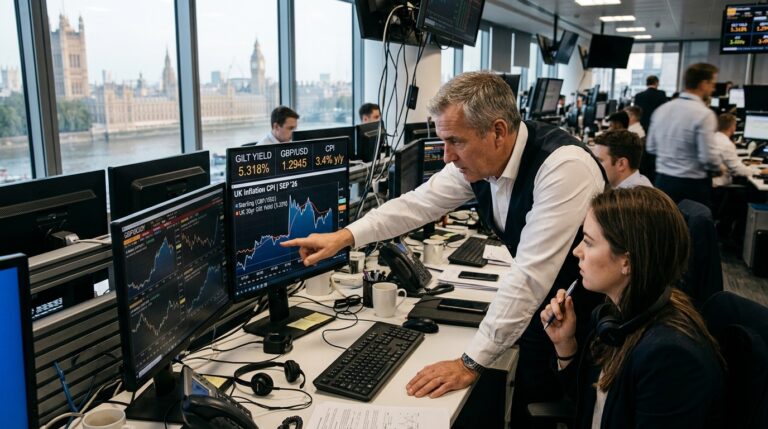
Three forces converged. First, inflation. CPI rose 0.6% last month and 3.7% year over year, while Brent crude traded above $106 a barrel earlier in the week before retreating. Hotter-than-expected consumer inflation this week reinforced the sense that price pressures are not fading cleanly.
Second, AI financing. CoreWeave has been under acute pressure as investors reassess whether the massive AI infrastructure buildout can earn its cost of capital. CoreWeave’s unsecured debt due in 2032 has traded below 80 cents on the dollar, a level widely associated with distressed credit. Investors’ concerns about technology companies outside of the Magnificent Seven using too much debt to fuel the AI boom also came to the fore, with Oracle down about 9% at one point this week.
Oracle’s debt-fuelled AI buildout is not an isolated case. Oracle’s $40 billion capital raise spooked investors even as cloud revenue grew 93% year over year, showing how quickly the market turns on companies whose spending commitments outrun near-term cash flow.
Third, China. The move came amid reports that China’s CXMT has made advances in memory-chip development, raising fears U.S. dominance in the space could be reduced. Micron, Intel, and AMD were among names down roughly 3% to 5% on Friday.
Fed and Yields
Federal Reserve Chairman Kevin Warsh stopped short of signaling another hike during his appearance at the IMF and World Bank meetings in Bangkok, and markets interpreted that caution as a sign policymakers are prepared to wait. The 10-year yield traded near 5.12%.
Where Money Went
Money rotated out of a very crowded AI trade and into value names. Energy held firm with Brent staying above $100. Gold bounced toward $4,200. Bitcoin traded quietly near $82,000. The global damage was not limited to U.S. markets: South Korea’s KOSPI fell 14.46% for the week, its worst performance since October 2008, as SK Hynix and Samsung sank on AI spending fears.
What Comes Next
Upcoming Big Tech earnings will need to demonstrate that the enormous investment in AI is translating into sufficient revenue and cash flow to justify the cost. This week’s selloff is about more than expensive technology stocks. It is about whether the economics of the AI boom can support the amount of money being poured into it. That question does not get resolved this weekend. It gets answered over the next four to six weeks of earnings calls.
Traders heading into Monday face a market where the Dow is the relative winner, chips remain under pressure, inflation is not cooperating, and the Fed has bought itself time without spending any credibility. The pause is tactical. The risk has not disappeared.